


As of this writing, the market is currently pricing in between a 20% and 30% chance that the Federal Reserve hikes interest rates by a quarter of a percent at tomorrow’s July 29th meeting (see below).
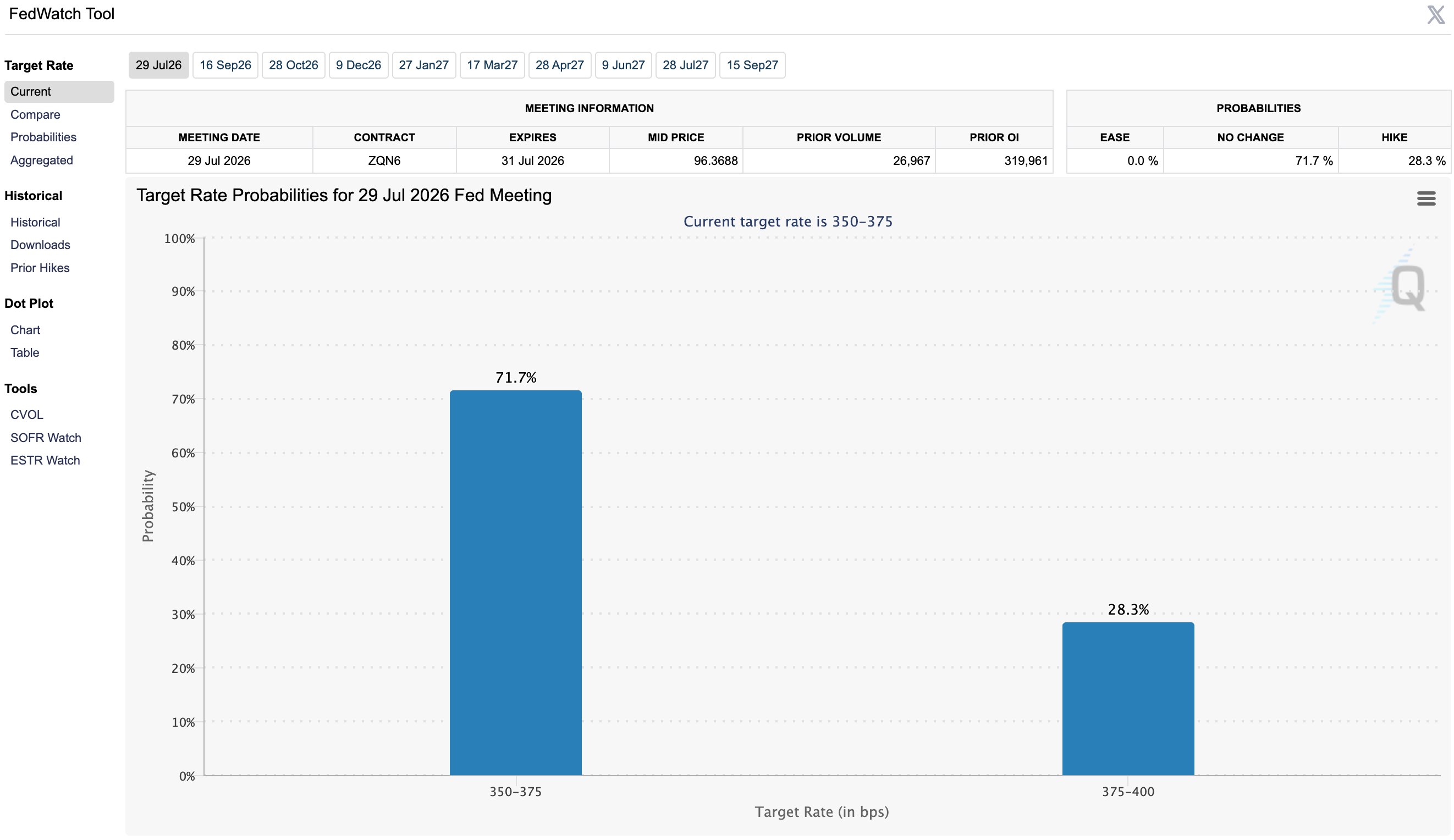
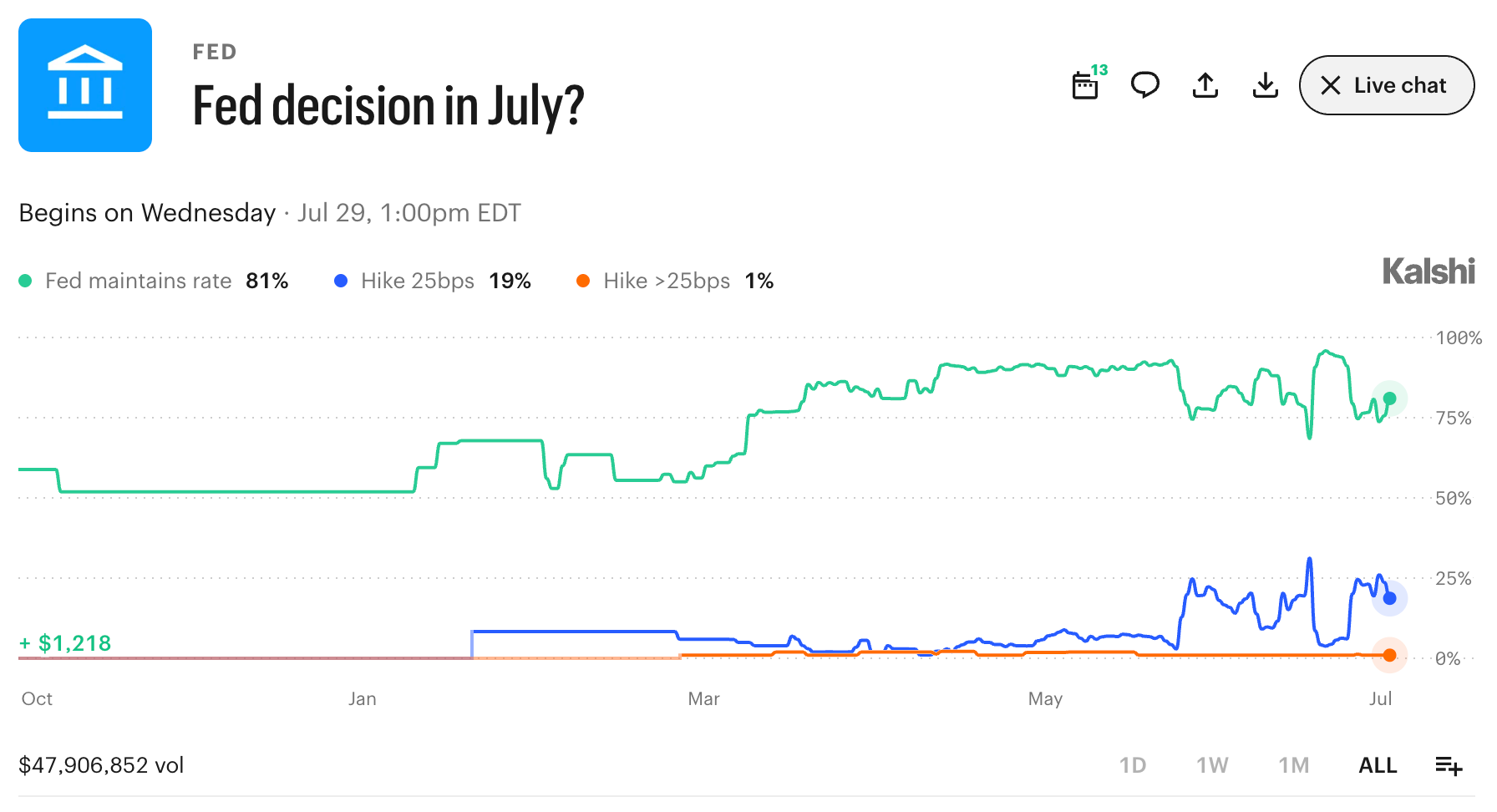
We believe this is a mispricing for three reasons:
Kevin Warsh is a career hawk, which the market has not come to terms with
Current inflation levels demand interest rate hikes
The economy is well positioned to handle a quarter percent increase in rates
1. Kevin Warsh
Many believe that Kevin Warsh was hand picked by President Trump to lower interest rates. Warsh himself seemed to allude to a lower rate bias by making the case in media interviews that technological advancements could lead to deflation. The market was surprised then, when Kevin Warsh kicked off his first press conference as Fed Chair with a very hawkish tone. From the June 2026 transcript:
We recognize that inflation has been running well ahead of the Fed’s long-stated inflation goal of 2 percent that’s been going on for more than five years. Persistently high prices are a burden for the American people. But the recent past need not be prologue. I am pleased to report that members of the FOMC are unambiguous and unanimous: This Committee will deliver price stability.
…we have the capability and commitment to deliver on our price-stability objective of 2 percent. That’s exactly what we’re going to do. In the Fed’s review of its strategy over the last any number of years—in January, the Fed—including the strategy that we’re still bound by—the Fed statement says that inflation is primarily determined by monetary policy. You bet it is. I’ve said for years inflation is a choice. You bet it is. And today I’m announcing that this Committee, unambiguously and unanimously, have decided we are going to deliver on that.
…let me restate it. Inflation remains elevated relative to the Committee’s 2 percent goal, in part reflecting supply shocks that have driven price increases in certain sectors, including energy. That paragraph goes on to say, but to be clear, the Fed’ll deliver price stability. My own judgment is the Committee spent quite a bit of time, not just in two days but over iterations of a couple weeks. That’s what we’re prepared to say about inflation, but the commitment to deliver is strong, unanimous, and unambiguous. And that’s, I think, an important message we’ve missed for five years, and, and we’re going to fix that.
Chair Warsh did not mince words. Inflation is above target, the Fed has failed to control inflation for over 5 years, and the Warsh Fed will not make the same mistake.
The market acted like it just got kicked in the mouth, with the S&P 500 and Nasdaq both falling over 1%.

For those that have studied the Fed, this language was not a surprise. Below is a chart from Anna Wong, Chief Economist for Bloomberg US. It shows Unemployment Rate and PCE Inflation during Warsh’s tenure as a Fed Governor from 2005 through 2011. If you have not seen this before, or did not know Warsh previously served on the Fed, please pause and read through it.
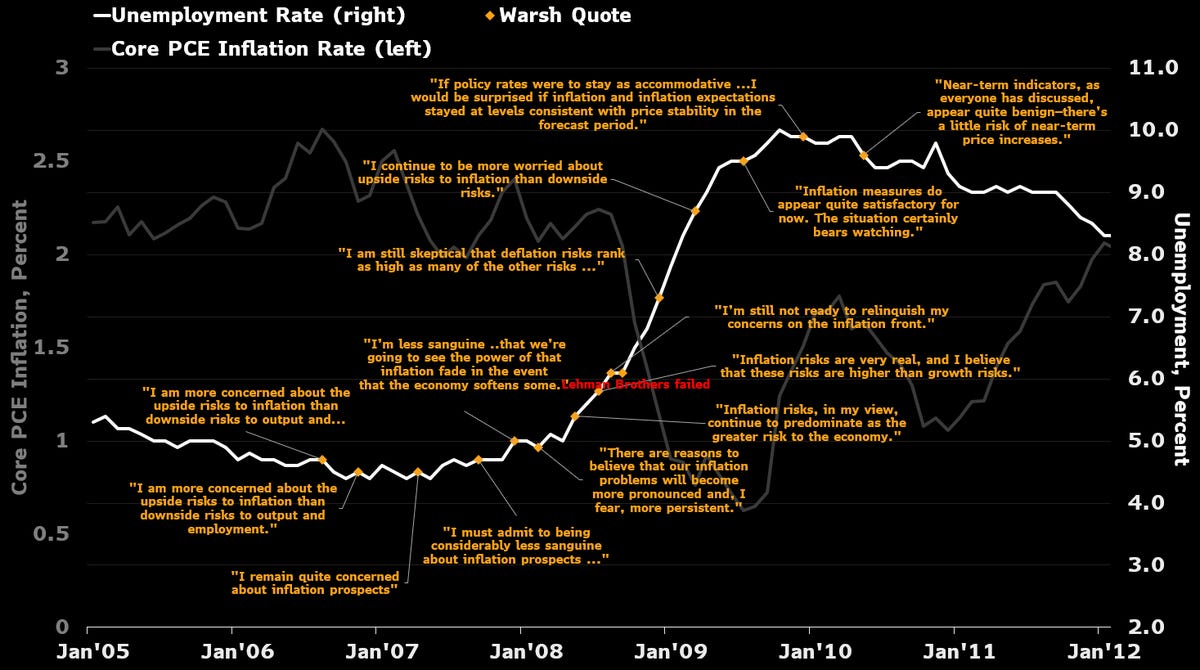
There are two clear takeaways from this chart in our view:
Kevin Warsh is a hawk.
Kevin Warsh is consistent (some may say stubborn) in his views.
Throughout this period, Warsh was very vocal about his concerns with respect to monetary policy and inflation. His longstanding commentary culminated in an op-ed in the Wall Street Journal in which he made his final case that monetary policy is not a substitute for real economic growth.
When others see Kevin Warsh, they may see a Trump appointed nominee who is open to pontificating about the potential impacts of widespread AI adoption. Who isn’t these days. When we look at Kevin Warsh, we see a consistent thesis that monetary policy is a tool for controlling (and losing control of) inflation, independent of economic growth. Under this thesis, growth and productivity gains driven by AI are exactly what Warsh would be looking to hike rates into. Let the economy handle growth, and let the Fed handle prices.
Inflation never materialized in the way Warsh feared, and the economy was able to recover. Warsh ultimately resigned from the Fed in 2011. Sometime around 2023, however, he must have felt a cathartic vindication.
2. Inflation
In 2020, the Federal Reserve pre-emptively lowered interest rates to 0% in response to the pandemic. Their rationale at the time was that it is better to be as accommodative as possible to mitigate the economic fallout of the Covid-19 pandemic.
What the Federal Reserve did not count on was that, as Warsh believed a decade prior, the economy took care of itself with respect to growth. Despite a global pandemic, we found ways to continue working remotely. The streets and buildings were empty, but the economy kept growing.
This growth, combined with both monetary and fiscal stimulus, led to a generational run-up in consumer prices. Below we plot a chart of actual inflation as measured by PCE compared to the Federal Reserve’s 2% target.
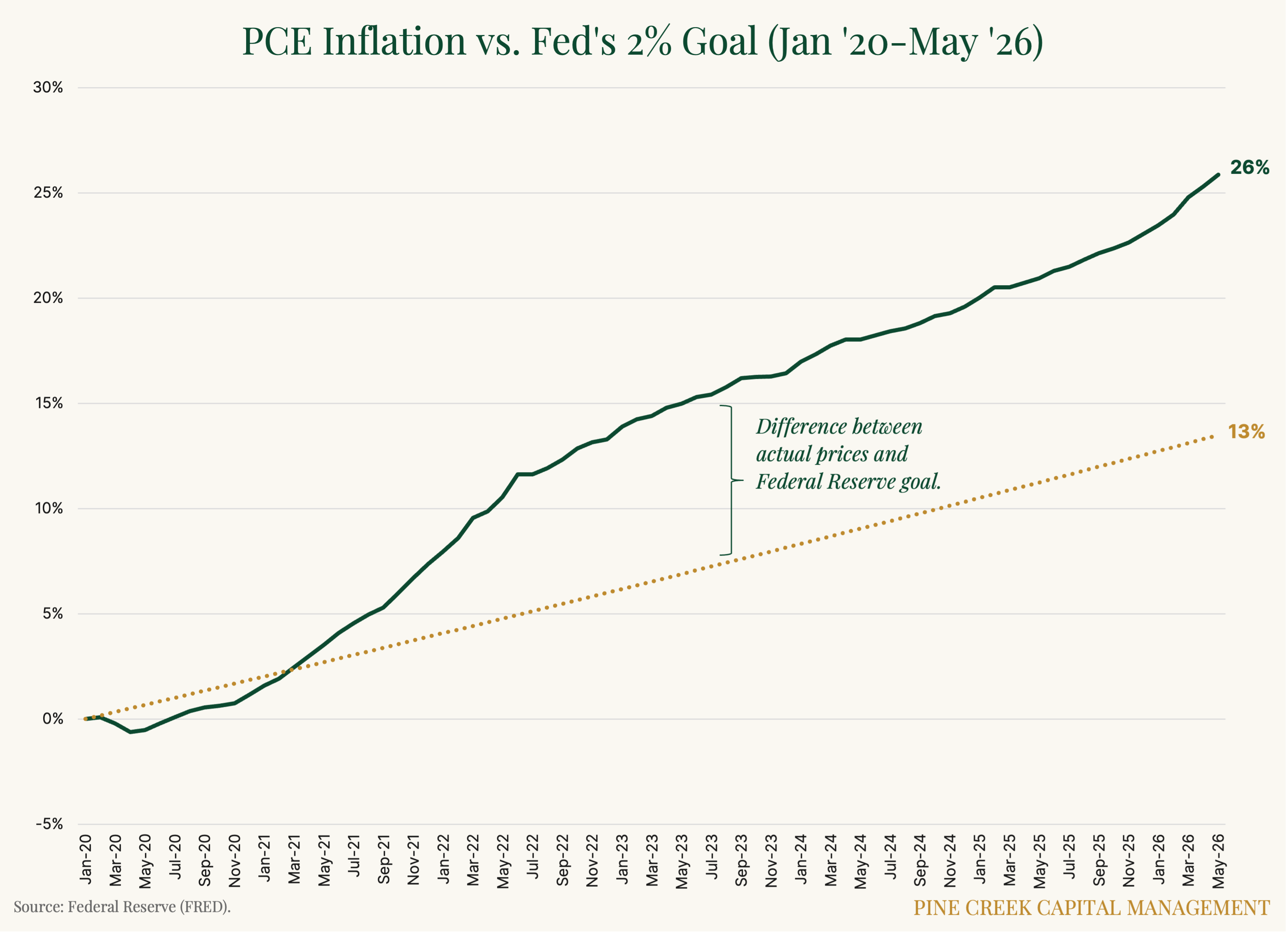
This time, there is only one takeaway from this chart: Kevin Warsh was right.
While it may be near impossible to argue that there should have been no loosening of monetary policy, they certainly seem to have been far too loose, too quickly, and for far too long.
This has culminated in a 2x divergence between where prices should be according to the Federal Reserve’s stated 2% target, and the prices we consumers pay today. Let there be no doubt, incomes have risen during this period, and spending remains strong…but the disparity between the victims of inflation and the beneficiaries of economic growth remains wide.
3a. Growth
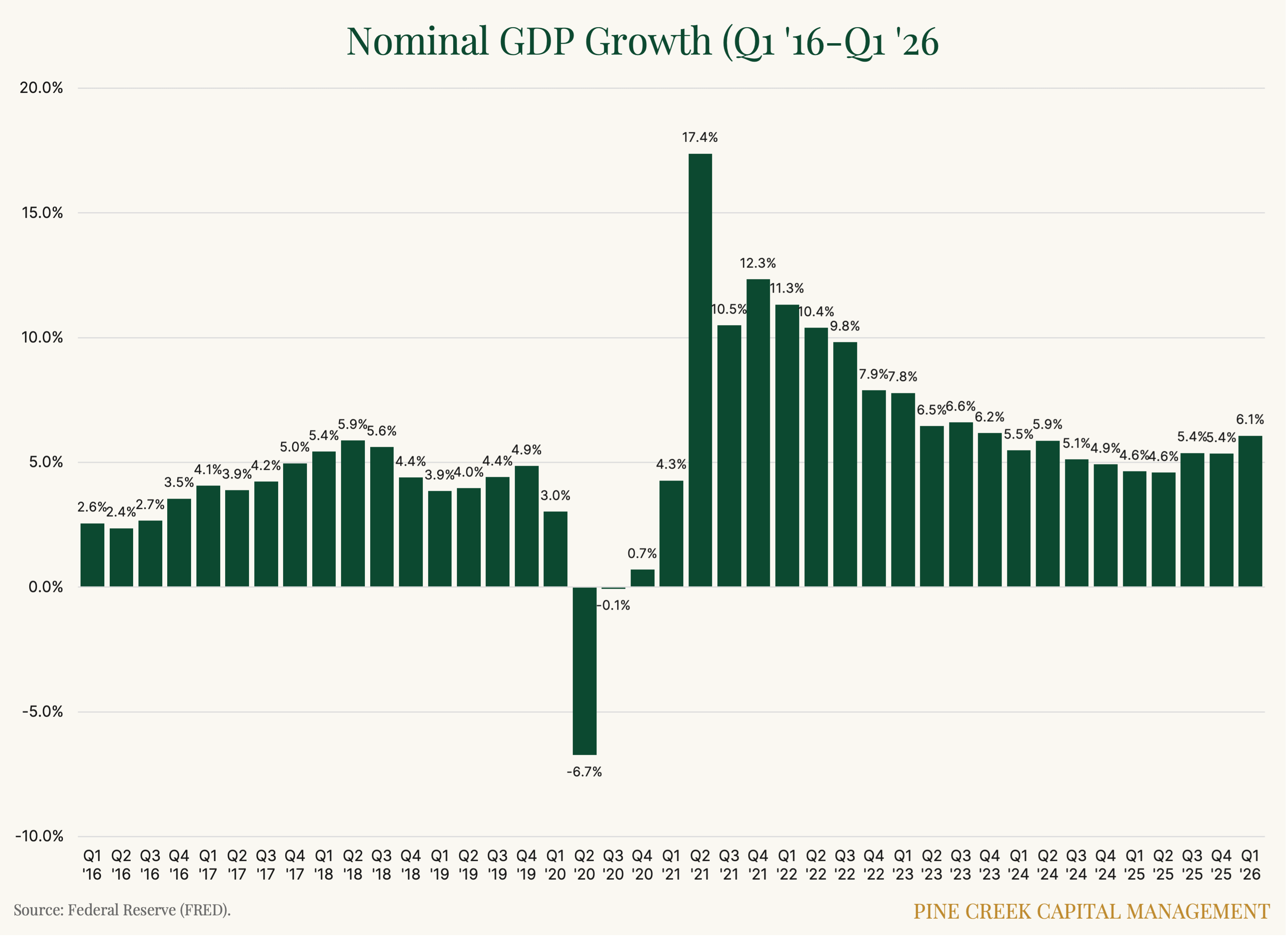
Economic growth is a major constraint on monetary policy. Raising interest rates too quickly risks denting or collapsing economic growth. However, growth as measured by Nominal GDP Growth has not been stronger in decades. Below we show a chart plotting Nominal GDP growth from Q1 2016 to Q1 2026.
We are back to two takeaways for our last chart:
Despite rising interest rates, Nominal GDP growth never fell below 4.5%, which was already considered a high level before the 2020 pandemic and ensuing period of zero percent interest rates.
Growth has actually started accelerating, from 4.6% a year ago to 6.1% in the most recent quarter.
While we should applaud an acceleration in growth, we should also recognize that an economy that grows too quickly can overheat, leading to further increases in inflation.
Readers may notice that we have mentioned nothing here of supply chain disruptions, of food and energy costs, or of the wars between Russia and Ukraine, or between the US and Iran. This is intentional, and is a recognition of the fact that Kevin Warsh acknowledged the impact of supply shocks, but refuses to use them as an excuse for the gap in inflation or as an out for not hiking rates.
From before, in his own words on the matter:
…let me restate it. Inflation remains elevated relative to the Committee’s 2 percent goal, in part reflecting supply shocks that have driven price increases in certain sectors, including energy. That paragraph goes on to say, but to be clear, the Fed’ll deliver price stability.
However, there is one additional data point we have left to cover, and that is unemployment.
3b. Unemployment
Along with growth, unemployment is another constraint to tightening monetary policy. Again, as with GDP, the US economy has never been in a better position to weather higher interest rates. Below we plot the headline unemployment rate from June 2016 through June 2026.
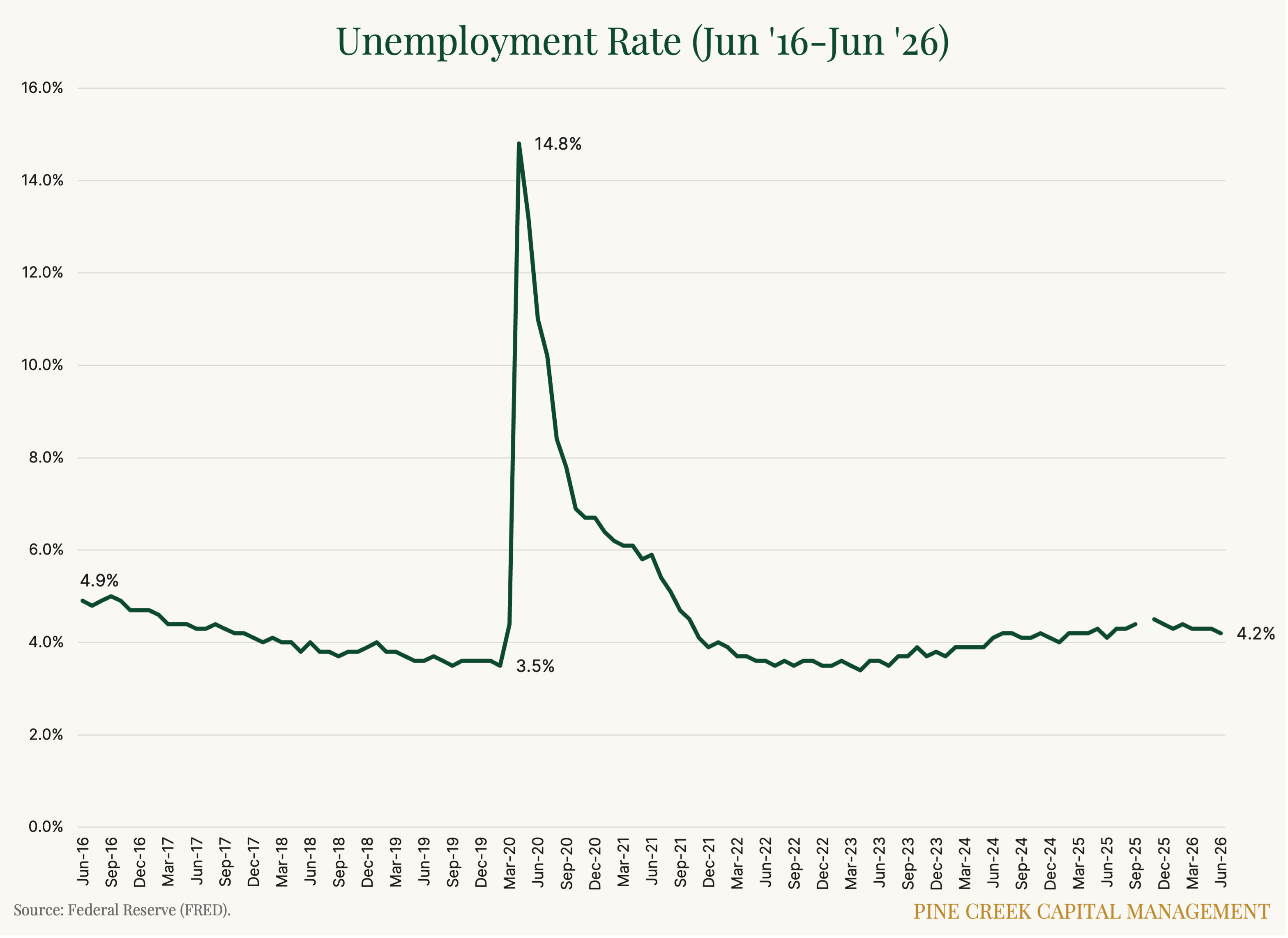
This chart needs little analysis: the unemployment rate currently stands at 4.2%, despite warnings from AI executives to the contrary. Throughout the previous rate hike cycle from 2022 to 2024, the Fed Funds rate rose from 0% to over 5%(!), while unemployment failed to breach 4.5%, still lower than much of the pre-pandemic period. In fact, unemployment has come down since then.
Conclusion
No matter where one looks, the case is clear: inflation has been too high for too long, and the economy is well positioned for higher rates. The new Fed chair, Kevin Warsh, has stated explicitly, in no uncertain terms, that the “…FOMC are unambiguous and unanimous: This Committee will deliver price stability.”
In fact, based on all we have discussed, it would seem inconsistent for the Warsh Fed to not increase rates at this July 2026 meeting. At the same time, the market is pricing in a mere 20% to 30% chance of a quarter percent hike in rates. Granted, the market may know something we don’t. Perhaps Warsh truly has changed his feathers and is now a dove, and the rhetoric from June’s meeting was meant to avoid any explicit criticism that the Chair is now an extension of the President.
In any case, we believe the market has this wrong, and should at minimum be priced closer to 60% or higher. This probability reflects our uncertainty as to whether or not rates will in fact be raised at this meeting. Another plausible path is a rate hold with further hawkish rhetoric, in which case we would still expect a steeper rate path than what the market is pricing in over the next 6-12 months.
For this reason, we have opened a small position in short ZQ futures at the August and September expiry.