


Welcome to Pine Creek Capital’s inaugural market update!
Each update will include a short situation overview directly from our Chief Investment Officer covering the most important news as we head into a new week for financial markets. Additionally, we will have a quick flash of important numbers such as interest rates and index levels, followed by a few short write-ups covering updates from last week and what to look forward to for the week ahead. Regular readers will find themselves developing a working memory of what is going on in the market, where major assets are generally trading, and what it all means for their portfolios.
I hope you enjoy these updates as much as I enjoy writing them. And as always, if you have any questions or suggestions for the newsletter, please don’t hesitate to reach out to brian@pinecreek.capital.
-Brian
By the Numbers
Equities
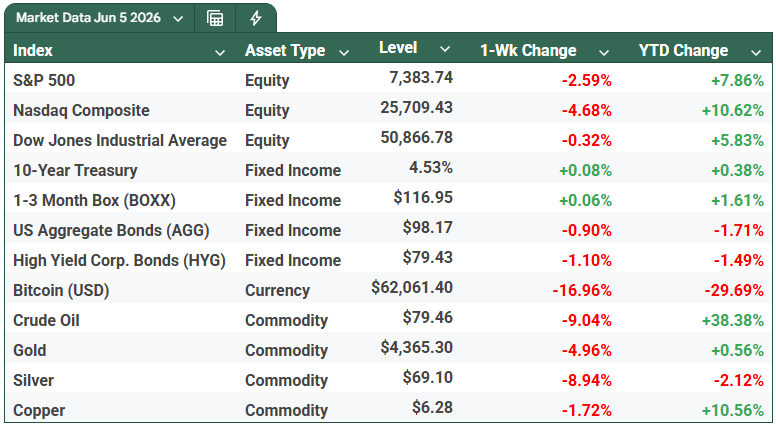
Just about every investment was down last week. Let’s start with equities. The S&P 500 ended the week down 2.59% while the tech-heavy Nasdaq sold off an incredible 4.68%.
Keep in mind that most of this decline happened on Friday, and much of the decline in equities was attributed to weakness in stocks heavily tied to AI. This narrative started to develop after Broadcom, ticker AVGO, reported earnings and affirmed their previously stated revenue goal for the year.
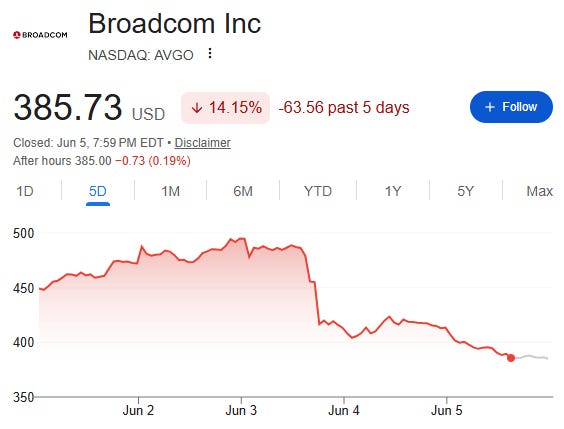
While the forecast is massive (“in excess of $100 billion), investors were expecting revenue guidance to be revised upwards even higher. This disappointment sent the stock down 20% and kicked off some hard questions about how sustainable AI revenue growth really is. We expect this topic to dominate headlines going into this week.
Fixed Income
Interest rates have been on the rise this year, with the 10-Year Treasury yield up eight basis points (0.08%) this week. The benchmark asset now trades at 4.53% and is now up 0.38% for the year, close to half a percent. This drove a decline in bond prices, with the US Corporate Bond ETF, ticker AGG, falling 0.90%.
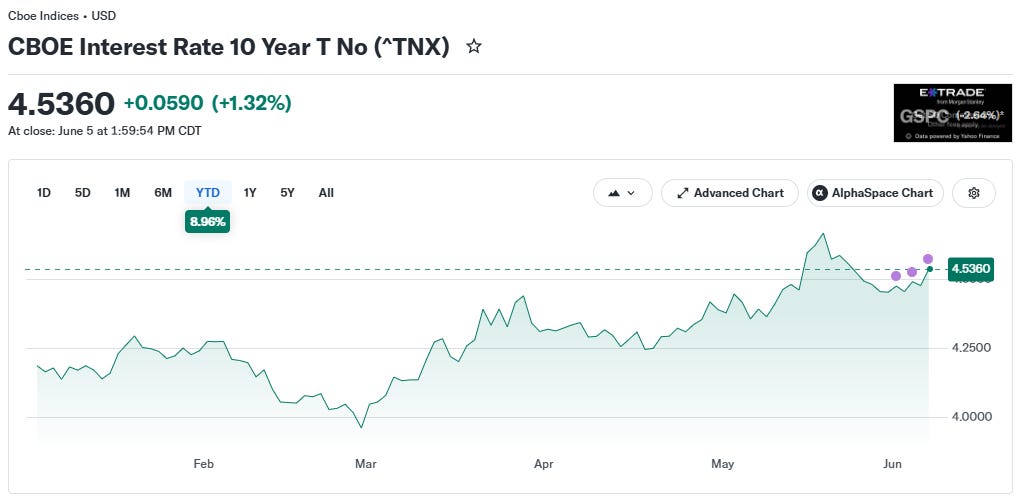
While the market consensus was that Fed Chair Kevin Warsh would work to lower interest rates, our position over the past ~6 months has been that interest rates are more likely to increase than decrease. This upward pressure on interest rates is driven by persisitently high inflation as measure by Headline and Core CPI. The Iran War and its resulting impacts on global trade have only exacerbated a problem that already existed and showed no signs of resolving anytime soon.
When interest rates rise bond prices fall. Well, most of them. As explained in a series of videos here, not all bonds are created equal. The longer the Duration of a bond (you can think of Duration as similar to Maturity), the more sensitive it is to interest rates. Therefore, in our view, investors should be reducing their overall portfolio duration. In this environment, we find ETFs like SGOV and BOXX to be particularly attractive.
Commodities
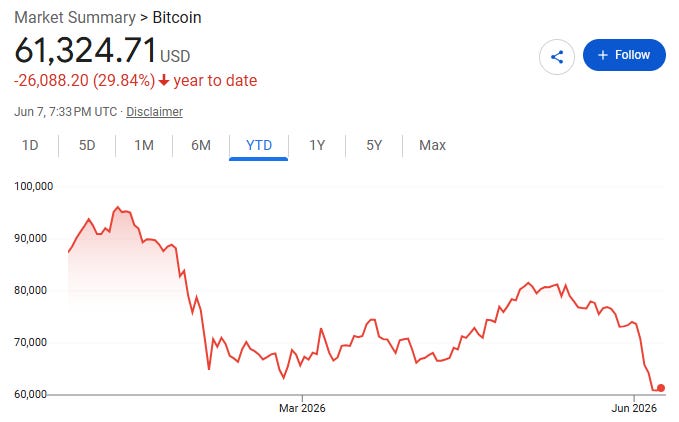
Bitcoin suffered the worst decline of all the assets we are covering today, down 16.96% for the week and 30.34% for the year.
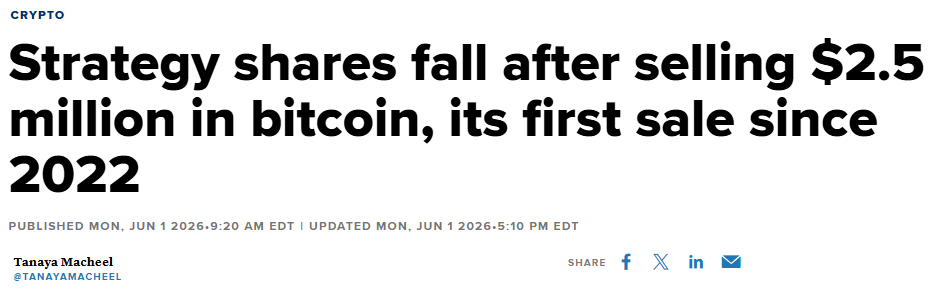
This selloff was triggered shortly after Strategy (formerly known as MicroStrategy), ticker MSTR, sold $2.5 million of its bitcoin holdings, equivalent to 32 Bitcoins. While this is a small fraction of the company’s 843,706 total Bitcoins, this represents a sharp pivot from the CEO’s prior stance of “never sell” with respect to Bitcoin.
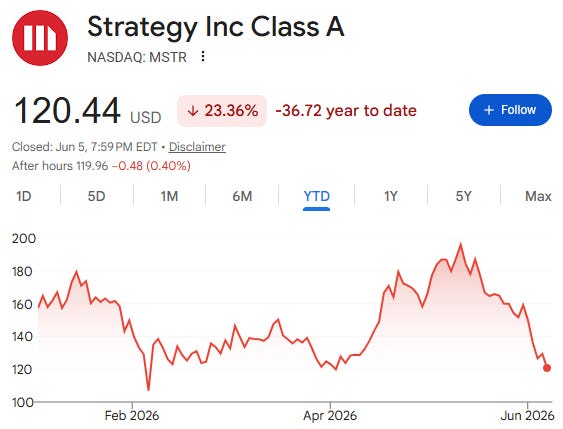
We do not cover crypto extensively, and our position is that Bitcoin’s long-term intrinsic value is $0.
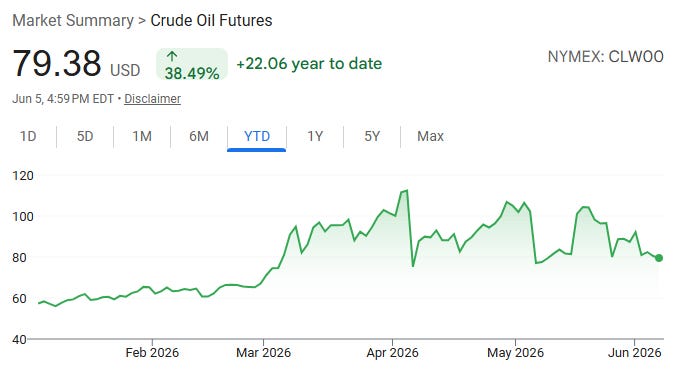
Crude Oil fell 9.04% over the past week to $79.43 per barrel as investors continue assessing what the future will hold for the Strait of Hormuz. Transit through the waterway remains restricted, and despite many warnings about a global oil shock, the impact so far has been notable but muted.
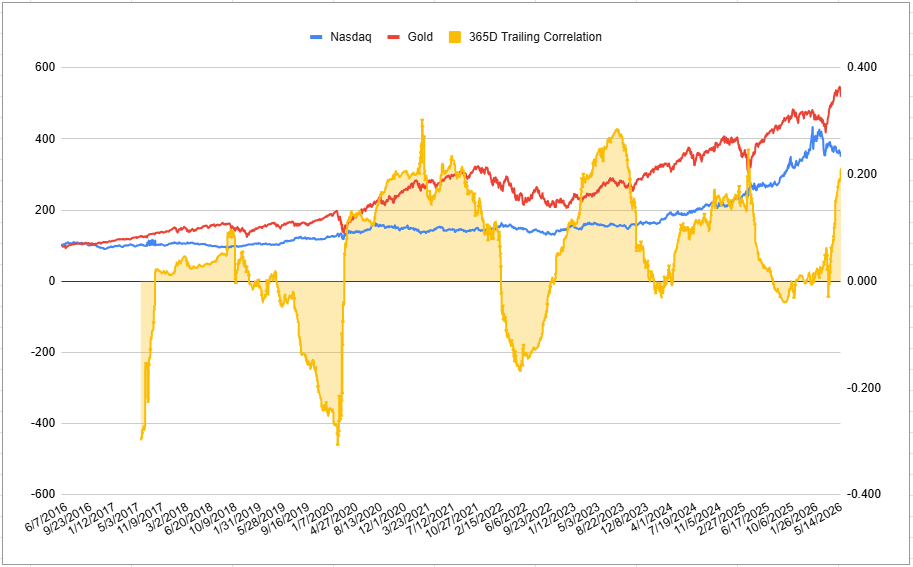
Gold, Silver, and Copper also saw similar declines of between 1% and 9%. As these commodities are used heavily throughout supply chains involving chips and semiconductors, the precious metals have started to follow the broader AI trade, which as discussed came under pressure this past week.
A Healthy Jobs Market
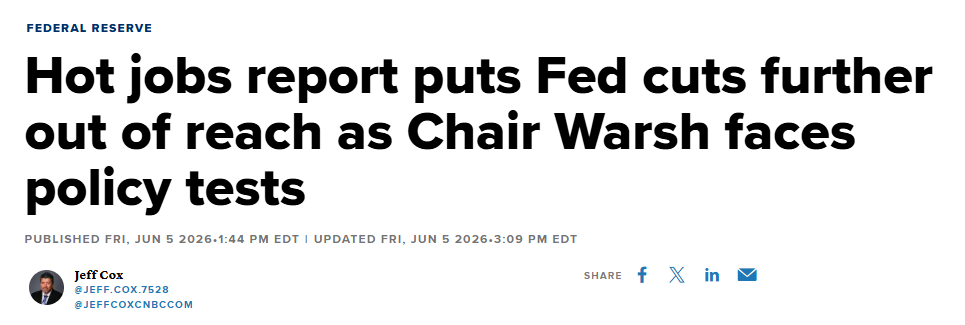
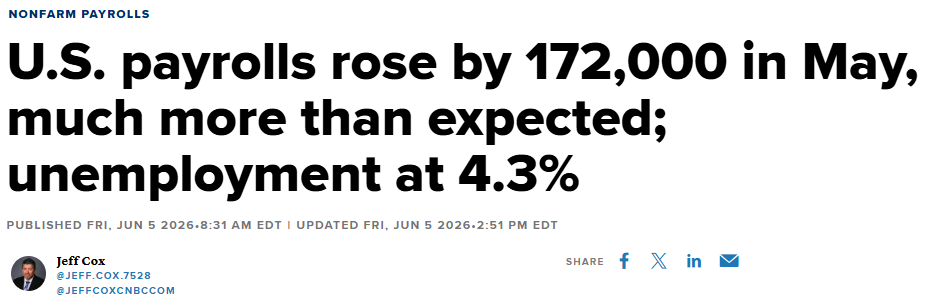
On Friday, the Bureau of Labor Statistics (BLS) released its most recent report on employment in the US. While experts predicted a gain of 80,000 jobs, the number came in much higher at 172,000. This would normally be a positive development, but in this environment, it likely added to the selloff on Friday.
That is because a healthy labor economy gives the Federal Reserve more reason to increase interest rates to combat inflation. The conern with rising rates is that the increase in borrowing costs could send consumers into a recession. However, if consumers are healthy and able to find work, then this gives the Fed plenty of room to hike rates.
Investors tend to not like higher interest rates. High flying companies that are losing money find it more expensive to borrow money to fuel growth, leading to decreased valuations across the board. It’s also worth noting the contradictory nature of a strong jobs market against the notion that AI will displace or replace a large portion of today’s workforce.
Coming Up This Week
On Wednesday, we will get an updated release of inflation as measure by the Consumer Price Index, CPI for short. The market is currently expecting a 2.9% annual rate of inflation, slightly higher than the last reading at 2.8%. If CPI comes in higher than 2.9%, or the underlying data shows signs of a building inflation shock, we may see interest rates continue to climb along with another hit to the equity market.
Wednesday will also see Oracle (ORCL) report earnings after the close. Oracle is another large player in AI trade, and many investors will be looking to their numbers and management commentary as an AI bubble barometer. As with Broadcom (AVGO), even a not-positive-enough quarter could send the company and broader market into a further spiral.
Adobe (ADBE) will report earnings on Thursday. This company has become something of a value stock, as investors seem to believe that the release of advanced AI coding tools will be the death of software. This is sometimes called the “SaaSpocalypse,” SaaS standing for Software-as-a-Service. We have maintained throughout the year that this logic is flawed and the selloff across the entire Software sector is overdone. We are bullish on Adobe and the broader sector as a whole, with some quality companies even trading at single digit P/E ratios.