


This week, Jersey Mike’s IPO allocations became available to retail investors via the Robinhood platform.
The shares are expected to start trading on Thursday, July 30th, and are currently priced in a range of $21 to $25 per share.
This is a very interesting time for a sandwich company to IPO. While equity markets are certainly hot, new issuances are dominated by technology and AI platforms. So why is Jersey Mike’s, of all companies, filing for a public offering?
And, more importantly, is $21 to $25 a fair price for the stock?
Mike’s Way
Jersey Mike’s began in 1956 as a family owned and operated sandwich shop, one of the first to specialize in what would become an American staple: the sub sandwich.
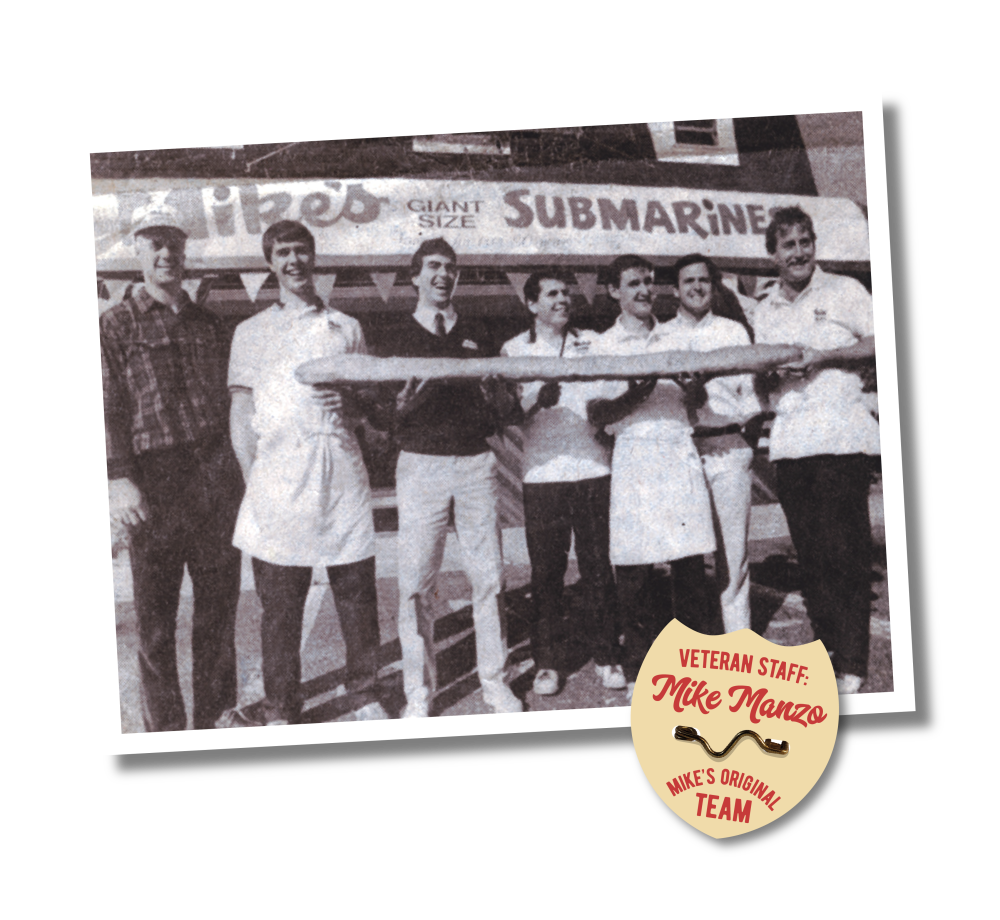
Mike’s became a favorite local restaurant over the next twenty years, at which point the original owner decided it was time to sell.
Peter Cancro was 17 at the time and had been working for Mike’s since he was 14. He was a senior in high school and had plans to study law and political science. But one night, his mom suggested that he buy the sandwich shop that he was working for.
Peter brushed off the idea. At 17 he wasn’t even legally allowed to cut meat let alone buy a business. But then Peter called the owner and pitched him on buying the shop. Mike said he had a week to find $125,000.
Luckily, Cancro played football in high school, and his coach happened to also be a banker. By the end of the week, Peter had the $125,000 loan he needed to buy Mike’s Sandwiches.
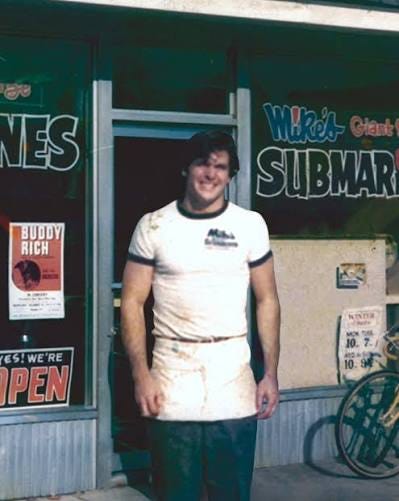
Nearly 50 years later in 2024, Peter had grown Jersey Mike’s from a local sub sandwich shop to a national franchise with nearly 3,000 locations that collectively brought in $3.7 billion in systemwide sales.
This time, it was Peter’s turn to hand over the reins. He sold to a private equity firm called Blackstone in 2025 for a reported $8 billion.

Just 18 months later, Blackstone is bringing Jersey Mike’s back to the public markets at a ~$9 billion valuation in a range of $21 to $25 per share. Let’s take a look at what investors are getting in exchange for this price.
The Business Model
When most people think of Jersey Mike’s, they think of it as a chain of restaurants, which is a very capital intensive, low margin business model. In fact, many restaurant and fast food companies are comparable to real estate holding companies, simply due to the fact that a large portion of operating a restaurant is servicing the buildings they operate in.
This is not “Mike’s way,” however. Jersey Mike’s is a Franchisor, which means that the company itself doesn’t own the physical stores. Instead, Jersey Mike’s “rents out” its business model for others to operate. This allows the sandwich company to sidestep the low profit margins that come with hiring and training retail staff, buying and servicing real estate, and managing inventory. Mike’s provides their brand name and logo, recipes, and a proven system for operating a successful sandwich shop in exchange for royalties from franchise owners.
This has allowed Jersey Mike’s to more than double its total locations over the past ten years.
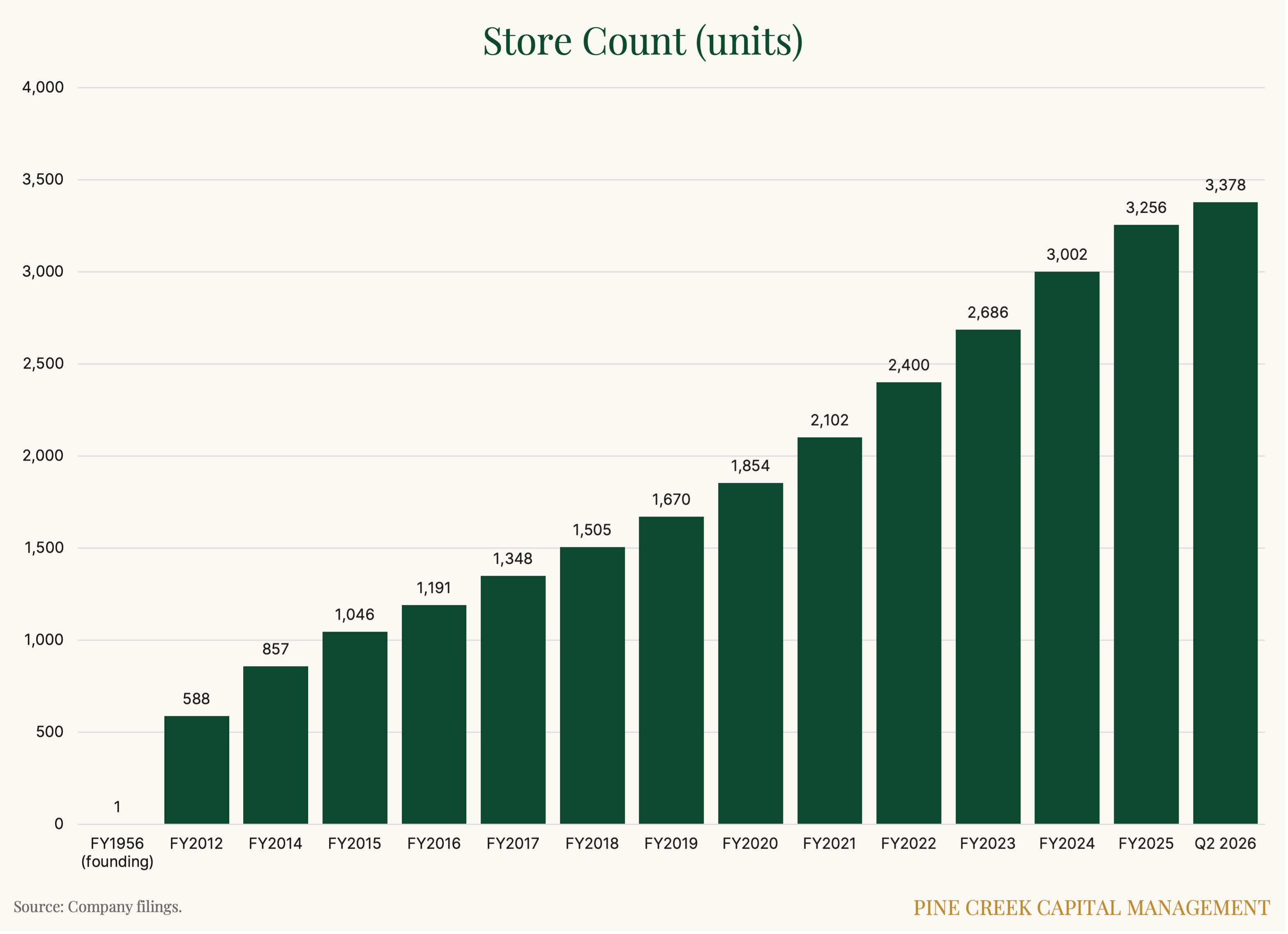
Over that same time, Average Unit Volume (AUV), which is a measure of sales per location, has increased 67% from $825,000 in 2016 to $1,376,000 in 2026.
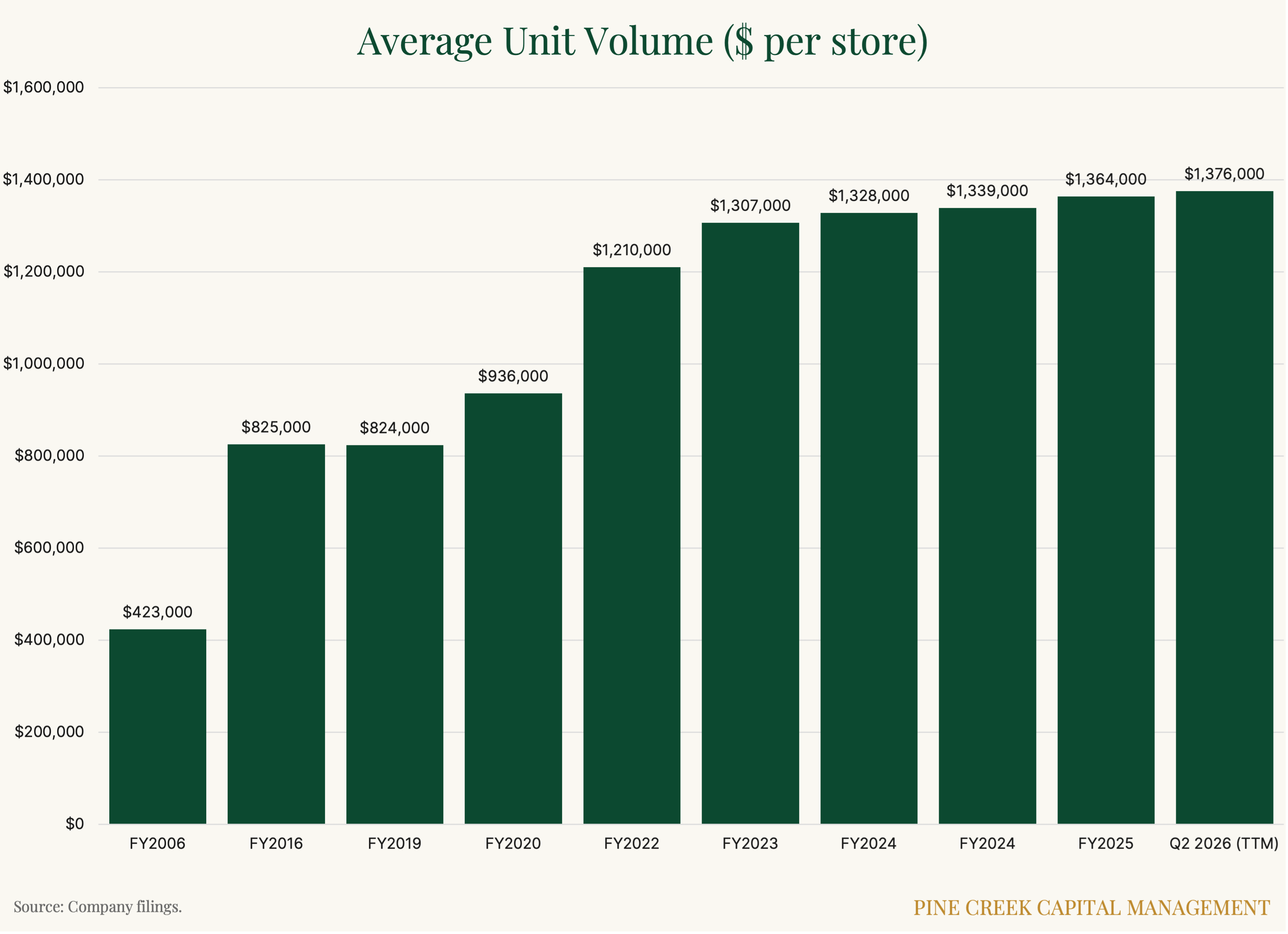
This shows that Jersey Mike’s has demonstrated strong brand growth and quality. Over the past 10 years, there has been a steady stream of new locations opened by franchisees, and those new locations are bringing in higher total revenue per store. Jersey Mike’s measures the total sales across all locations using a metric called Systemwide Sales, which more than doubled from $1.6 billion in FY2020 to $4.2 billion in FY2025.
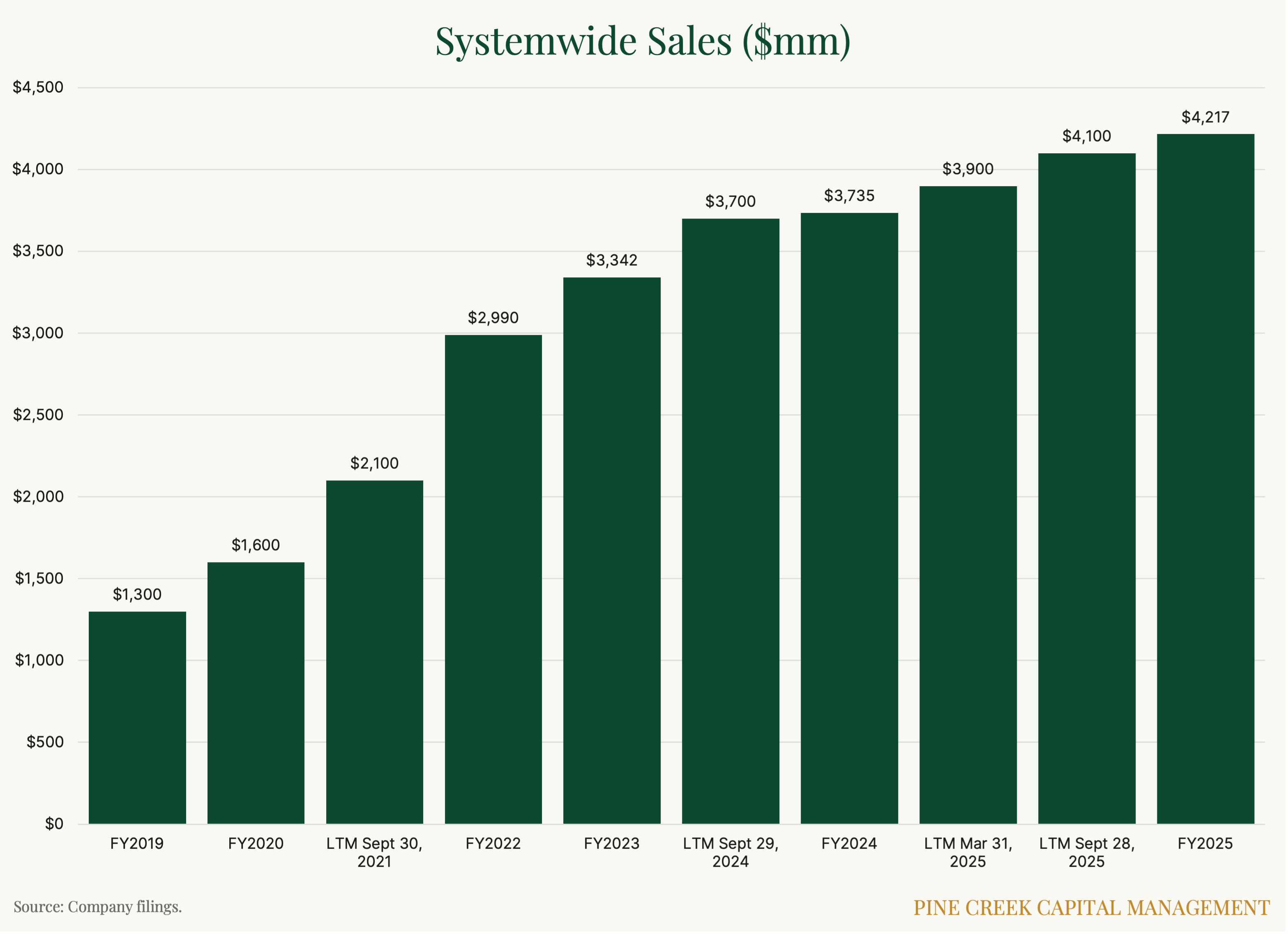
We must keep in mind, however, that this is a high level view of Jersey Mike’s business model. Next, let’s take a look at the company’s financials.
Financial Profile
When reviewing a potential public company, it is important to review their financials closely. For this analysis, we will examine each financial statement presented in the S-1 and provide our own analysis.
Income Statement
Below is a screenshot of Jersey Mike’s income statement. One point of interest worth noting is that the company is going through a restructuring as part of this transaction, which is why you see so many columns in the below screenshot. For this section, we will focus on pro forma numbers and will revisit some of the mechanics causing the restructuring in a later section.
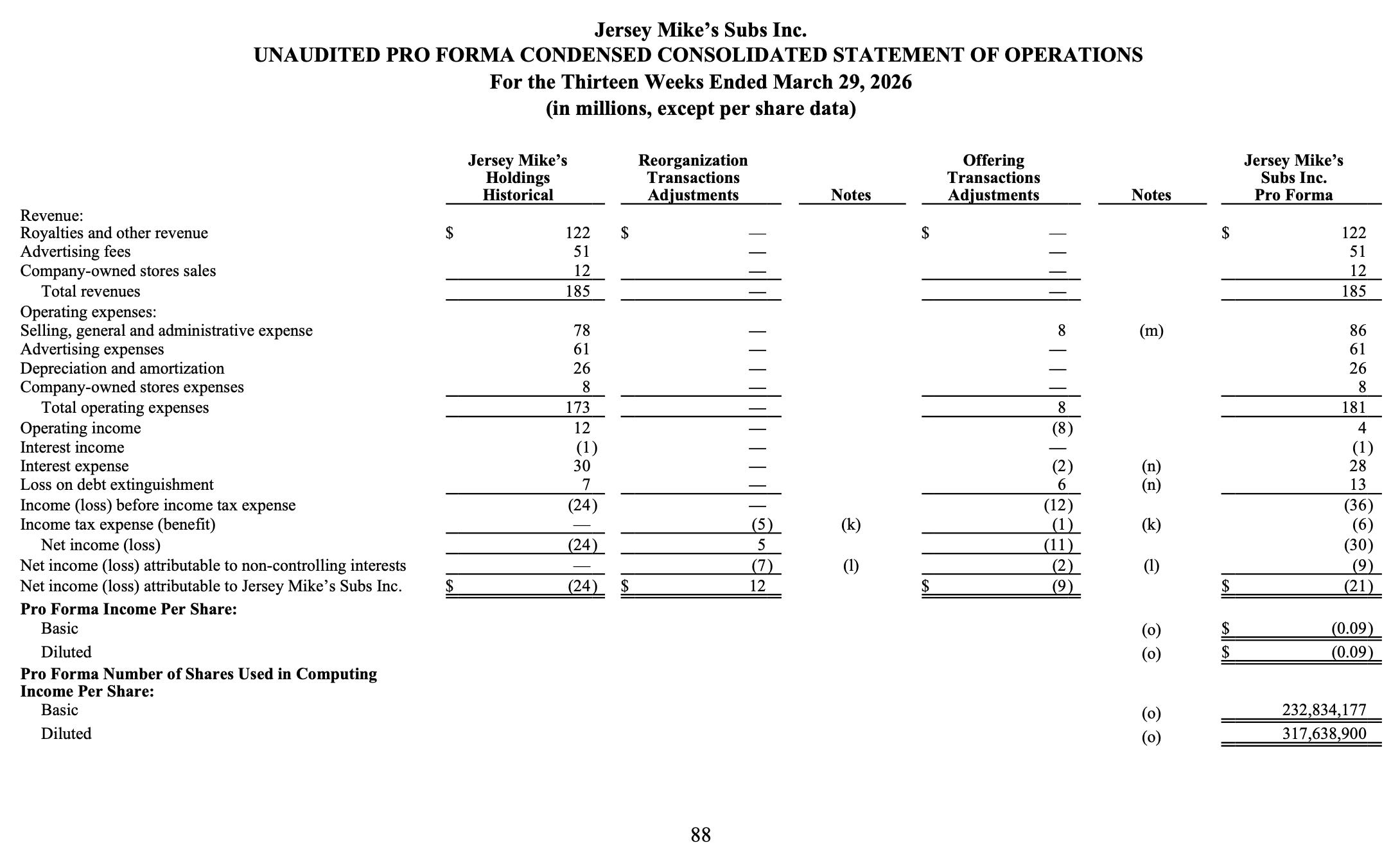
These numbers paint a different story from what we’ve seen so far. In Q1 of 2026, Jersey Mike’s lost $21 million compared to $185 million in total revenue on a pro forma basis. This puts EPS at negative $0.09 for the quarter, or negative $0.36 annualized. However, income statements can be misleading when reviewing a business’s performance.
Below is a table that reconciles Net Income to EBITDA. We should be upfront that EBITDA should never be taken at face value. But the line items in this table provide valuable context.
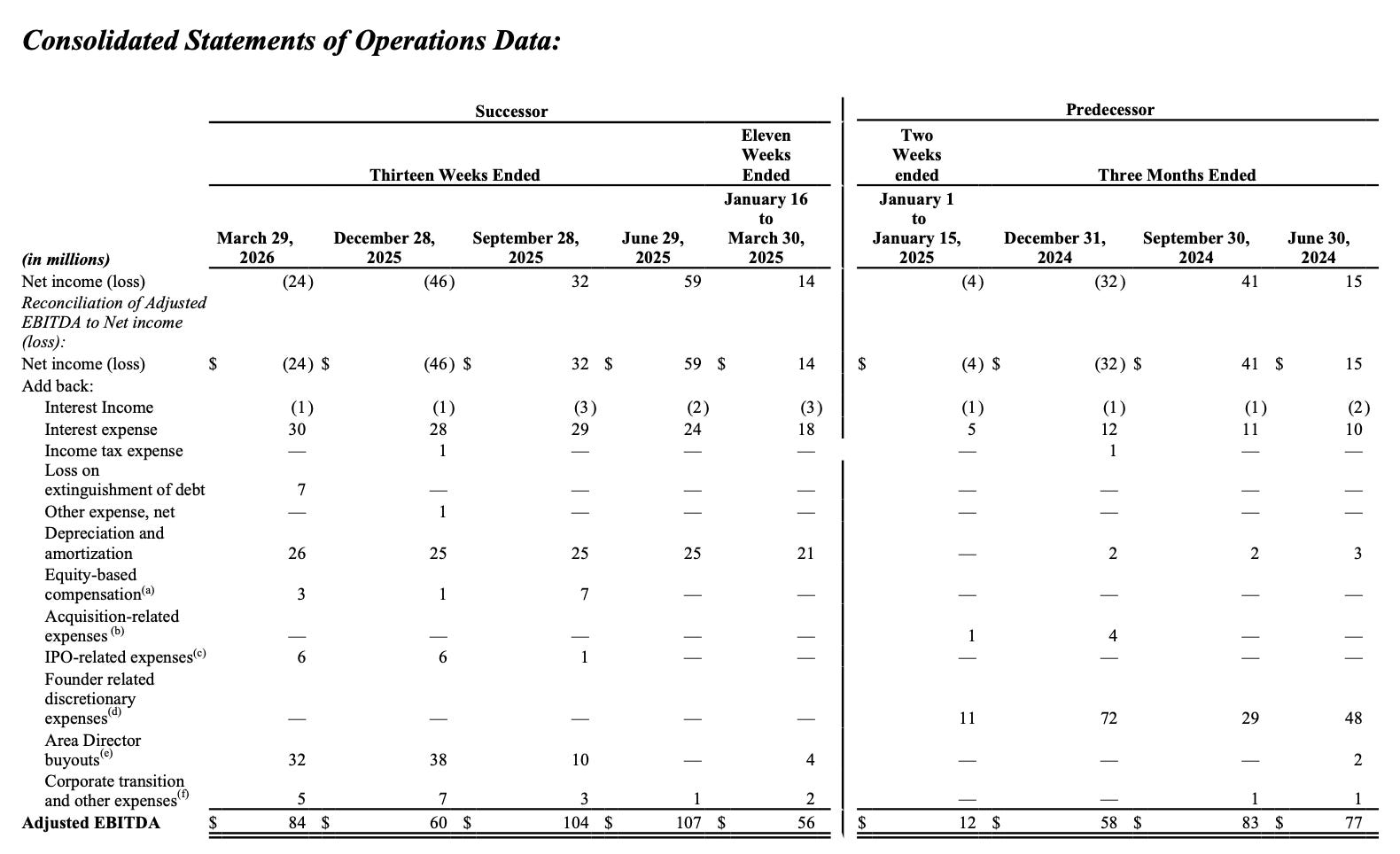
In the above table, we can see three major items that drag on net income: interest expense, depreciation and amortization, and Area Director buyouts. We also see an item with only one entry called "loss on extinguishment of debt.”
Interest expense is a normal expense of doing business and should absolutely be counted against net income. However, as shown below, the company plans to pay down $295 million worth of debt using money received from the IPO.
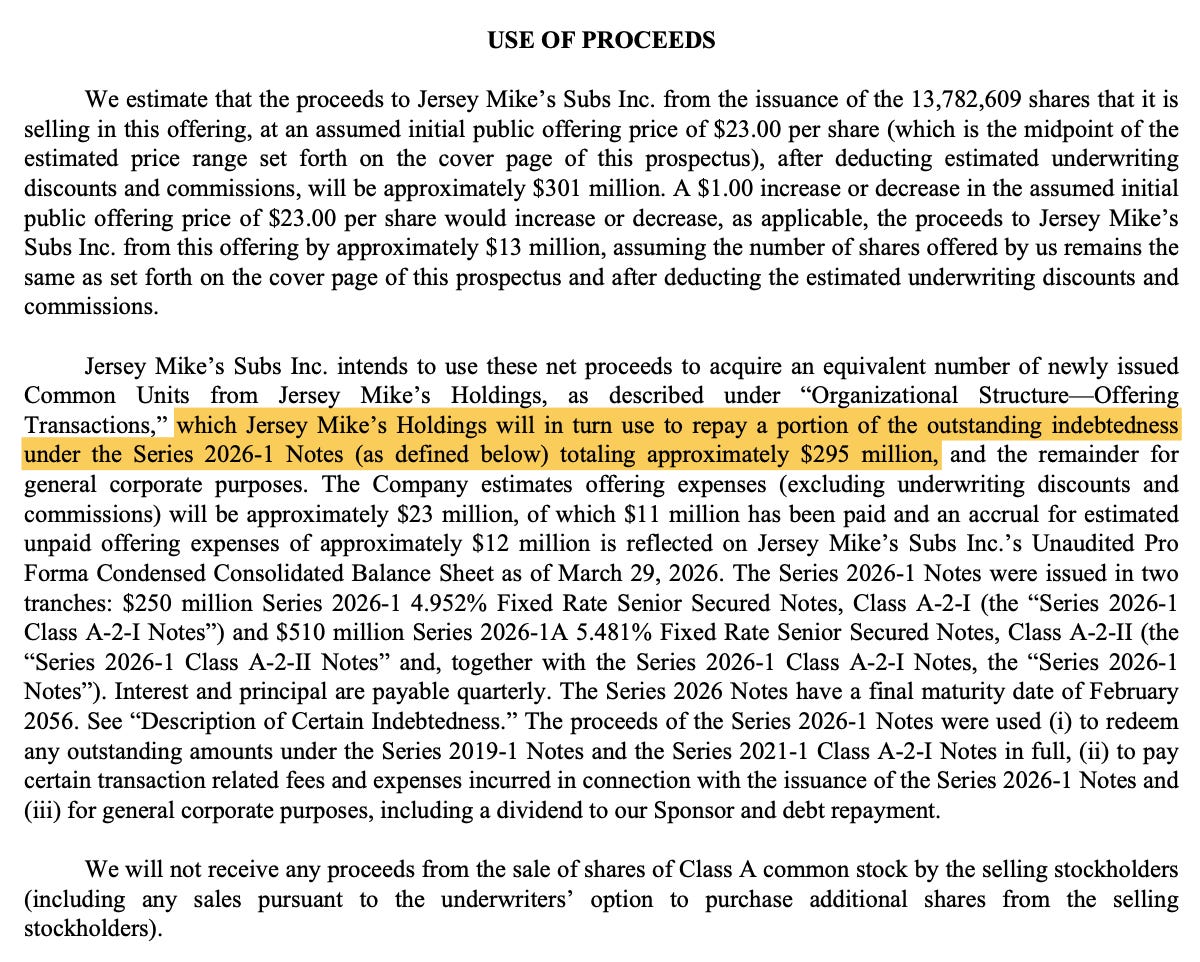
Surprisingly, this debt has a very low interest rate of 4.952%, almost 2% lower than the current rate on a 30 year mortgage. By paying down $295 million of this debt, Jersey Mike’s will save approximately $15 million per year going forward.

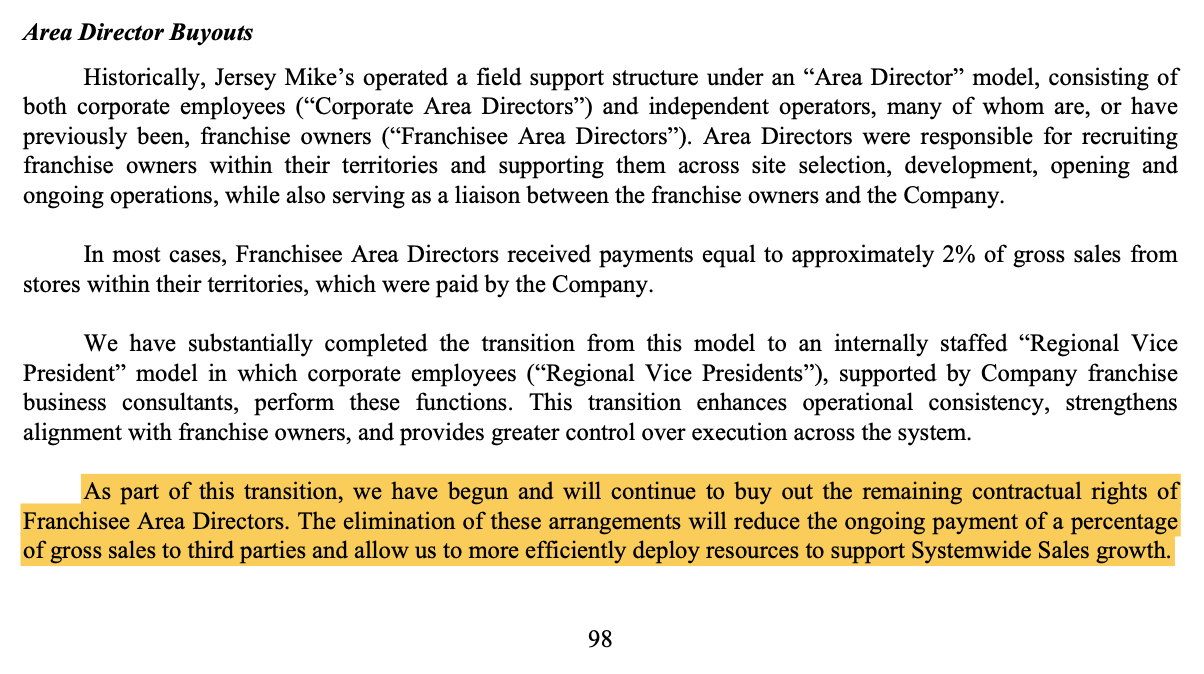
Area Director buyouts are the next major line item dragging down net income, and these expenses have ramped up in the last two quarters. This expense represents an intentional one-time refinement in Jersey Mike’s franchise model.
Previously, the company relied partially on established Franchisees to help grow locations in a specific area. In exchange, these franchisees would receive 2% of gross sales from all locations in that region. This is not an expensive model at scale, as revenue share is arguably the most expensive form of corporate ownership or partnership.
Jersey Mike’s realizes this, and is finalizing the process of buying these Area Directors out of their 2% revenue share, replacing them with salaried Regional Vice Presidents. This will reduce the company’s operating costs going forward, as both the 2% revenue share and the $80 million in recent buyouts will not recur in a meaningful way.
Lastly, we see that depreciation and amortization has dragged on net income by about $25 million per quarter since January 2025. This is unusual given that Jersey Mike's is a franchise-based operation and therefore has little to no property to depreciate.
The reason this line item exists is because of the transaction by Blackstone to buy the company in 2025. Under GAAP accounting rules this $8 billion transaction created an asset on the balance sheet of a roughly similar value, broken down into trade name and franchise agreements.
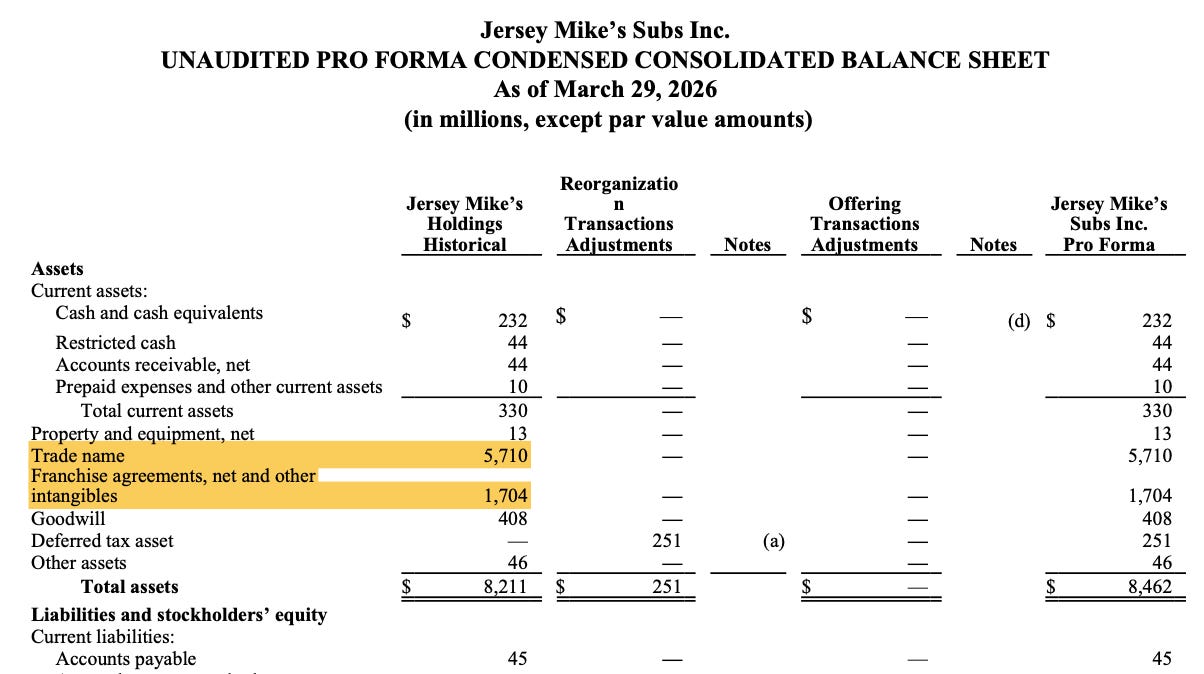
While the $5.7 billion trade name does not amortize, the $1.7 billion in franchise agreements do, creating a 20 year straight-line drag on net income of about $21.25 million per quarter. Though there are valid technical reasons the accounting is presented this way, this amortization figure simply does not represent the expense of ongoing operations of the underlying business.
If one were to ignore the items we have mentioned above, the true economic profit of Jersey Mike’s is closer to positive $41 million as opposed to the reported pro forma figure of negative $21 million, a $62 million delta.
In summary, the net income statement as it stands is a poor gauge of Jersey Mike's health as a business, and our estimated valuation for this company is based on an EBITDA multiple rather than an analysis of owner’s earnings. Before we look at the valuation, however, let us move on to the balance sheet and then the cash flow statement.
Balance Sheet
Below is the company’s unaudited pro forma balance sheet as of Q1 2026, and it is about as benign as they come. In fact, we have already discussed intangibles which are the company’s largest listed asset.
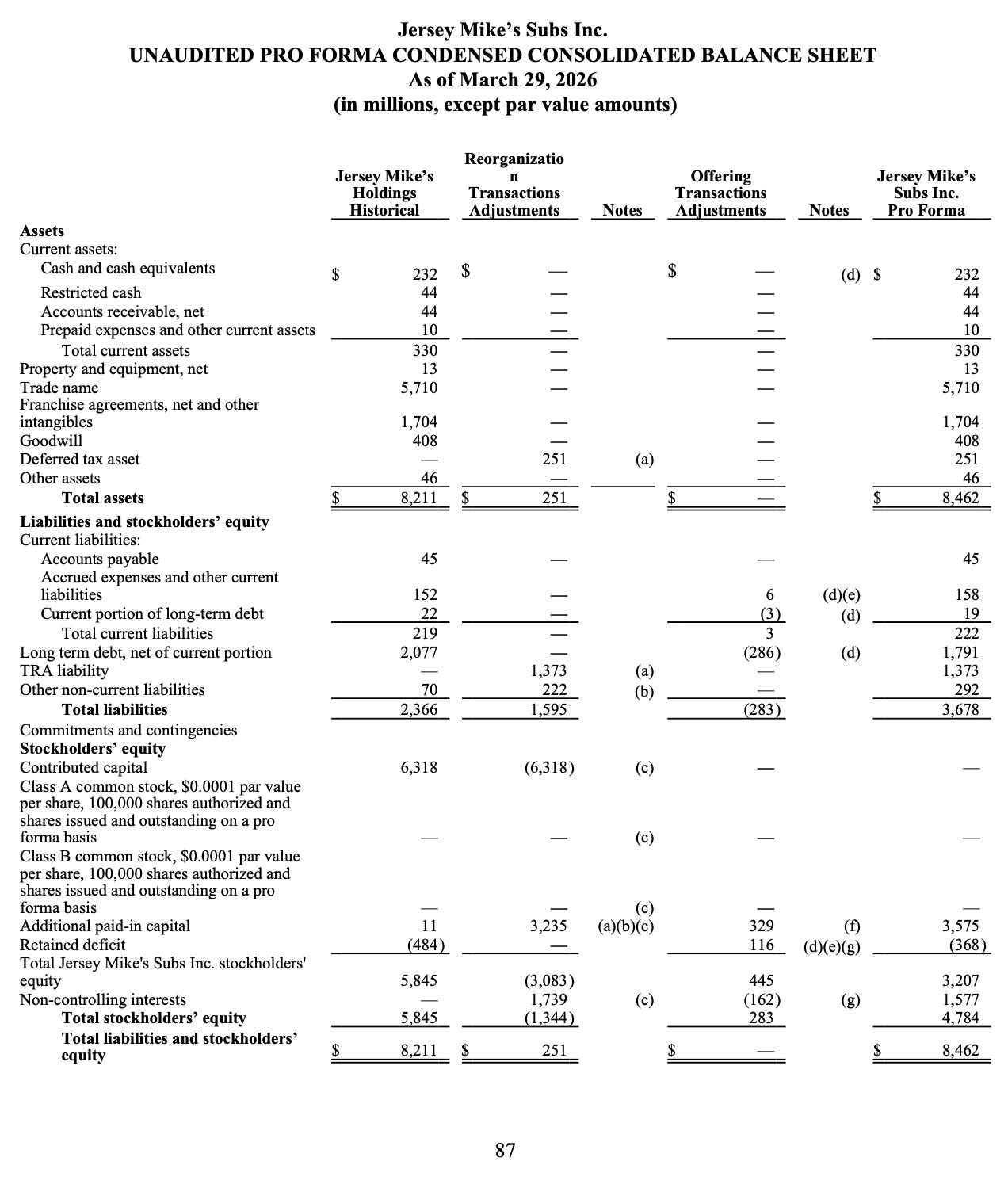
The primary concern with any company under private equity ownership is its level of debt compared to its ability to service that debt. At first glance, Jersey Mike's looks like it has a lot of debt compared to its current assets with $330 million in total current assets and $3.7 billion in total liabilities.
However, much of the $3.7 billion is made up of a $1.4 billion line item called “TRA liability.” This is an agreement between Jersey Mike’s and its previous owners, Peter Cancro and Blackstone, where Jersey Mike’s will pay them 90% of its future tax savings.
This agreement exists because Peter and Blackstone will realize taxable gains as they exchange their partnership units for public shares over time, and each exchange steps up the company’s tax basis, allowing it to claim higher deductions. This TRA structure is meant to give a majority of those savings back to the sellers (Peter and Blackstone).
What is important about this line item is that it is not like normal debt, which demands interest payments whether or not the company is making money. The TRA simply sits there on the balance sheet, and the owners of that liability only get paid when Jersey Mike’s realizes tax savings.
As we discussed previously, the other half of this debt is fixed interest at a very low rate, and based on its most recent income statement, the company makes more than enough in revenues to service the interest payments on this debt. We can see this even more clearly when looking at Jersey Mike’s cash flow statement.
Cash Flow Statement
Below is the latest statement of cash flows from the Jersey Mike’s S-1 for Q1 ‘26. We should note that this is not a pro forma cash flow statement, which is why the net income here of negative $24 million does not quite tie to the pro forma net income we covered above at negative $21 million.
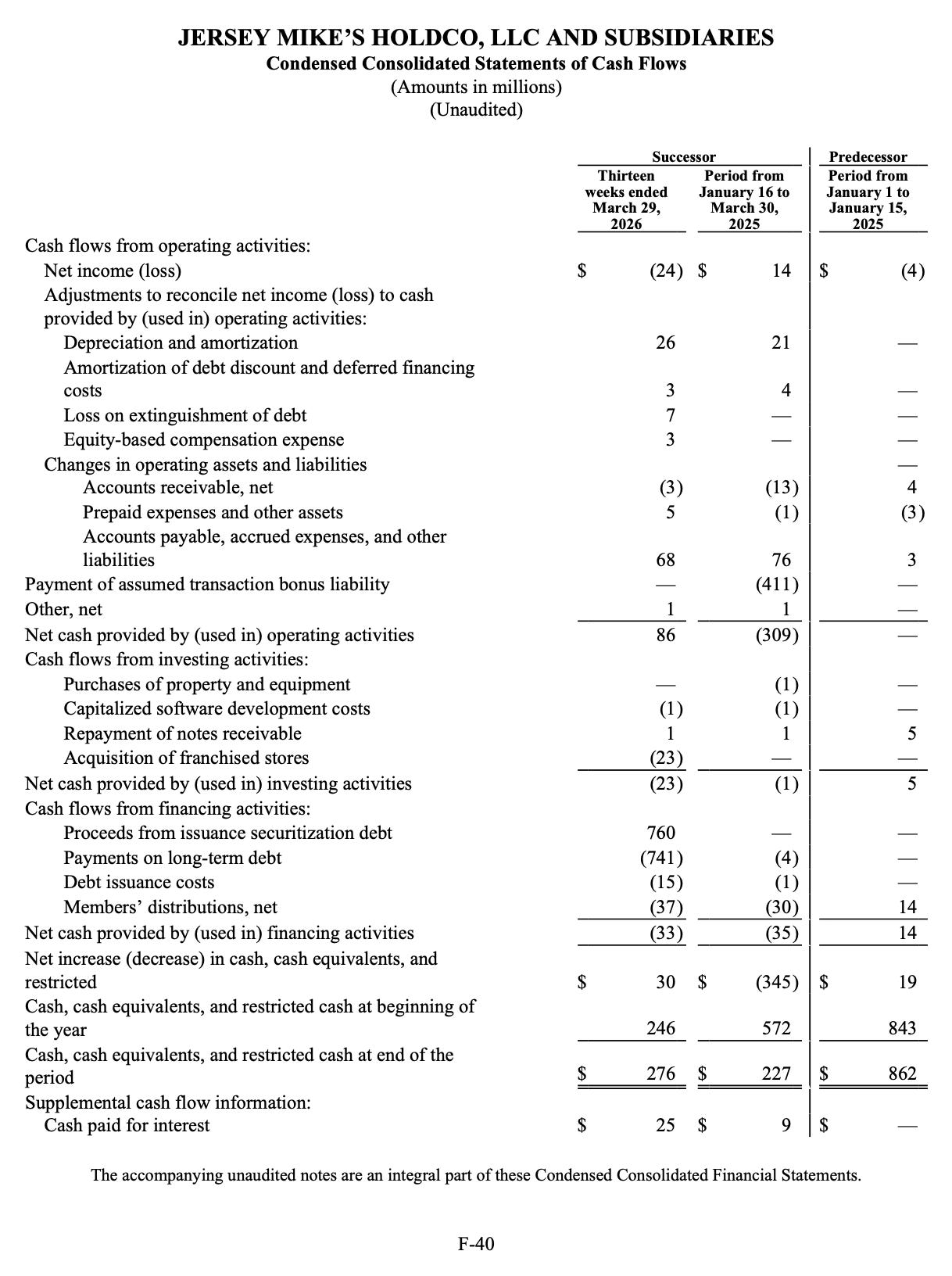
As we look through the company’s cash flow from operations, we can see quite clearly that there is ample cash flow to service Jersey Mike’s ongoing interest expenses.
While net income was negative $24 million, cash flow from operations comes out to $86 million, driven by $26 million in depreciation and amortization and $68 million from increases in accounts payable and similar liabilities, thanks to working capital timing. Plenty enough to continue funding growth even after paying interest expense. But there is more to valuing a stock than just having a “good enough” financial profile.
Let’s answer the question of whether Jersey Mike’s is a buy in the $21 to $25 per share range, and if not, at what price we would invest.
