


Hello Investors!
This week, the United States of America turned 250 years old, and we hope you had a safe and fun time celebrating!
It was a short week for markets, with trading closed on Friday, but that didn’t stop stocks from having a strong week in the green (more on that below).
This also marks the halfway mark for the year, with stocks already up double digits. One can only wonder what the second half will look like…
Let’s dive in!
-Brian
By the Numbers
Equities
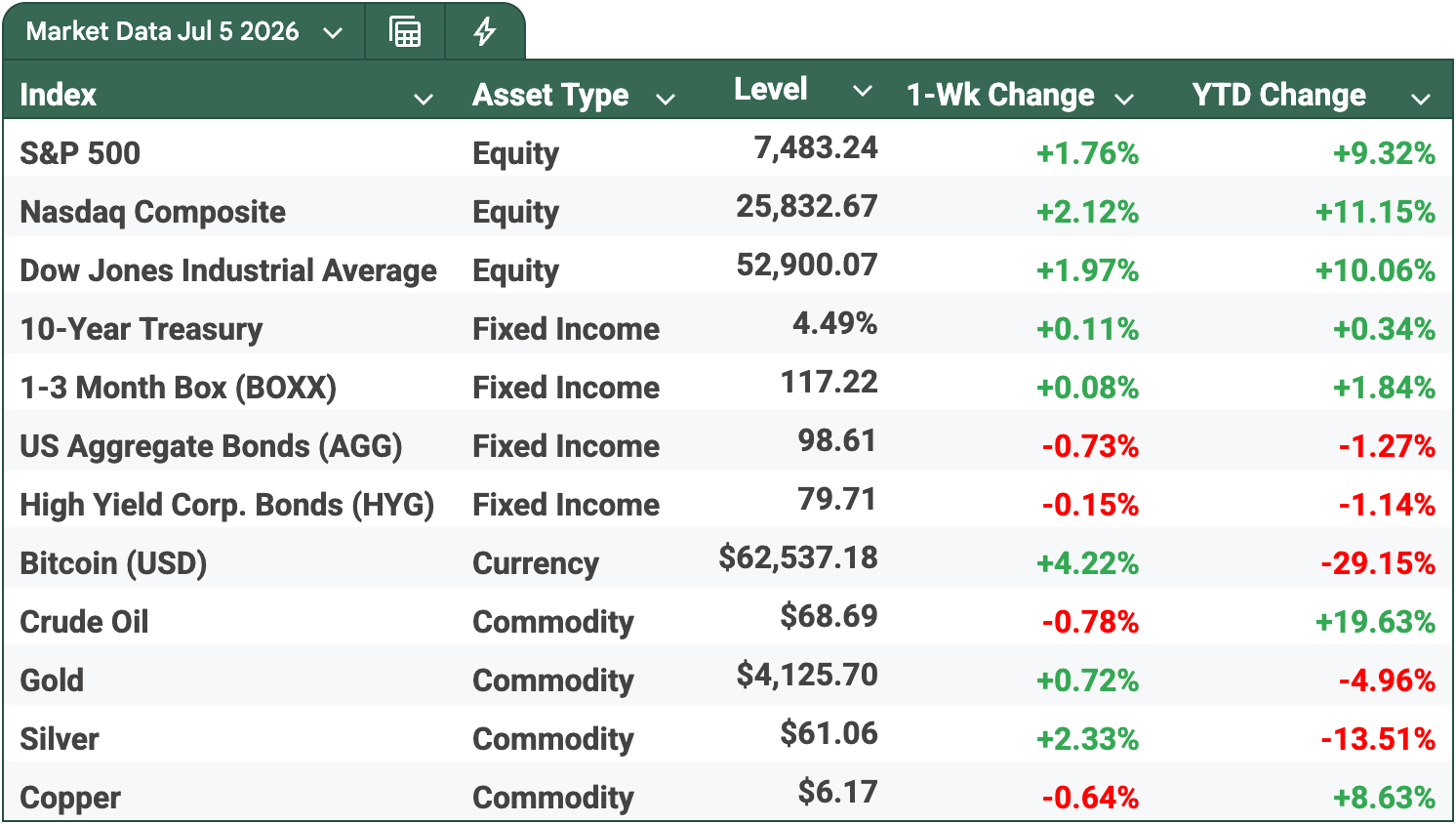
Stocks had a great week going into the holiday, with the S&P 500 up 1.76%, coincidentally close to 1776…The Nasdaq and Dow Jones Industrial Average were slightly less “patriotic” on the other hand, gaining 2.12% and 1.97%, respectively.
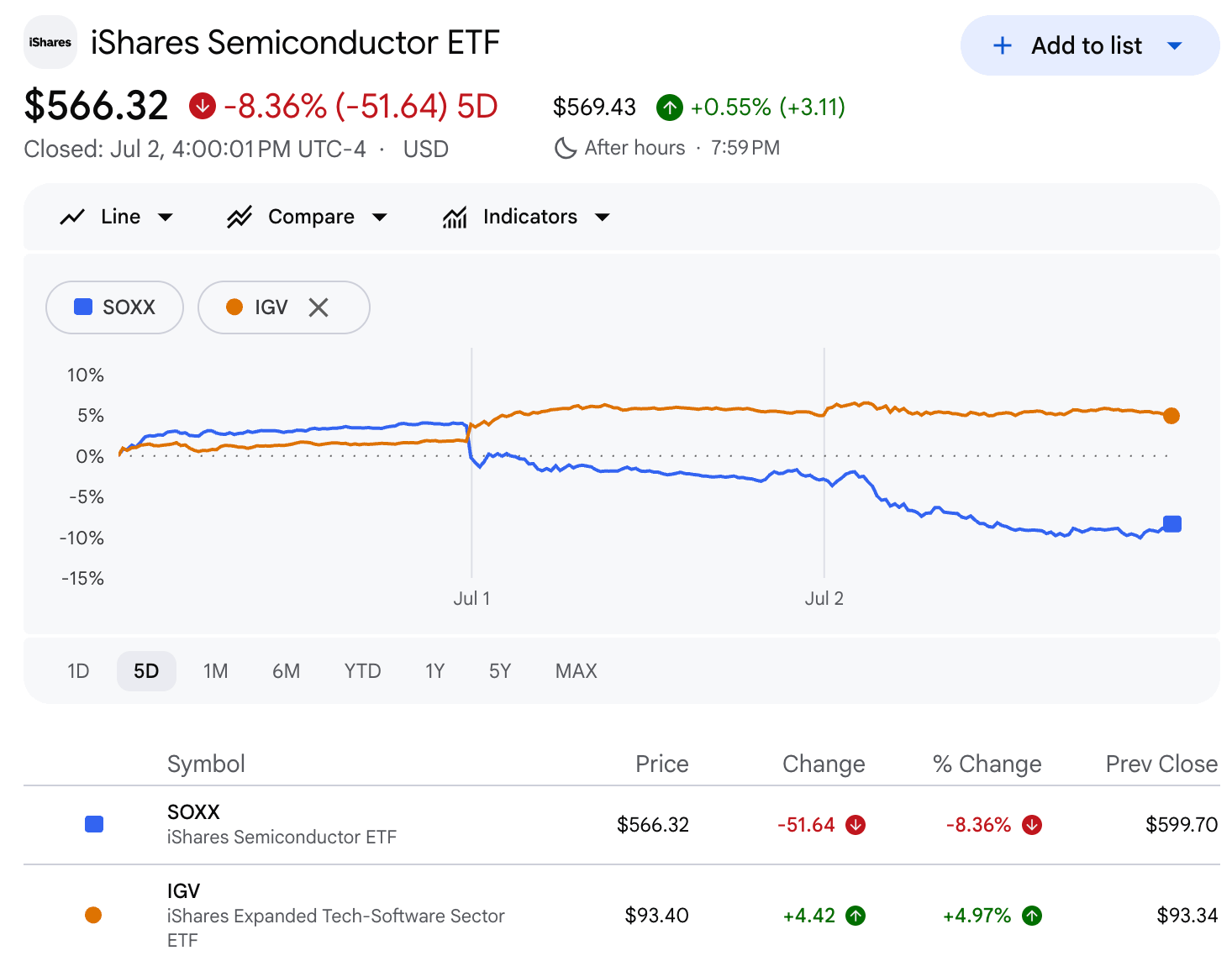
The big theme in the market this week was a rotation out of semiconductors and into software, a trade that we at Pine Creek are well positioned for. Over the last week, SOXX 0.00%↑, a popular Semiconductor ETF, fell over 8% while IGV 0.00%↑, a popular Software ETF, gained nearly 5%.
What is the semiconductor vs. software trade, and why is it reversing?
Throughout the year, semicondutor have rocketed to new highs as there is a continued shortage of computing chips to power AI workloads across all industries. From GPUs to CPUs to DRAM, there is simply not enough computing power, generally referred to as “compute,” to satisfy demand. When demand outstrips supply, prices go up, and when prices for chips go up, so to do the revenues of chipmakers.
Take Micron (MU 0.00%↑) for instance, their stock is up 209% YTD and over 700% compared to a year ago. Here is what Micron management said about supply and demand for chips in their latest earnings call:
So if we look at this multiyear time horizon, even going beyond 2027 into 2028, et cetera, we are able to get very high confidence demand from our customers that is far in excess of our ability to support using our supply.
So the demand continues to be well above our supply…
…but our expectation is that the supply growth will continue to remain short of what is needed to meet the demand. We don't really see when the supply is going to be able to meet demand. That is not something we are able to project at this time.
On the other side of the trade are software stocks, which have languished compared to their semiconductor peers. Over the past year, SOXX 0.00%↑ is up 137% while IGV 0.00%↑ is down over 15%. And the logic is simple: with the release of AI coding tools like Claude Code and Codex by OpenAI, why would anyone invest in a software company that someone with a $200/mo Claude subscription could recreate in a weekend?
Well the market seems to be coming around to the idea that:
One cannot, in fact, rebuild a multibillion dollar software company with the help of a large language model
These multibillion dollar software companies also have access to this same technological advantage, negating any kind of “head start” from competitors
There is no evidence of a widespread “replacement” of major software companies and their products
Why is this happening now? One can only speculate. Our belief is that the rally in AI-related chips and semicondutor stocks is overdone. These stocks are priced to perfection, and investors are now starting to look elsewhere for companies priced more reasonably compared to their fundamentals. And by any investor’s criteria, software stocks look like an obvious buy.
Fixed Income
Interest rates spiked last week, with the 10-Year Treasury Yield back to 4.49% compared to 4.36% a week ago, bucking a recent downtrend that started in mid-May.
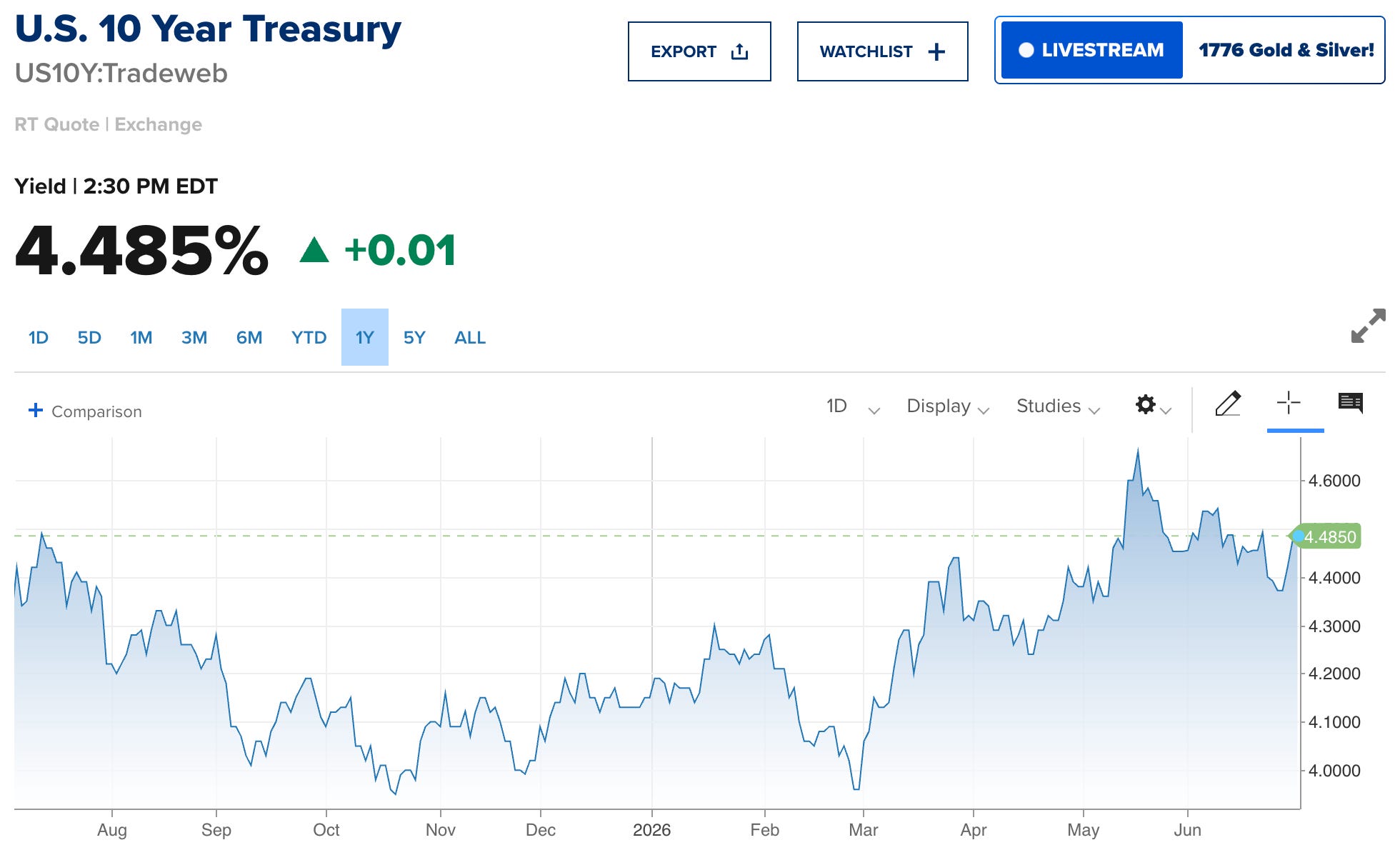
Interest rates tend to follow expectations of growth and inflation, and this week was no exception. While there was no new inflation data released, Kevin Warsh, Chairman of the Federal Reserve, spoke at the European Central Bank’s annual policy forum in Sintra, Portugal. During the speech, Warsh stated that “prices are too high.” This signaled to the market that the Fed has high expectations for inflation, to which the bank would respond with higher rates.
Below is a visual representation of how interest rates have changed so far this year:
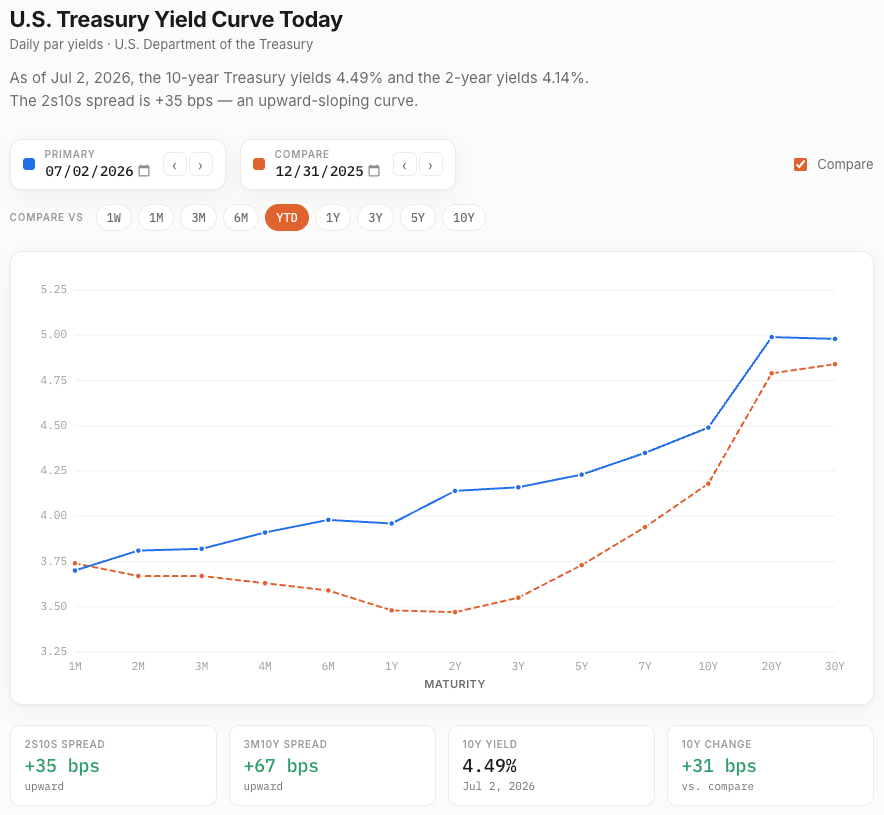
Over the first half of the year, interest rates have generally increased across the curve, reflecting the markets expectations that rates will remain higher for longer.
We reiterate our view that overweight fixed income and underweight duration is prudent in the current environment.
Commodities
Bitcoin regained some of its footing this week, trading up to ~$63,000 per coin. The cryptocurrency has continued to fade throughout the year as investors question its viability as either a currency or an investment asset.
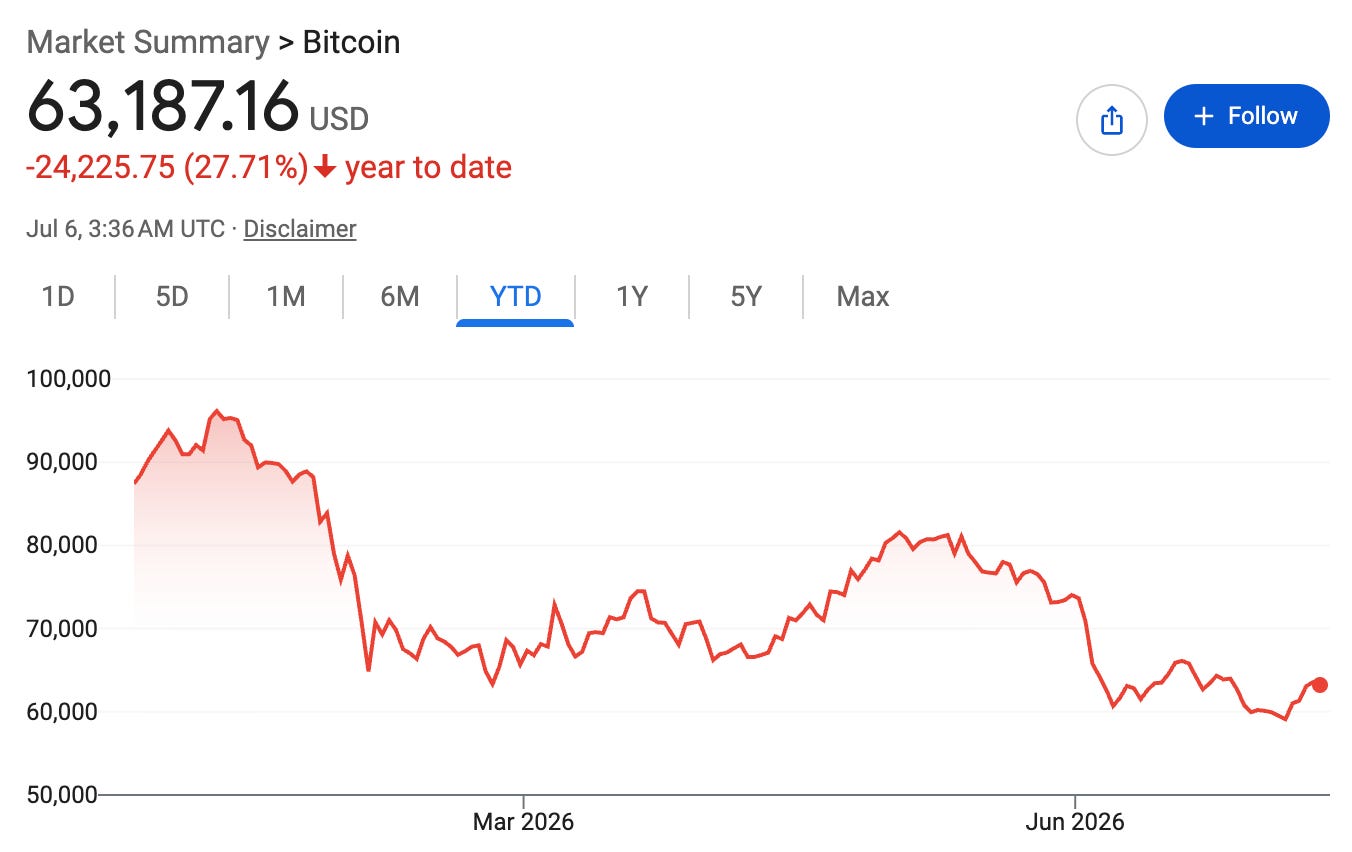
Last week, we covered Strategy with a focus on their preferred shares. Our view is that Strategy is effectively caught in a death spiral through its extensive bitcoin-backed financing. This week however, the company lives to see another day.
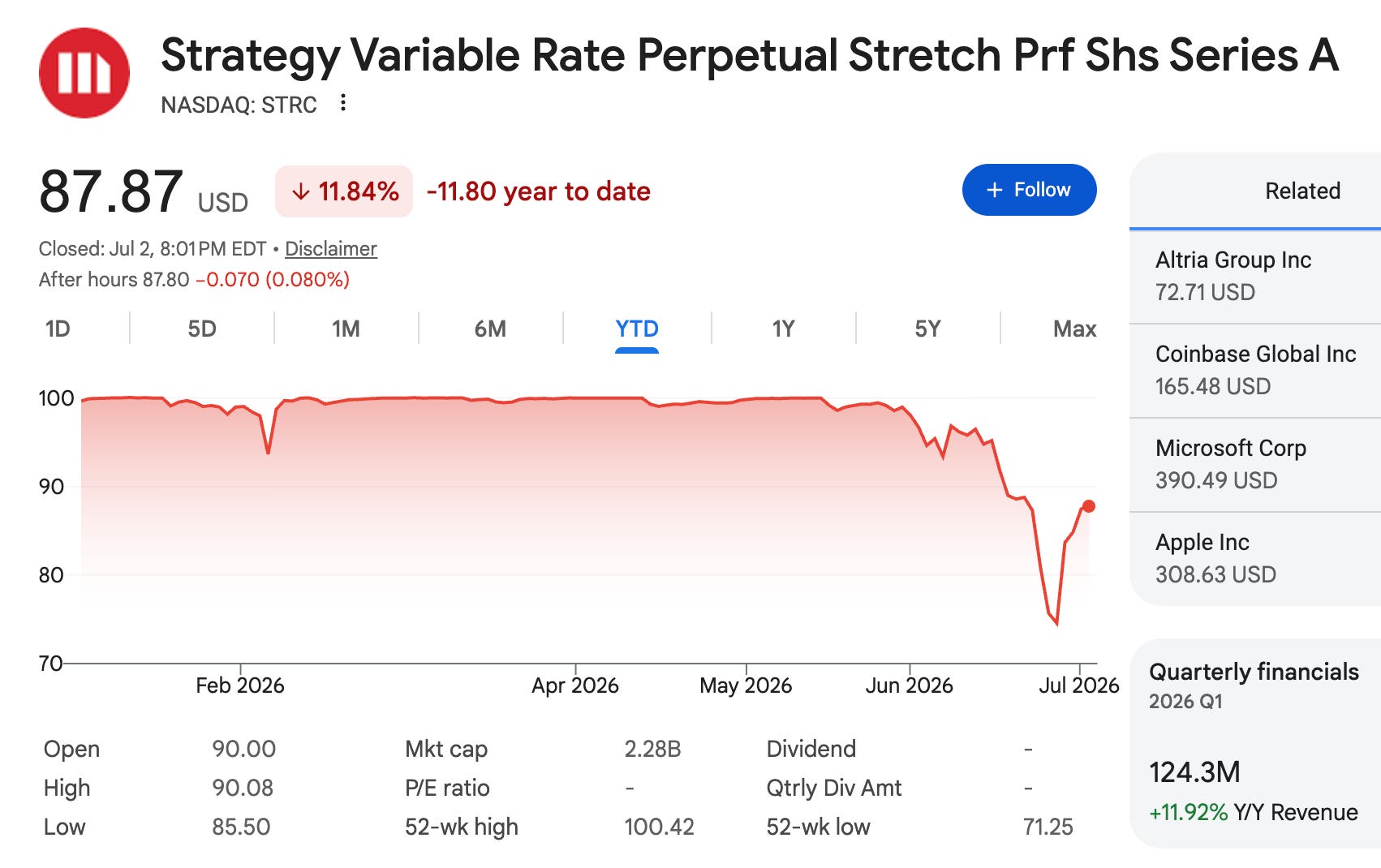
Strategy Preferred Shares (STRC 0.00%↑) traded higher after the company announced a board approved US Dollar reserve that is meant to cover at least 12 months of its preferred share dividend. This is good news for holders of preferred shares (at least for the next 12 months), but we should note that this only validates our thesis.
As stated in a prior newsletter:
At some point (soon it seems?), Strategy’s hands are tied and they can’t buy more Bitcoin, but they have to keep servicing their dividends and debt payments.
In order to service those payments, they’ll need to sell Bitcoin to raise cash instead of raising debt or selling shares. As Strategy sells Bitcoin, the price falls, kicking off a downward spiral. Every time Bitcoin falls in price, Strategy will need to sell more Bitcoin to get the same dollar value as before.
The reality is that Strategy cannot raise funds to cover its preferred share dividend, and must therefore sell Bitcoin to raise money to pay dividends. This can only end one of two ways: either Strategy halts its dividend completely, or it continues selling Bitcoin to raise dollars to pay the dividend on $STRC. Strategy’s hope is that Bitcoin somehow rallies in the meantime to essentially save the company. While this is not impossible, we are not holding our breath.
Note: Pine Creek Capital does not currently hold a position in MSTR, STRC, or BTC, and our long-term intrinsic value estimate of Bitcoin is $0.
Crude has started consolidating around our key level and currently trades at ~$68 per barrel. While there is no material news related to negotiations between the U.S. and Iran or shipping traffic through the Strait of Hormuz, oil prices (for now) have found support at around $67 per barrel.
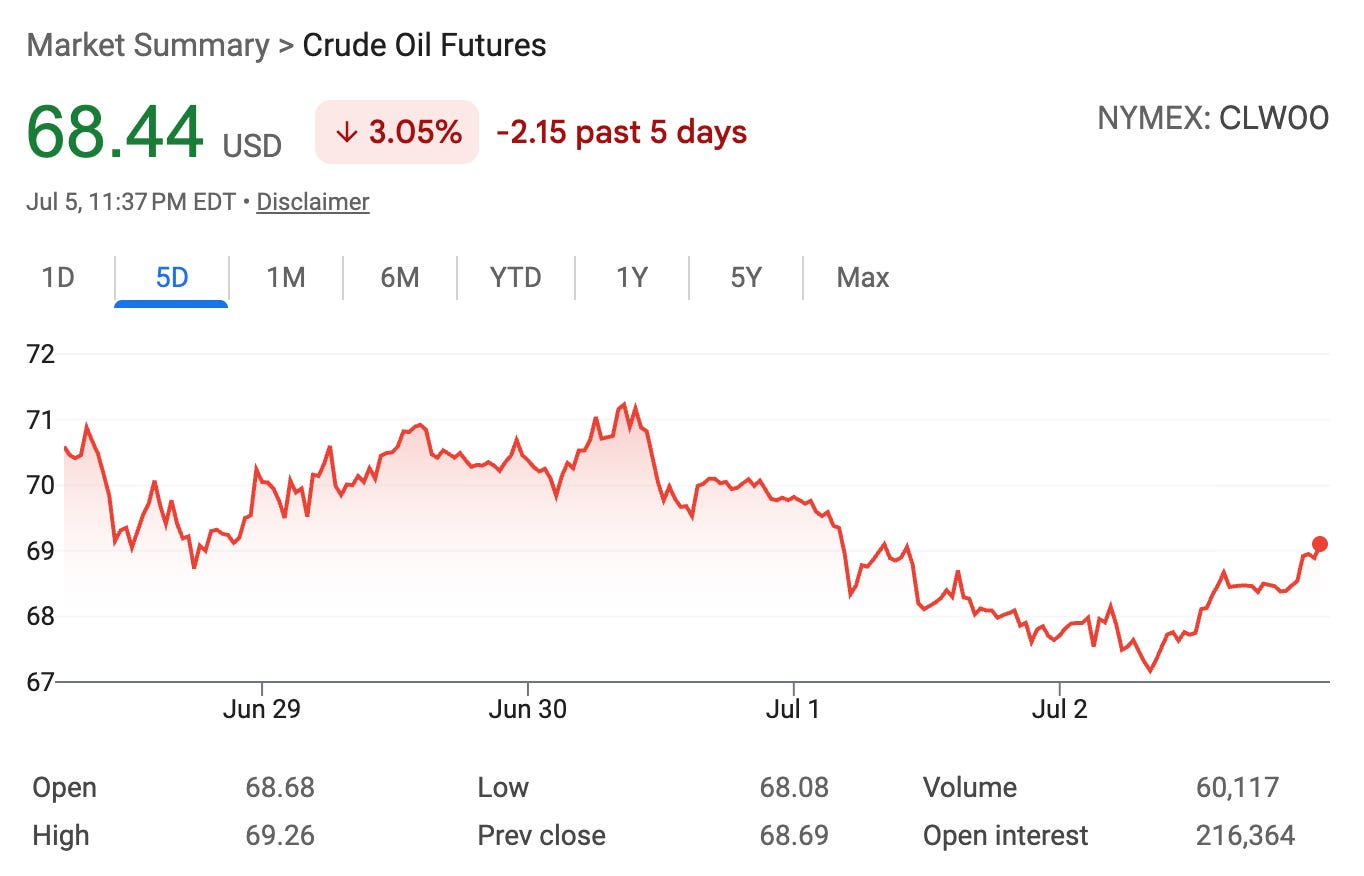
We have stated previously that the $65-$70 price range is a key level for two reasons:
We believe that the market is underpricing the risk of a re-escalation of the Iran War. A flare up in tenstions or an all-out resumption of conflict could send oil back to $100+ per barrel overnight.
Global strategic reserves remain depleted and at historically lo levels. Countries will need to replenish their reserves and will buy oil at any price, putting an effective floor on the market for the next 2-5 years. We estimate this floor to be in the $65-$70 range.
Based on this logic, we are looking closely at opening a small position on crude oil for Pine Creek’s portfolio somewhere in the $65-$70 range, which we have previously stated could be an effective floor over the near term. Additionally, the asymmetric return profile of ~$100+ to the upside and ~$50-60 to the downside is attractive. If you are interested in following our trades in real-time, consider becoming a Paid Subscriber.
Gold and Silver increased 0.72% and 2.33%, respectively, while Copper fell 0.64%. The precious metals remain volatile as they are coming off of historic highs and multiple competing pressures drive prices. Our view remains unchanged: we believe Gold and Silver remain too volatile to hold exposure to, while Copper remains attractive as a critical metal for supply chains. PCCM does not hold a position in any of the three metals.
Earnings & Data
On Wednesday, we will get a copy of the meeting minutes from the latest FOMC meeting. These minutes give markets an inside look at what was discussed among leaders of the Federal Reserve Banks. Investors will be parsing these notes carefully for any signs as to the likelihood of future interest rate cuts.
This will be a quiet week for earnings. No companies (!) are reporting earnings on Monday, and a smattering of consumer stocks will report throughout the week, such as Levi’s (LEVI 0.00%↑) and Delta Air Lines (DAL 0.00%↑).
That’s all we had for you this week, let us know your thoughts by leaving a comment! You can also like this article via Substack to show your support.
A weekly snapshot is useful.
The bigger question is whether the underlying macro trends are strengthening or simply reflecting liquidity-driven market momentum.