


Hello Investors!
This week SpaceX, the space-exploration-turned-AI-company founded by Elon Musk, completed the largest initial public offering in history. Though that wasn’t the only historical moment, as SpaceX’s valuation propelled Musk’s net worth to a new record of $1.1 Trillion.
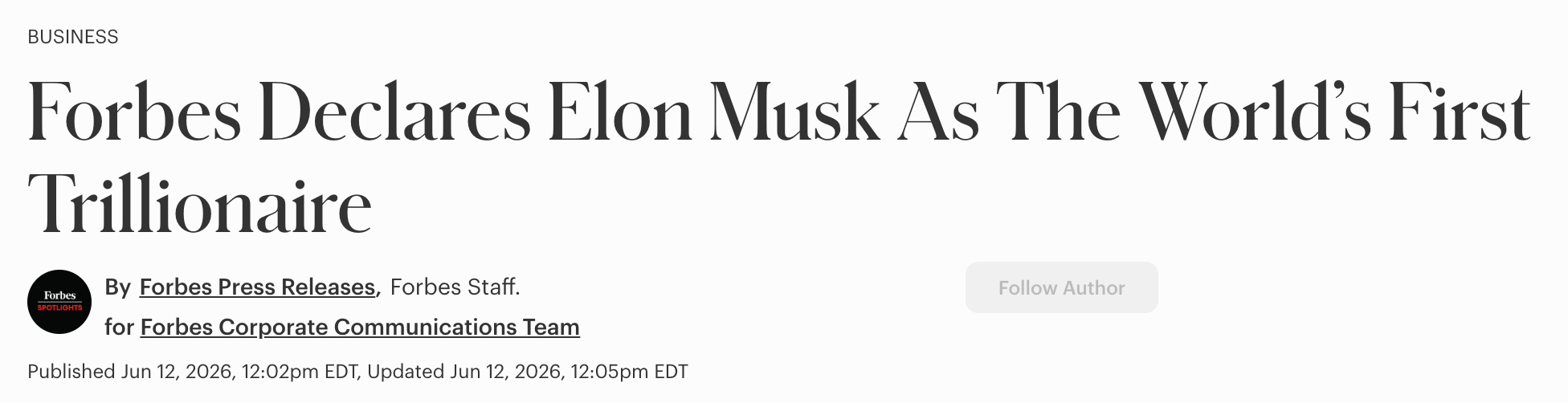
This instagram post here does a really great job visualizing just how much a trillion dollars is (it’s a lot). Here is a chart of the 25 biggest public offerings in history. It’s not even close.
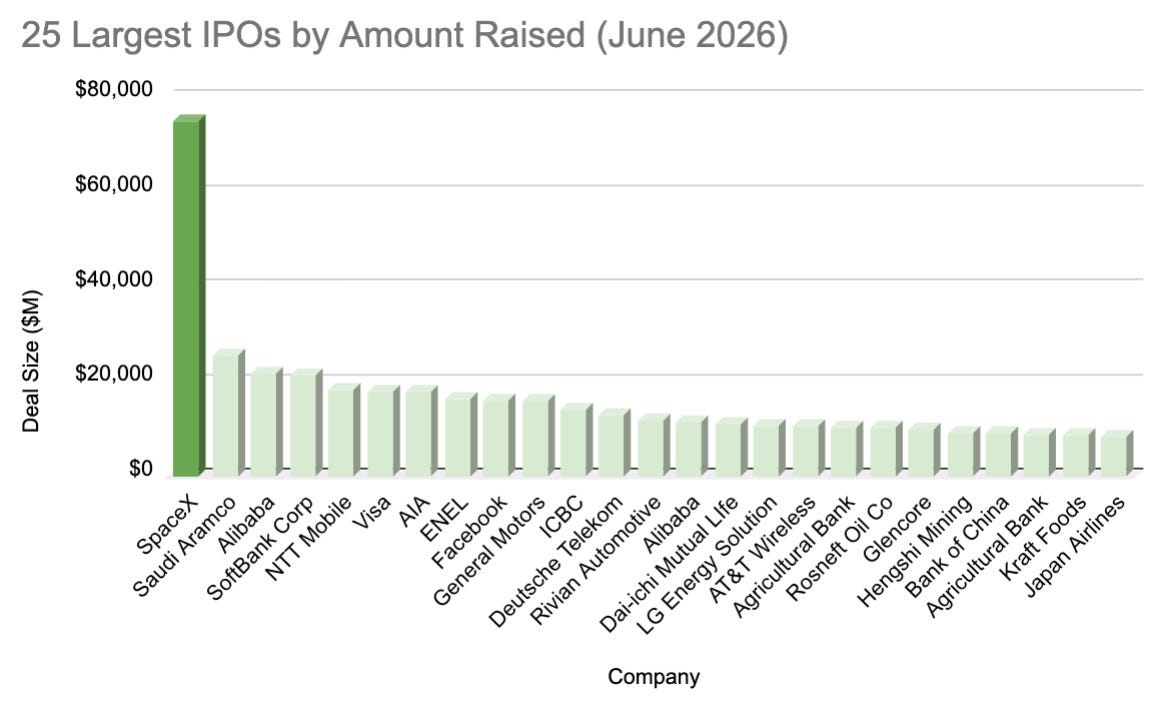
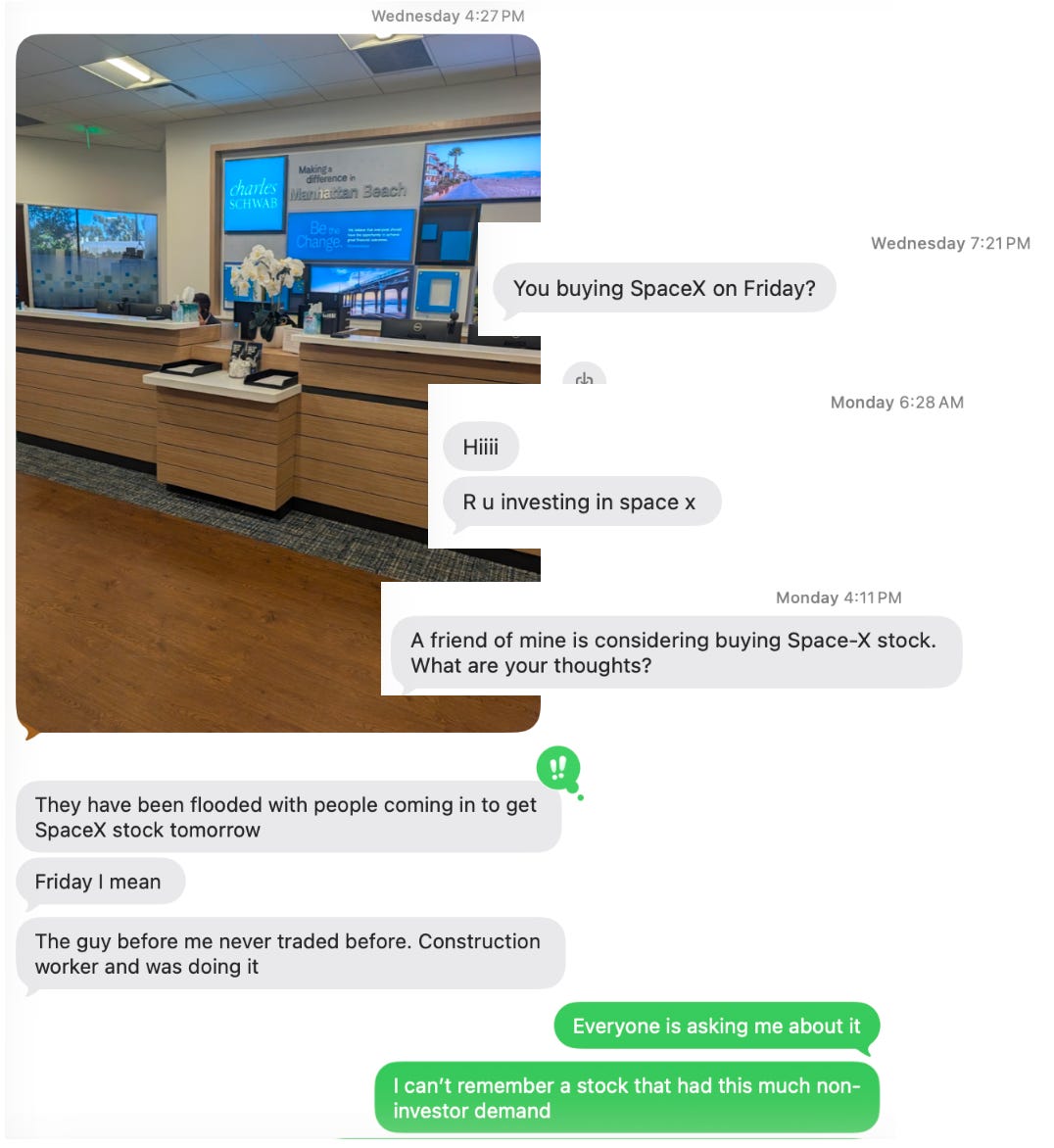
Many investors, including myself, wondered if there would be enough market demand to soak up nearly $80B worth of SpaceX, regardless of whether or not it’s a “good investment.” Over the week, I was flooded with questions and anecdotes from friends and family and their friends and family. Everyone seemed eager to know, “where can I get in on the SpaceX IPO?”
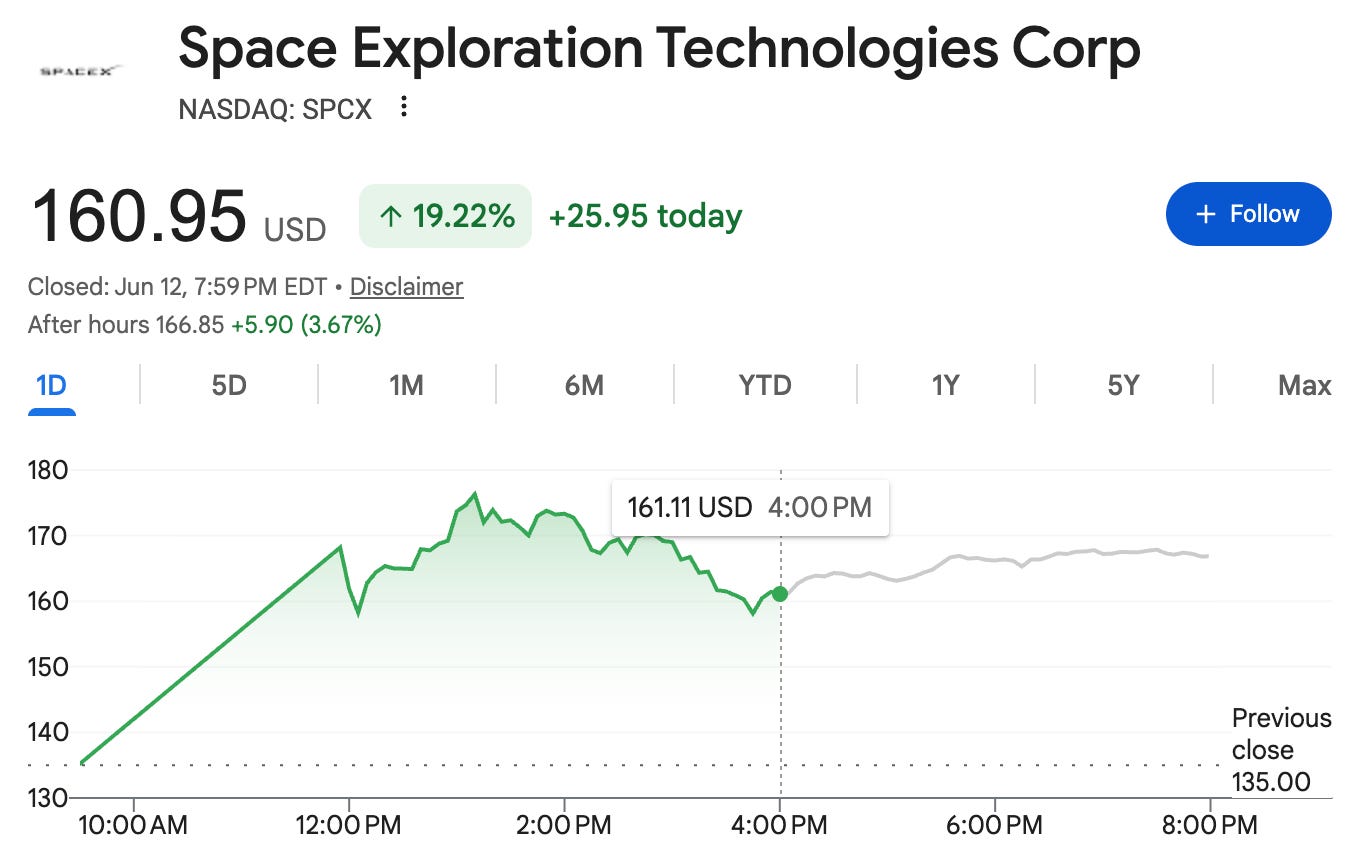
And this unprecedented demand showed up on Friday to buy SpaceX stock. The company initially priced at $135/share on Thursday night, and by early friday there were indications that it could open at $175. Demand moderated slightly from there, and by midday the stock finally opened for trading at $150. Throughout the day it continued upward, reaching a high of $176.52 before settling at $161.11.
Full disclosure: PCCM does not hold a position in SpaceX. However, we will be publishing a deep dive on the company including a valuation of the stock and what price we would consider investing in the company.
In the meantime, let’s take a tour of what else is moving markets. And as always, if you have any questions or suggestions for the newsletter, please don’t hesitate to reach out to brian@pinecreek.capital.
-Brian
By the Numbers
Equities
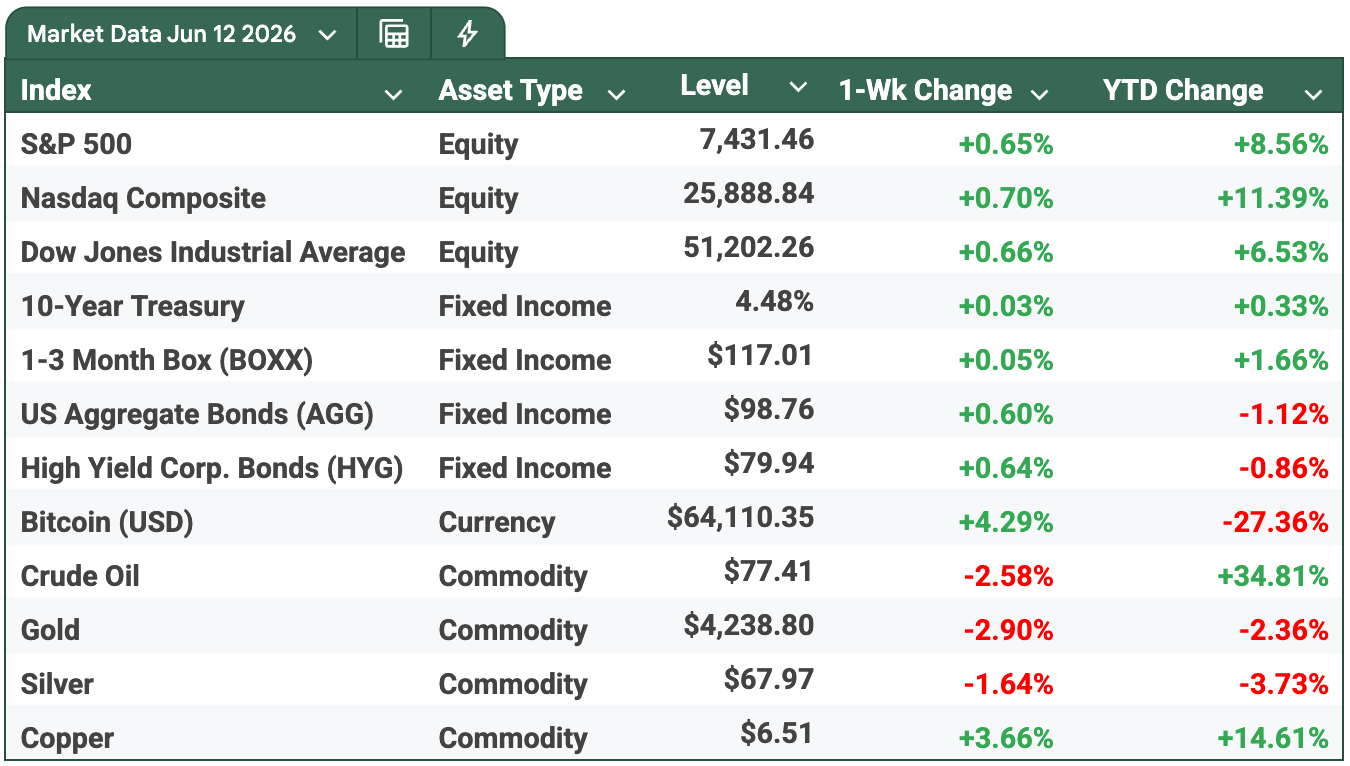
After a week of losses, stocks staged something of a comeback this past week. S&P 500 ended the week up 0.65% while the tech-heavy Nasdaq and the Dow Jones Industrial Average saw similar gains of 0.70% and 0.66%, respectively.
Much of the turnaround was driven by President Trump’s announcement during the week that a peace deal has been reached with Iran and would be signed shortly. A further clarification from the President claimed the deal would be signed on Sunday, June 14th.
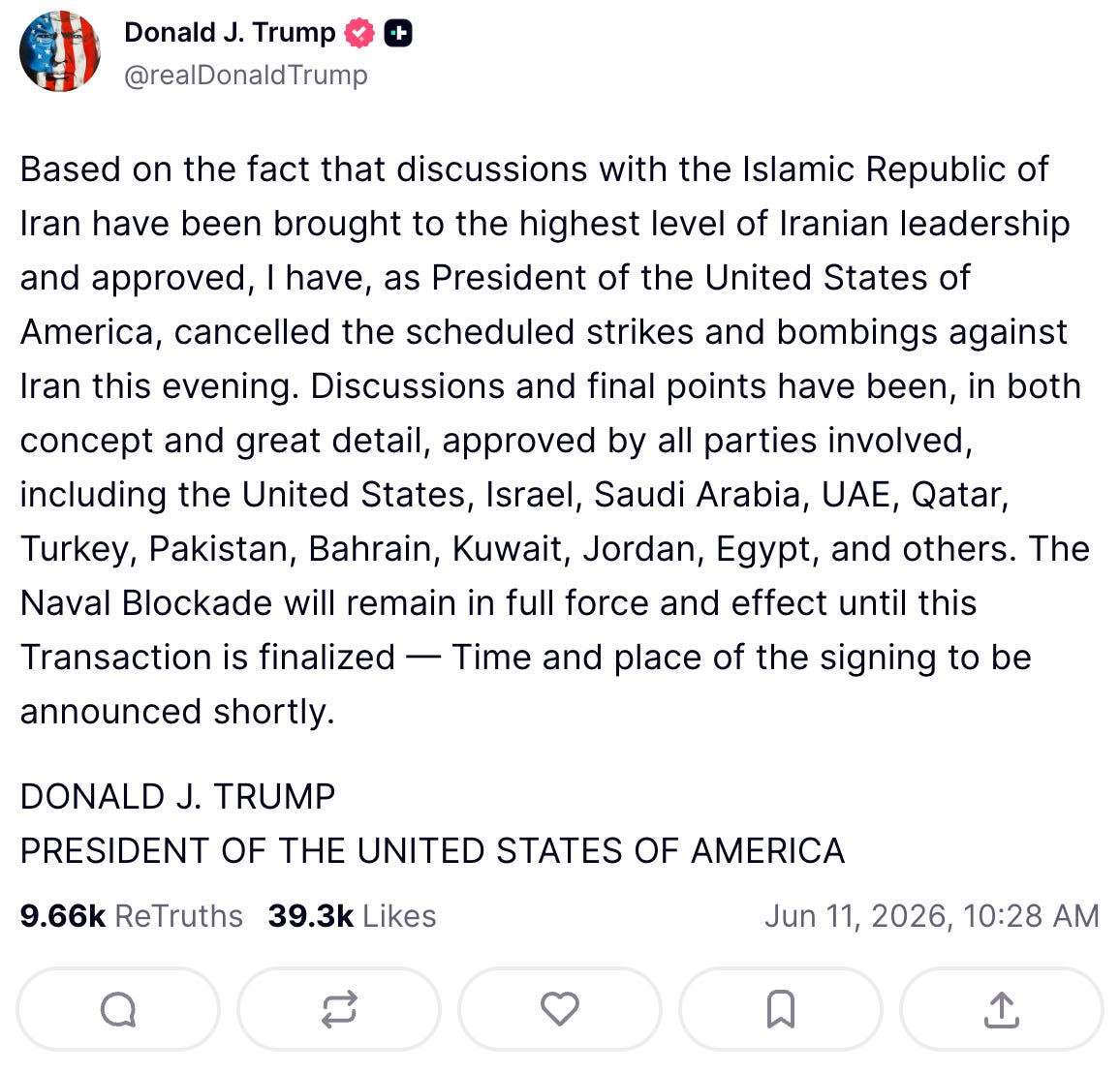
Iran quickly denied these claims, and Isreal continued to conduct strikes in the region, leaving investors confused about what if any progress to end the war in Iran would be made this weekend. That ambiguity has continued through the time of this writing, though both sides are indicating some sort of agreement is close. The terms of such a deal will be a primary driver of this market this week.
UPDATE: Since writing this newsletter, the U.S. and Iran have announced a memorandum of understanding to end hostilities. We will cover this in more as information becomes available. Our flash take is that this “deal” looks to effectively be another 60-day extension of negotiations. Equity futures are up over 1% and Oil prices are falling on the news.
Fixed Income
Along with the rise in equities, interest rates moderated, with the 10 Year Treasury falling from 4.54% to 4.48%. This led to a broad increase in fixed income, as bond prices rise when rates fall. AGG, an ETF that tracks a broad basket of Investment Grade US Corporate Bonds, rose 0.60%.
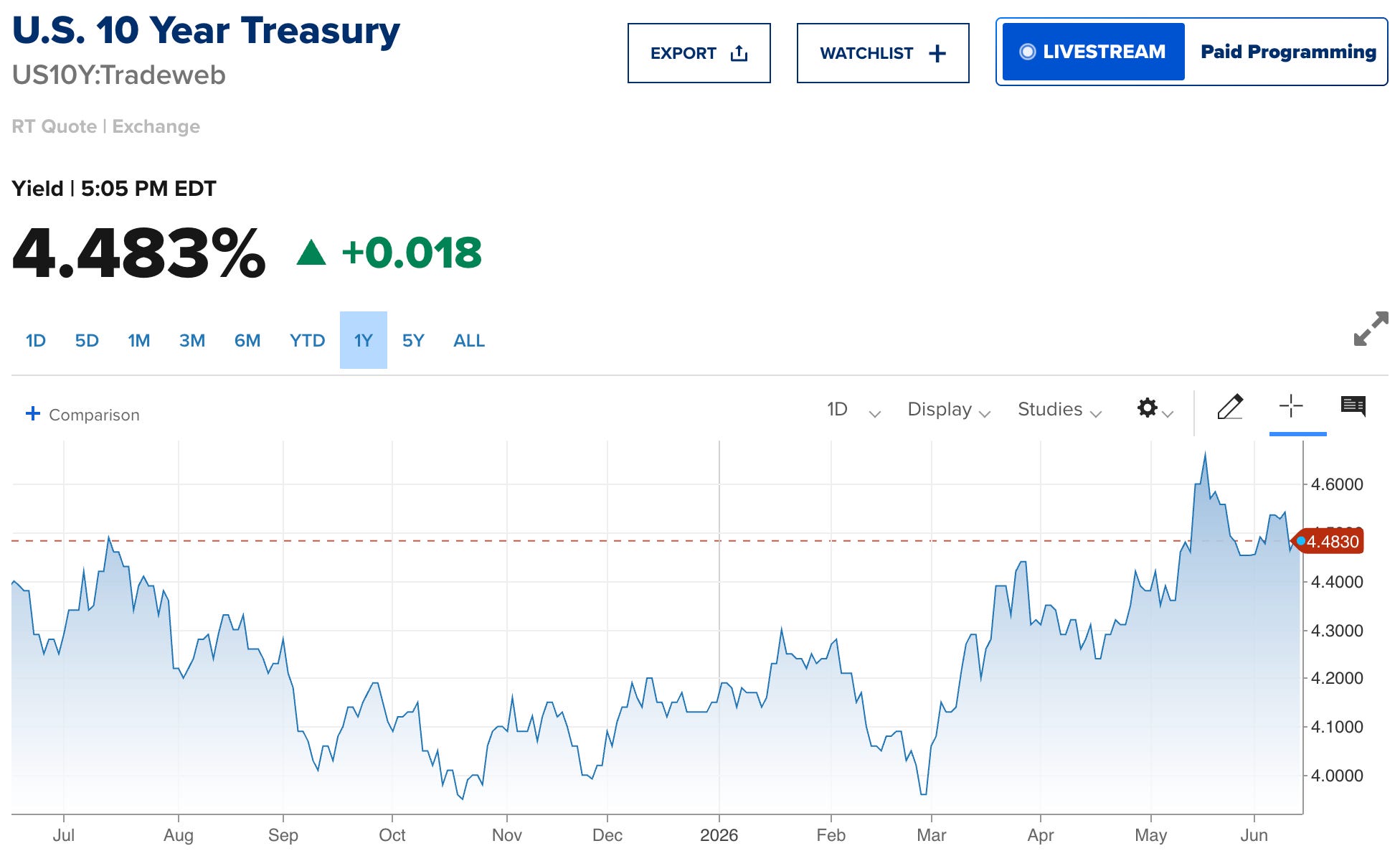
As of this writing, investors are pricing in a 57% chance that the Federal Reserve increases interest rates a quarter point or more by the end of the year, and a near zero (0.6%) chance of rate cuts. We continue to believe long fixed income and underweight duration is an attractive position in this rate environment.
Commodities
Bitcoin staged a modest rebound after a rough week prior, rising 4.29% through the end of the week. Despite the rally, the speculative cryptocurrency remains nearly 50% off its highs 8 months ago and is down 27% this year.
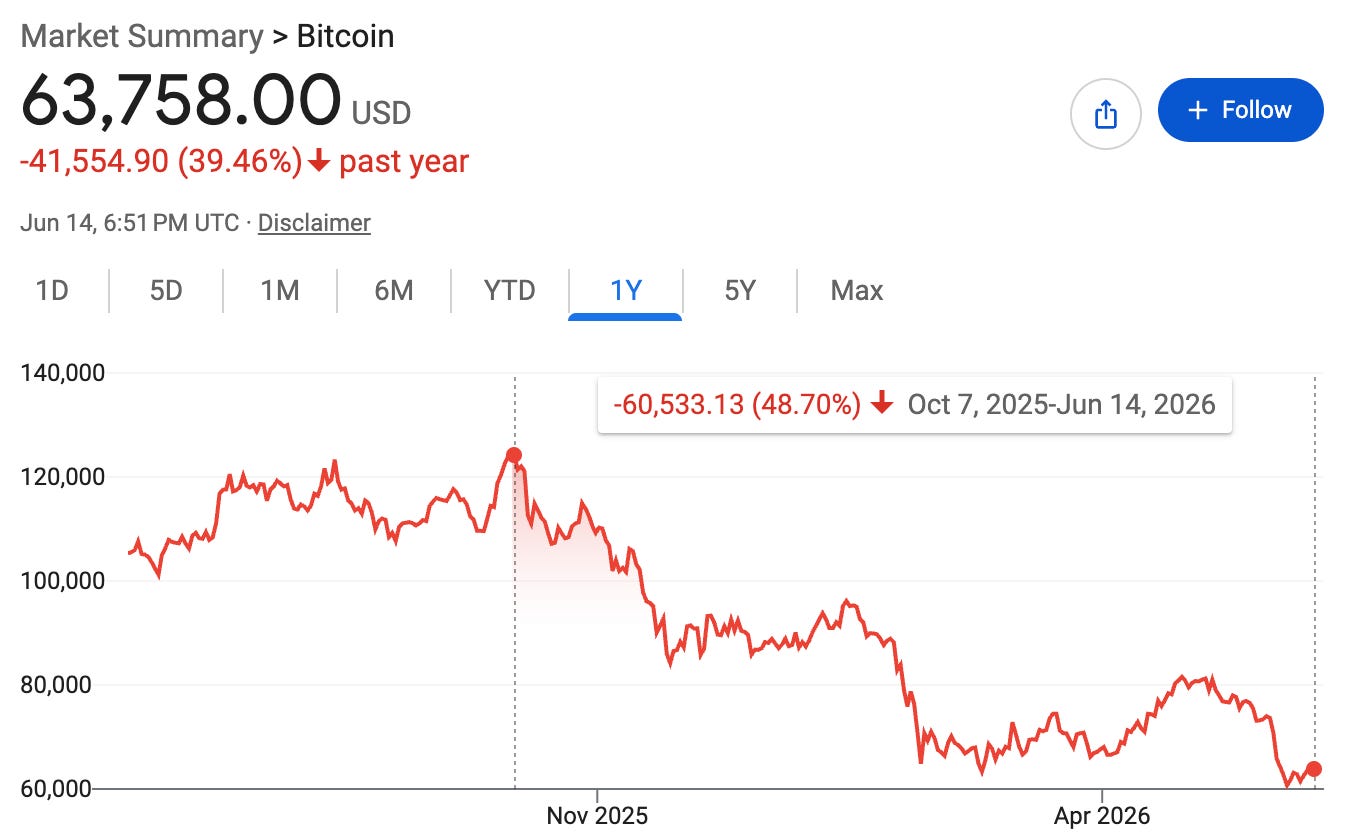
The most recent selloff came after Strategy (formerly known as MicroStrategy), ticker MSTR, recently sold $2.5 million of its bitcoin holdings, equivalent to 32 Bitcoins. This led followers of the company to question CEO Michael Saylor’s stance to never sell Bitcoin, who has posted sage advice such as:

During a conference this week, Saylor clarified what he meant, saying “I said to you, never sell your Bitcoin. I never said that the company wouldn’t sell its Bitcoin.” We continue to hold our view that the long-term intrinsic value of Bitcoin is $0.
Crude Oil continued its decline, dropping 2.58% to settle at $77.41 per barrel. The broader decline reflects investor optimism that the war in Iran will come to a close and cargo ships will again be free to transit the Strait of Hormuz.
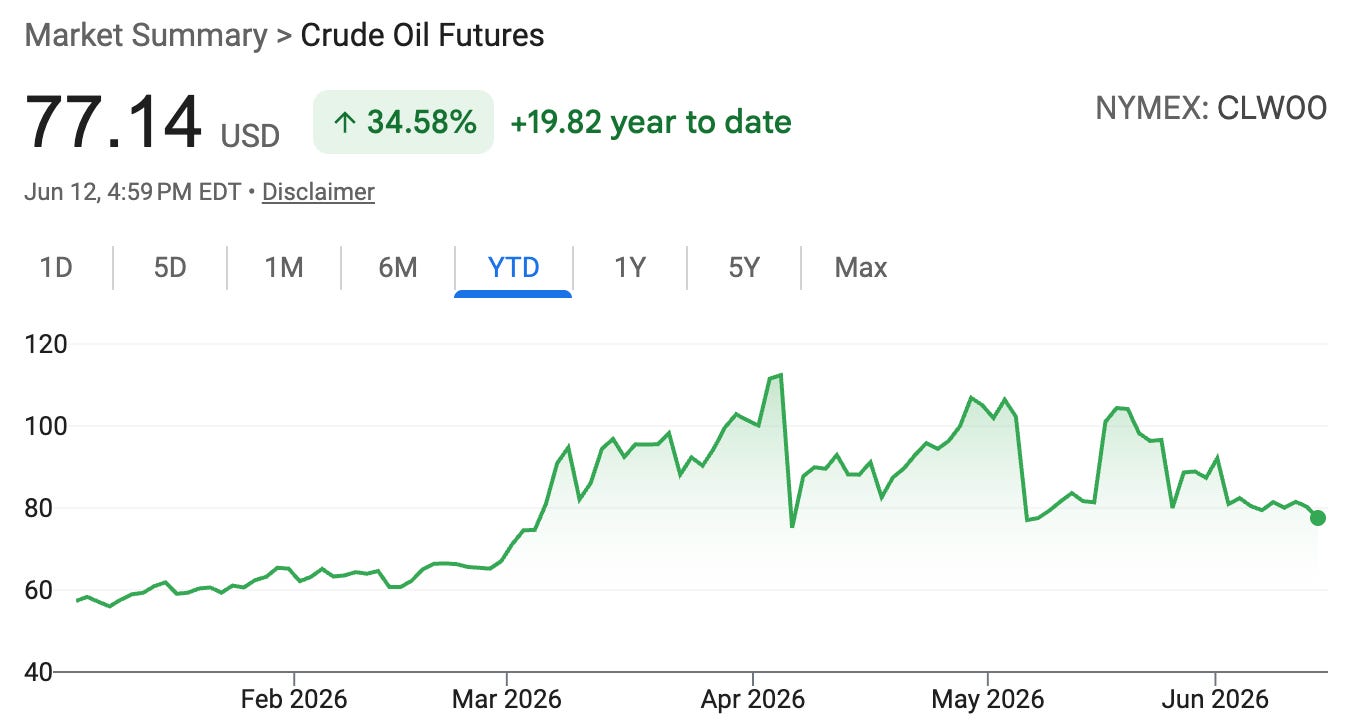
At current levels, we believe oil futures are attractively priced for a sharp potential rebound. Should negotiations fail or drag on, or a deal result in large concessions to Iran, or heavy fighting restart altogether, oil prices could jump sharply. Additionally, we believe the $65-$70 per barrel range is an effective floor for the foreseeable future, as countries will need to replenish their strategic reserves.
Gold and Silver declined 2.90% and 1.64%, respectively, while Copper rose 3.66%. The precious metals remain volatile as they are coming off of historic highs and multiple competing pressures drive prices. We believe Gold and Silver remain too volatile to hold exposure to, while Copper remains attractive as a critical metal for supply chains. PCCM does not hold a position in any of the three metals.
AI Pricing Wars on the Horizon
If you have used a major LLM, such as ChatGPT or Gemini or Claude, you may have marvelled at how much value they deliver for as little as $20 per month. The answer is that they can’t. LLM providers run on surprisingly thin margins, and despite unprecedented growth in users and revenue, these companies burn through billions of dollars per year.
One would logically expect that, in order to succeed and become profitable, these money losing companies would at some point have to increase prices. However, OpenAI has different plans. Per the Wall Street Journal:
OpenAI is considering drastically lowering the prices it charges users as it seeks to win customers from its rival Anthropic.
The company is weighing significant cuts to what it charges for tokens, the unit of measurement artificial-intelligence firms use to bill for their products, according to people familiar with the matter. The move would be in anticipation of similar cuts the company expects at Anthropic, the people said.
Business executives have begun to balk at the high prices for AI usage. OpenAI Chief Executive Sam Altman said at a recent event that costs had become “a huge issue.”
Drastic price cuts could potentially erode the profit margins of both companies, which already lose billions of dollars because of the enormous cost for computing resources needed for AI systems to process queries and carry out tasks.
This situation, where competing companies lower their prices to win over customers, is also known as a “race to the bottom.” And it is a long way to the bottom for both of these companies.
For starters, both OpenAI and Anthropic offer largely the same product: a chatbot that can help with coding, writing, and everyday questions. This means that switching costs between the platforms is very small. There is nothing embedded in either of these platforms that creates a feeling of being “locked in,” and they do roughly the same thing. Therefore, from a pricing perspective, there is no “bottom.” At some point, the two companies will need to differentiate on product.
The issue is that this isn’t really possible with large language models. An LLM is an LLM. Any feature one LLM adds can be easily added to another, either through research and training, or via distillation. While there are some differences that can be applied to the look and feel of the product, or the user experience, these are superficial, easily replicable, and do not create any real competitive advantage.
And then there’s the “end game.” Let’s say OpenAI wins the pricing war, bankrupting Anthropic in the process and capturing all their users. What next? Well, if the company was losing money at its original prices, it will need to at least get prices back to where they were, and probably much, much higher, while likely decreasing the quality of the product to reduce costs. This scenario is known as “enshittification,” a process by which digital products decline in quality over time.
While this hypothetical could very well end up with OpenAI succeeding as the “winner,” we can’t ignore the impact that a company like Anthropic failing would have on the global economy. After all, the company is currently valued at close to $1 Trillion dollars. A failure of a company this size is unprecedented, and would have downstream impacts on the rest of the economy, potentially taking OpenAI down with it.
The reality is that the AI incumbents have backed themselves, and the rest of the industry, into a corner. They are out of VC money and are turning to public markets to raise money and cover their cash burn. And based on their burn rate, an $80 billion raise from public investors would just be a short term solution. Since they can’t differentiate their product from competitors, the only option is to lower prices. And since they are already money-losing, this is not a real option.
It’s impossible to look at the AI industry as it stands today and not see a house of cards ready to fall.
Coming Up This Week
This week is expected to be relatively quiet.
On Wednesday, the Federal Reserve will announce their decision on whether or not to adjust interest rates. This will be the first Fed press conference under the leadership of Kevin Warsh, and the market is pricing in no change in rates. Investors will instead be watching Chair Warsh closely to better understand how he will change the Fed’s relationship with public markets.
While many companies are reporting earnings, none on the docket are expected to move markets based on their results or commentary. We will also get a smattering of macroeconomic data primarily relevant to the housing market.