


SpaceX went public on June 12th at $135 per share, raising $75 billion at a $1.77 trillion valuation, making it the largest initial public offering in stock market history.
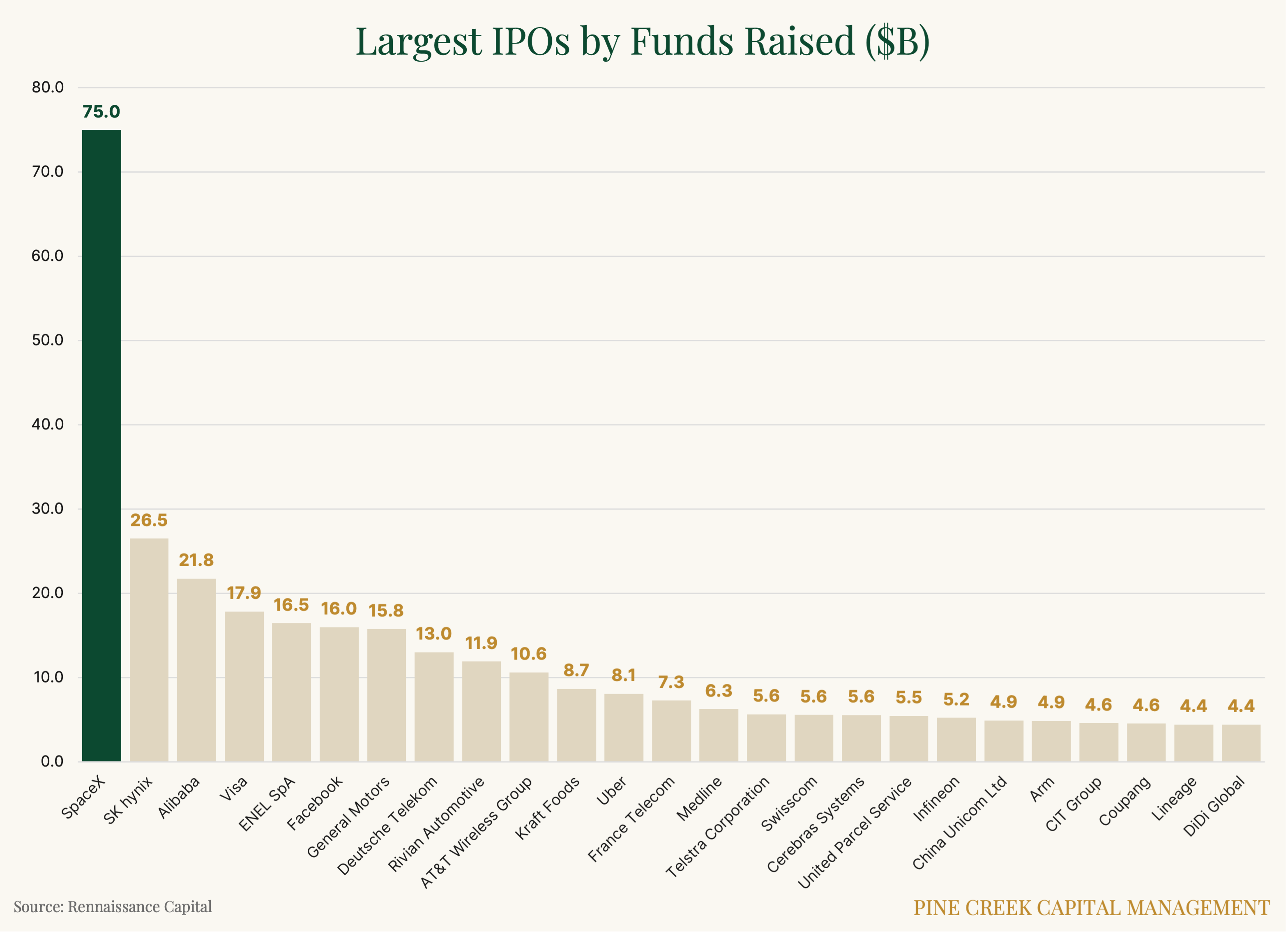
Not only was this the largest IPO in stock market history, but it is also the most popular IPO we have personally experienced. During the week leading up to the IPO, we received numerous messages asking about whether SpaceX is a good investment at the IPO.
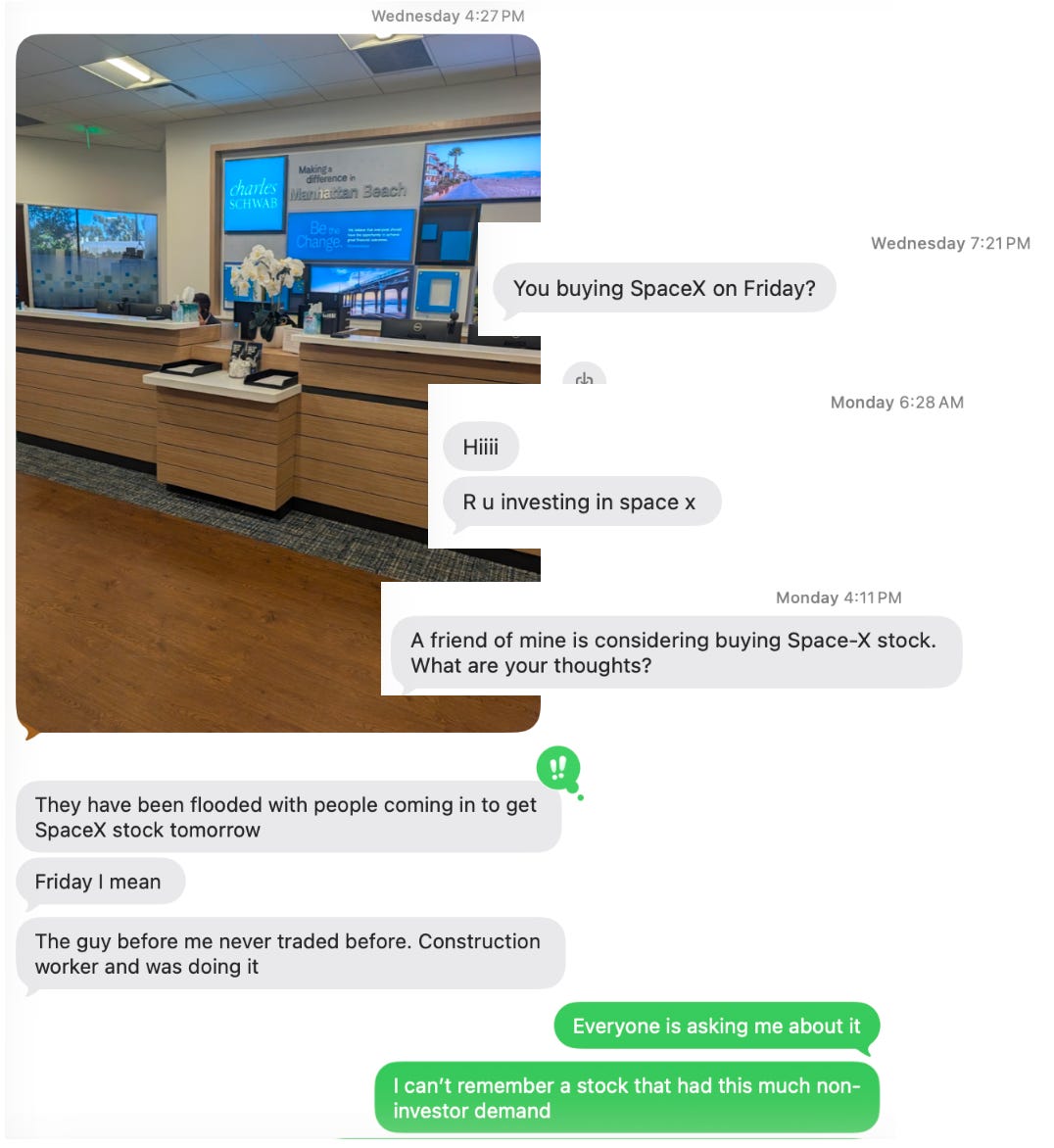
We shared the above in our newsletter published shortly after the offering, and disclosed that while we did not hold a position, we would publish a deep dive with a price at which we would be interested in starting a position in SPCX. We decided to hold off on publishing this report as the stock price was sent into the stratosphere.
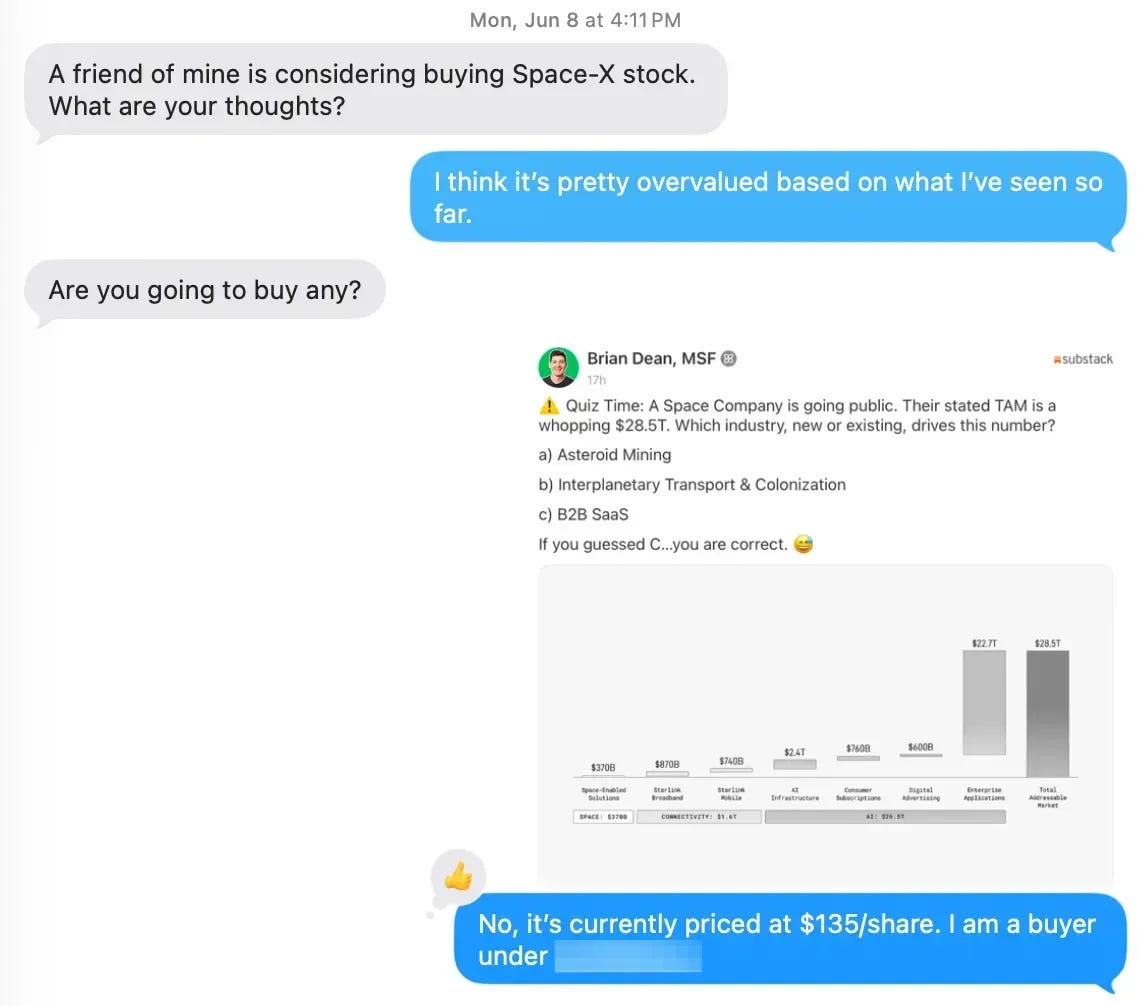
We believed the company was well overvalued, so much so that our thesis would be pretty much useless unless one was looking to short the company. Even then, shorting a newly listed company is impossible during its first few days of trading, and prohibitively expensive even as shares become available to borrow.
This is likely the environment that enabled SPCX to close its first day at $161, and hit $225.64 four days later.
As of this writing on August 3rd, the stock now trades at ~$110/share, down 50% from its high and 18.5% from its IPO price of $135.
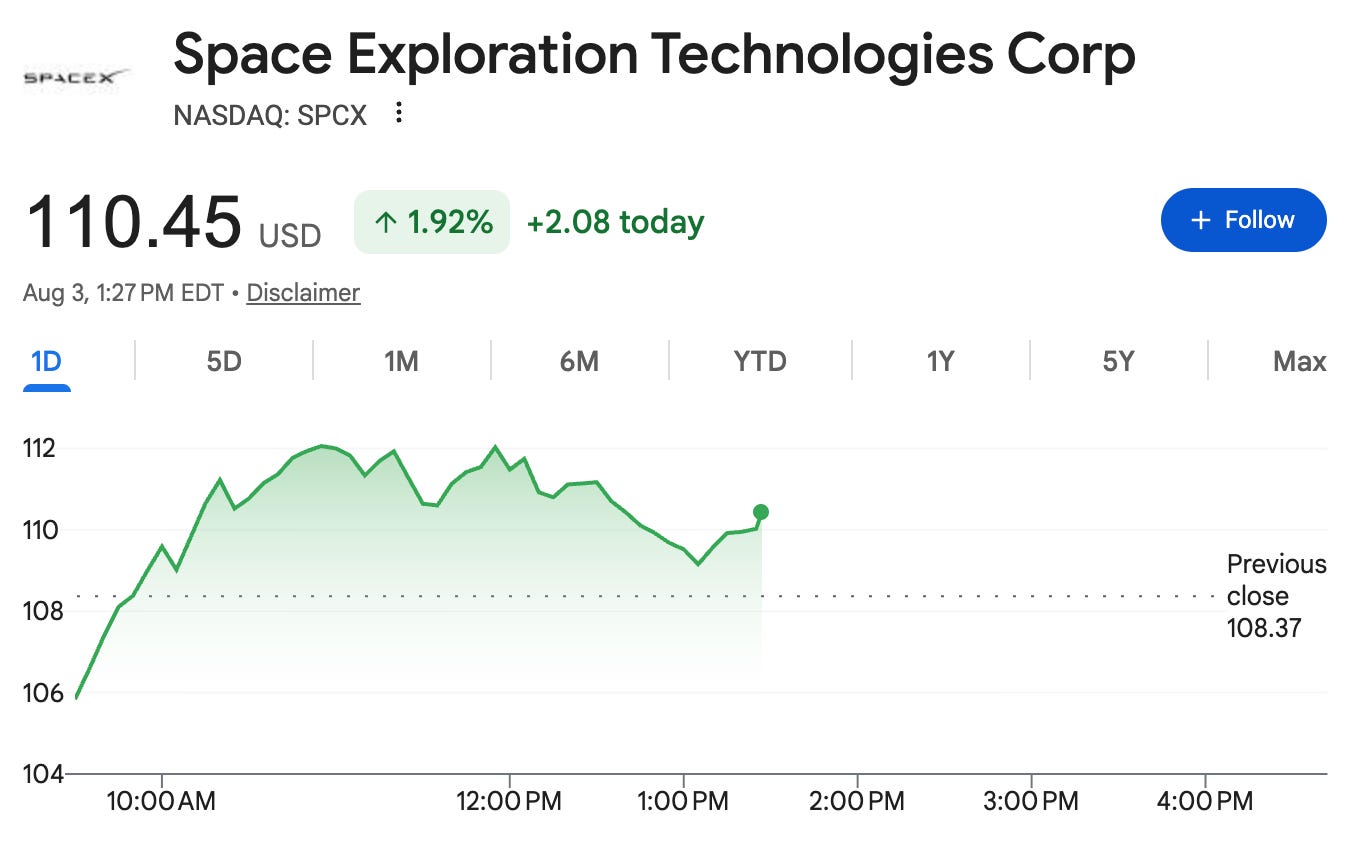
Tomorrow, August 4th, SpaceX is set to report earnings results for its first quarter as a public company. Additionally, on August 6th, shares of employees and early investors will become eligible for sale on the public markets. It is against this backdrop that we decided to answer the million dollar question we have been asked since June: what is SpaceX actually worth?
In this IPO Spotlight, we will cover:
A Brief History of SpaceX
How SpaceX Makes Money
Our Valuation of SPCX Stock
SpaceX: A Brief History
Elon Musk founded the company Space Exploration Technologies in 2002, contributing ~$100 million of his own capital via proceeds from the sale of PayPal. His goal with launching SpaceX was to dramatically reduce the cost of reaching orbit.
In the biography “Elon Musk” by Walter Isaacson, there is a fascinating excerpt about how Elon ran the numbers of what it would cost to build a rocket from scratch in an Excel spreadsheet. At the time, rocket launches were primarily done by government contractors with no incentive to compete on price, and each launch could cost upwards of $100 million or more.
Musk noticed this and concluded that the industry was wildly inefficient, estimating that with the right team, he could build a functioning rocket for a fraction of the cost. And with that, SpaceX was born.
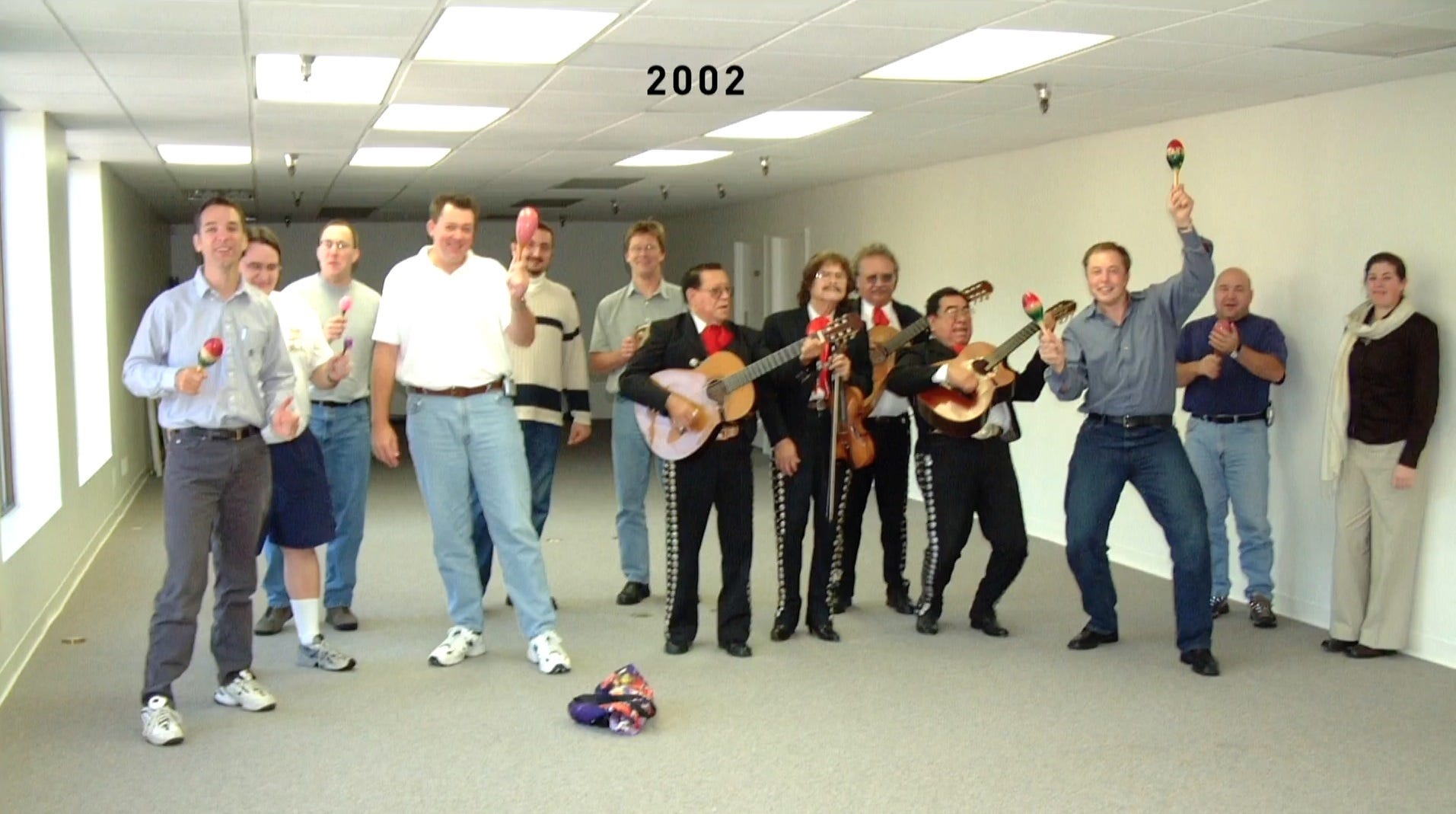
SpaceX’s first product was Falcon 1, a small two-stage rocket set to launch in 2005.
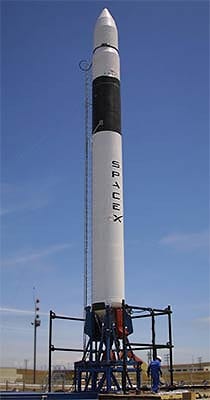
After multiple delays, Falcon’s inaugural launch took place on March 24th, 2006 from Omelek Island. Below is a video of the rocket’s short-lived flight.
Falcon 1 failed to reach orbit, and failed subsequent launch attempts in 2007 and 2008.
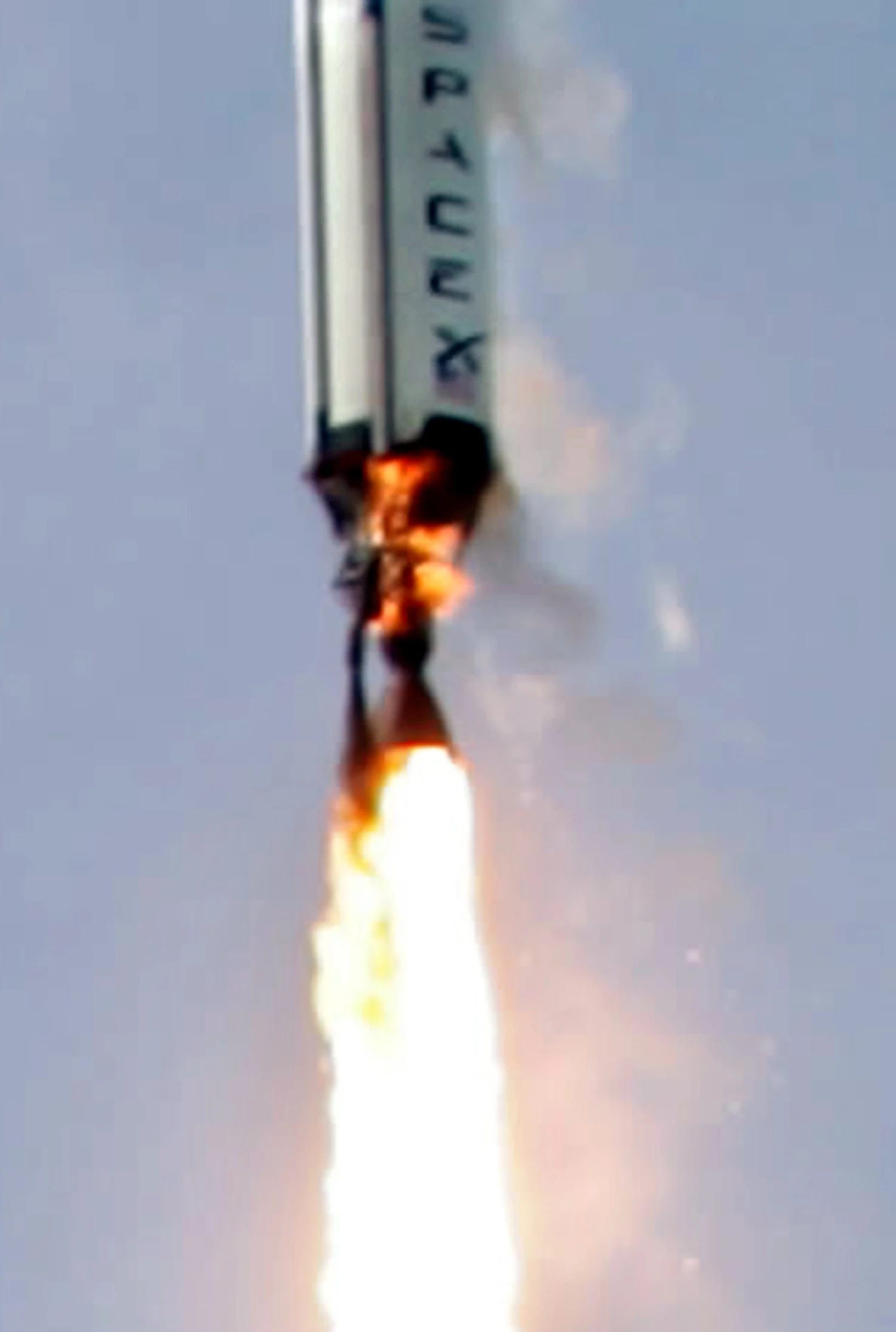
After three failed launch attempts and a global financial crisis unfolding in real time, SpaceX had enough money for just one more launch. On September 28th, 2008, at 4:15pm local time, the countdown started.
“Five…..” White fumes emanate from the launch pad as excess liquid oxygen boils through the rocket’s release vents. In a split second, the valves close. Helium is flooded into the tanks and the rocket stiffens like a skyscraper-sized aluminum balloon.
“Four….” The launch computer sends a simple command:
vehicle: startup
Control of the rocket has been passed from the SpaceX team to the flight computer on board. There is nothing any human on Earth can do now. She is on her own.
“Three...” The massive Merlin 1C engine’s turbine starts spinning at hundreds of times per second, preparing to move a metric ton of propellant in seconds. The engine’s main fuel valve opens. Triethylaluminum and triethylborane, a mixture so eager to burn that air alone sets it off, is injected into the chamber a heartbeat before the propellants arrive. It ignites on contact with the atmosphere, creating an emerald green flash. But it needs more.
“Two..” Rocket fuel and liquid oxygen rush in to meet the ignition, and in a moment the launch pad is engulfed in flames reaching over 2,000 degrees celsius. The rocket is now pushing against the ground with 78,000 pounds of thrust. She wants to fly, but massive steel clamps are holding her in place. They won’t let go until the onboard runs its checks and gives the green light.
“One.” Falcon 1 is at full thrust. The computer is still checking. The launch crew is watching the webcast feed, their careers on the line. Time seems to stand still.
And then the computer sends a final pre-flight message:
engine: healthy
commit.
“Zero.” The clamps release. Umbilical cords fall away. And 90,000 pounds of propellant-filled aluminum accelerate towards the sky.
Approximately nine minutes later, Falcon 1 became the first privately developed liquid-fueled rocket to reach orbit.
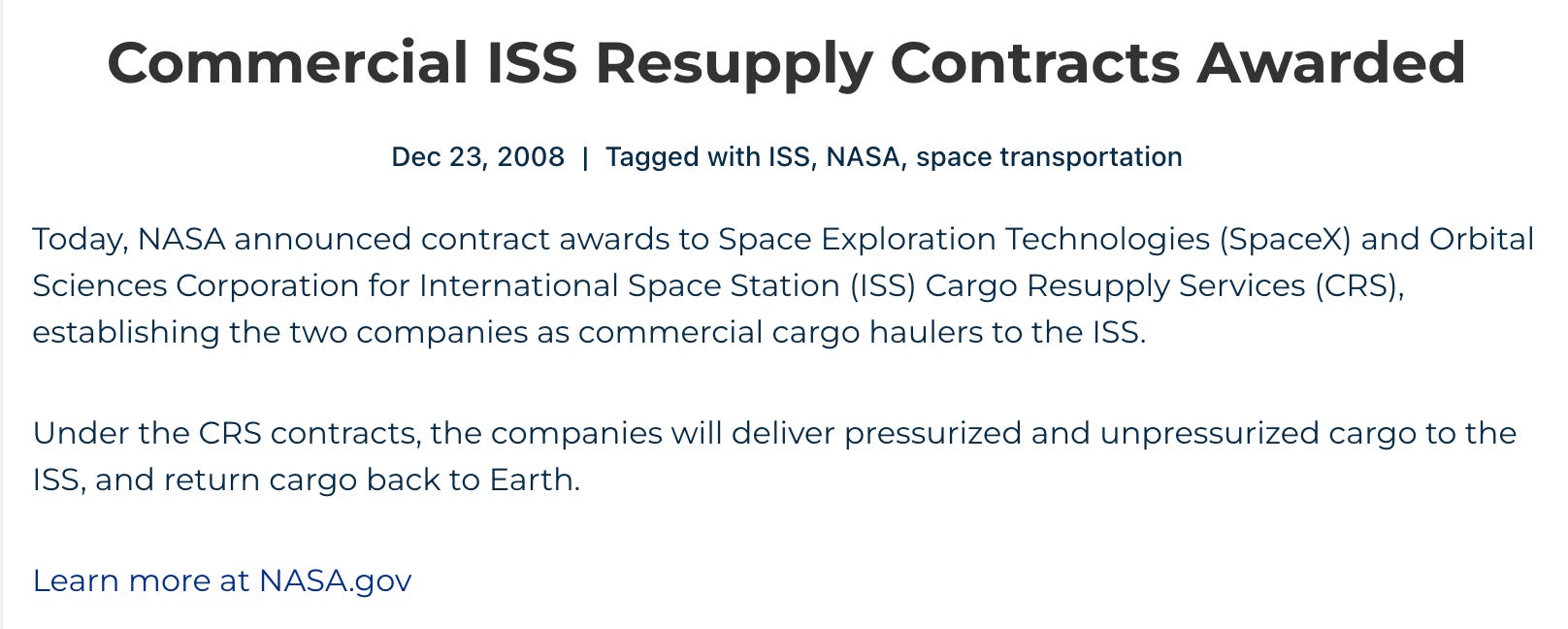
Three months later, NASA announced a $1.6 billion contract for SpaceX to deliver 20,000kg of cargo to the International Space Station.
The story of the Falcon 1 encapsulates the theme of SpaceX’s history: improbable success.
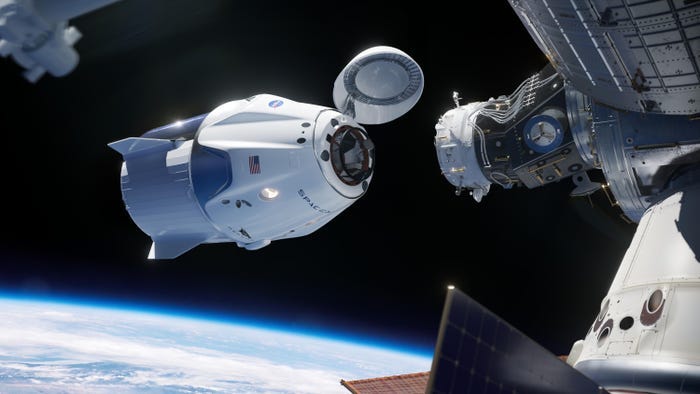
In 2012, SpaceX successfully docked its Dragon spacecraft to the International Space Station. As with Falcon 1, they were the first private company to reach this milestone.
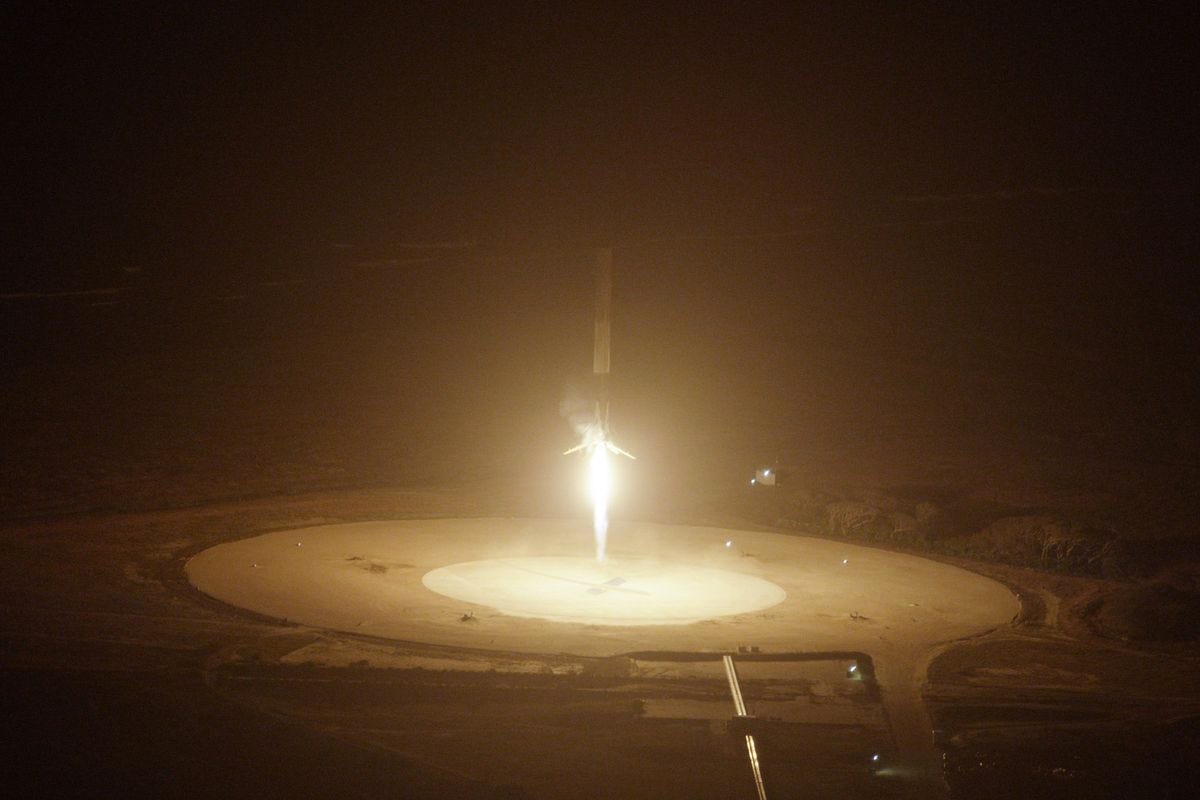
In 2015, SpaceX successfully landed the first stage of its Falcon 9 rocket after launching to space. This was the first time any launch vehicle of its kind landed itself, and it became a proof of concept that they could be reused. The booster was relaunched in 2017.
In 2019, SpaceX began deploying a broadband constellation of satellites in low Earth orbit which became what is now Starlink.

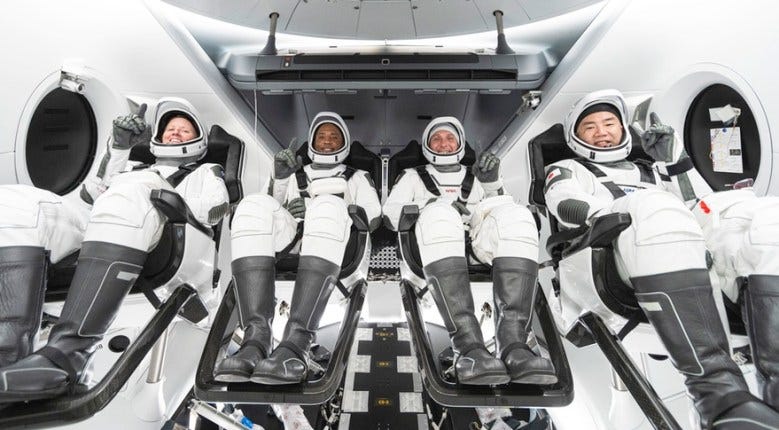
In 2020, NASA astronauts flew to the International Space Station via SpaceX’s Crew Dragon craft.
By 2025, SpaceX was launching 170 times per year, delivering 2,213 metric tons to orbit. At 9,600 satellites, SpaceX makes up roughly 75% of all active maneuverable satellites in orbit.
In 2025, Musk began consolidating various companies under SpaceX. In March 2025, xAI acquired X (formerly Twitter), and SpaceX later acquired the consolidated xAI in February 2026. While the consolidated company is still called SpaceX, there is now much more to the business than just launching rockets.
So what exactly are investors in SPCX getting themselves into? Let’s break it down:
The Business Model
SpaceX reports three segments: Space, Connectivity, and AI.
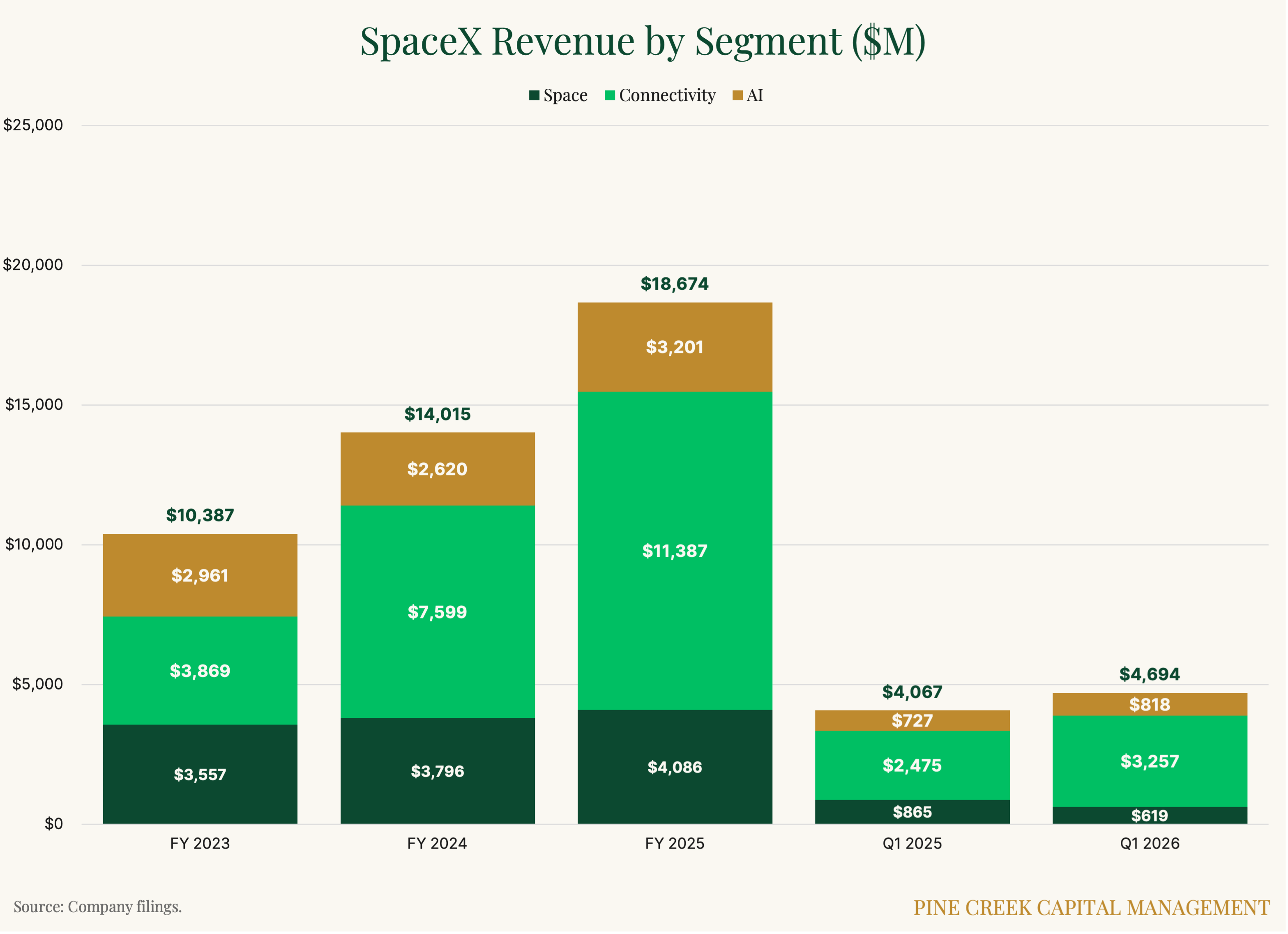
In 2025, these business lines generated a combined $18.7 billion in revenue, up 33% Y/Y. As readers will notice in the above chart, substantially all of this growth comes from the Connectivity segment, with modest growth in Space and more volatile growth in AI.
While Connectivity is by far the most interesting segment by revenue performance, we will pay homage to SpaceX’s roots by starting with a walkthrough of the Space segment.
Business 1 | Space (The Launch Business)
Since we have already discussed SpaceX’s history in detail, we will keep this section brief. This segment generates money through contracts with customers that need to transport stuff into space; usually satellites.
In 2025, the Space seegment generated $4.1 billion in revenue, with ~$2.6 billion of “Launch Services” (LS) revenue, and ~$1.5 billion in “Launch and Development” (L&D) revenue.
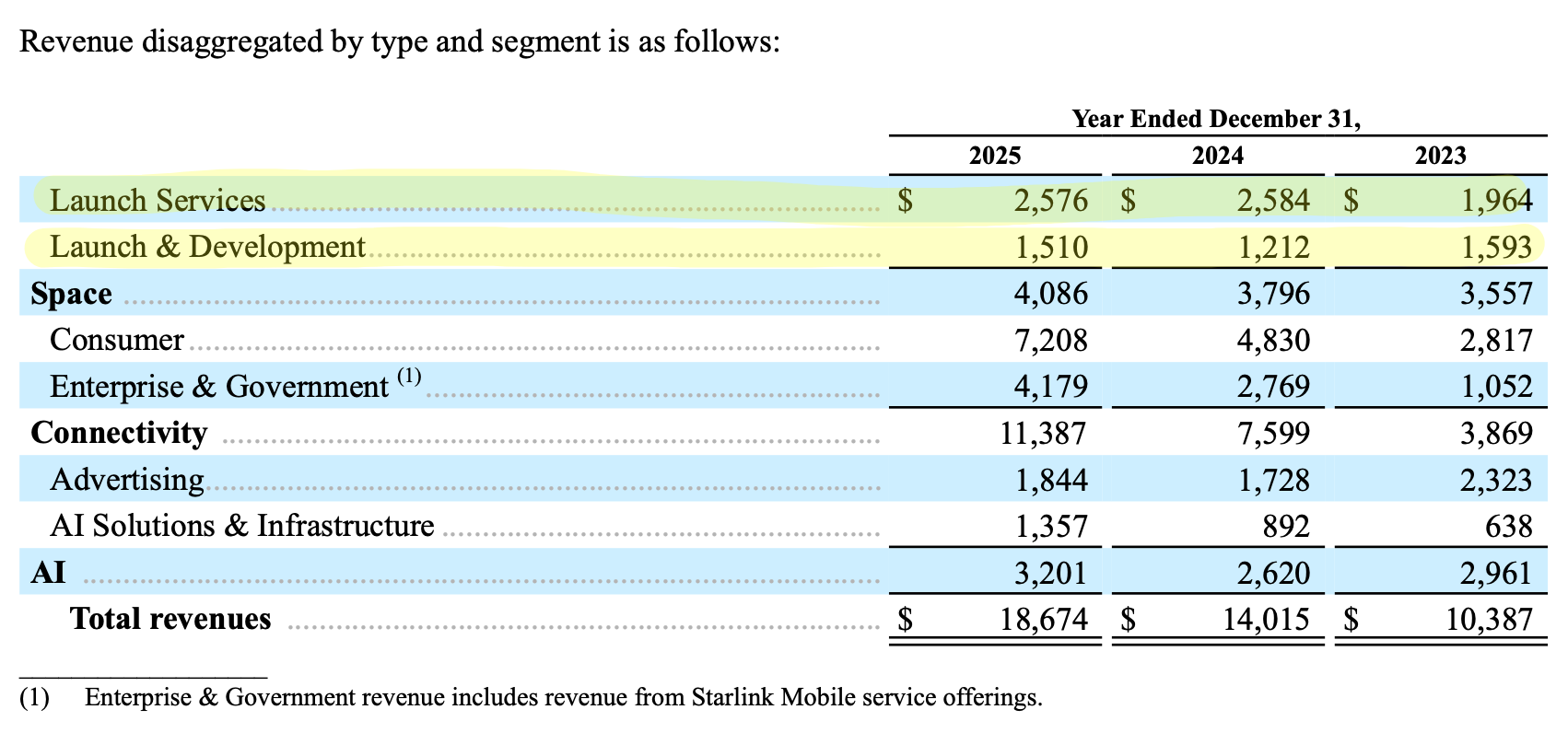
LS revenue is primarily commercial and government customers that need to get payloads into space, while L&D revenue represents more complex missions that require bespoke spacecraft, such as getting astronauts to the International Space Station.
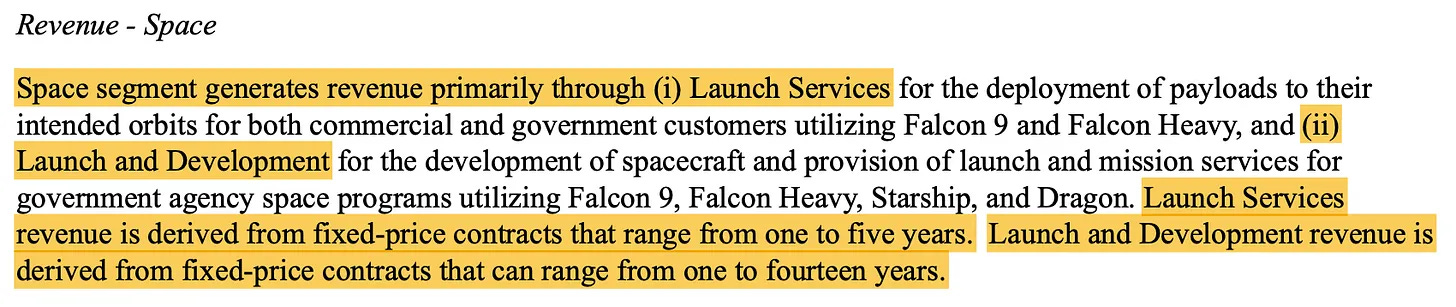
Compared to the combined company’s $18.7 billion in revenue, $4.1 billion seems very small for the segment the company was built on and that has the widest moat. The reason for this is that of the 170 flights SpaceX carried out in 2025, the marjority were missions carrying the company’s own Starlink satellites.
Another way to think about this is that SpaceX has made spaceflight so cheap and efficient that there is now an oversupply of available launches. Instead of grounding its rockets, the company decided to find something productive to do with them: launching batches of internet satellites into orbit, which is the Connectivity segment.
Business 2 | Connectivity (Starlink)
The Connectivity segment sells internet service, similar to other Internet Service Providers (ISPs) such as Cox, AT&T, and Verizon, to consumers, companies, and gevernments.
Consumers buy a Starlink Kit which allows them to connect to Starlink satellites and pay a monthly subscription for access, While commercial customers install Starlink equipment in aircraft, ships, rigs, and remote sites to enable high speed internet where it is otherwise inaccessible. Governments also use Starlink for secure and reliable connections that cannot be sabotaged as easily as physical infrastructure down here on Earth.
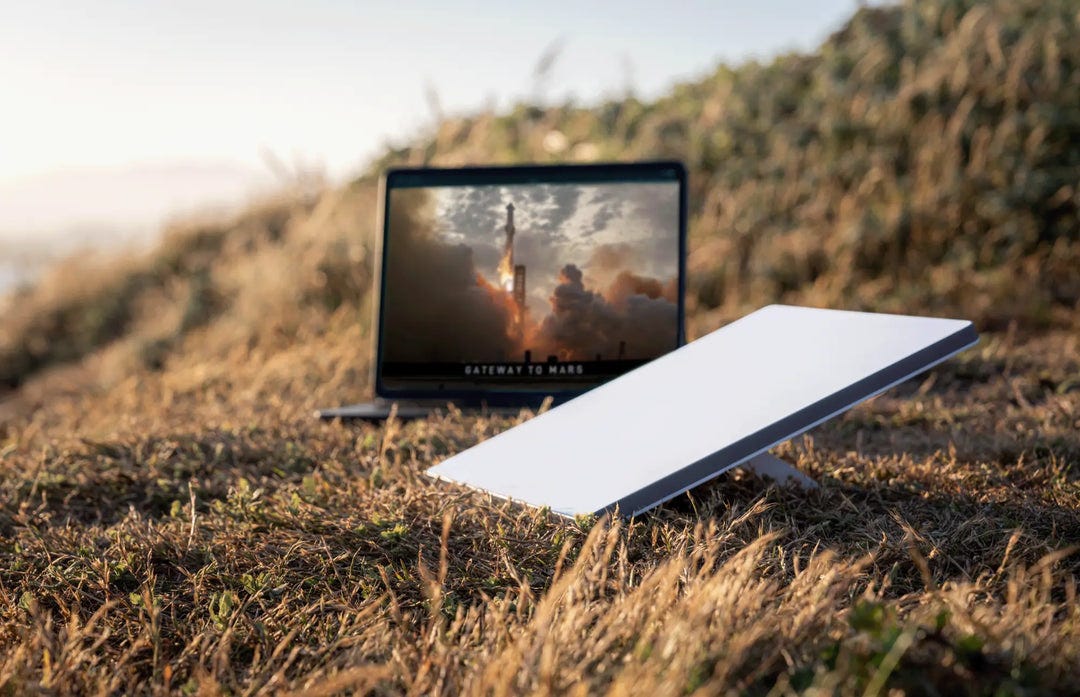
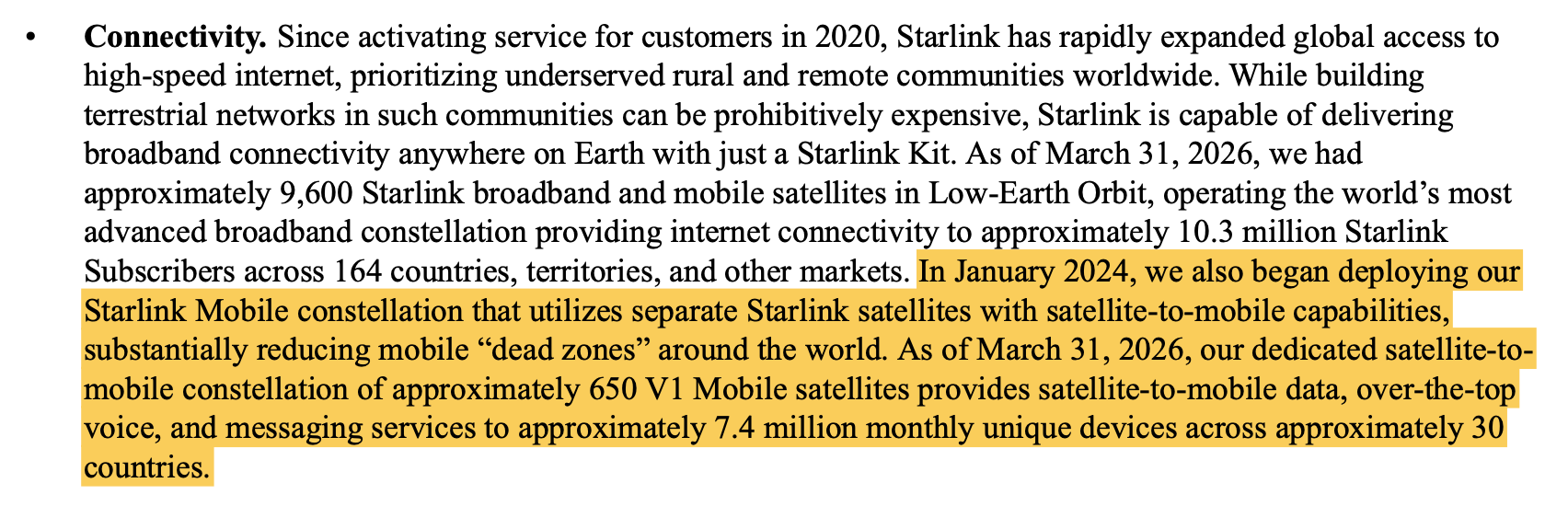
SpaceX has also launched a newer constellation called Starlink Mobile, which connects ordinary phones directly from orbit, serving ~7.4 million monthly devices across ~30 countries as of Q1 2026. Currently, this service only supports low-bandwidth activity such as emergency services, bridge-coverage for select carriers when customers have no signal, and standard text messaging. Future constellations are planned to enable higher speed voice and data capabilities.
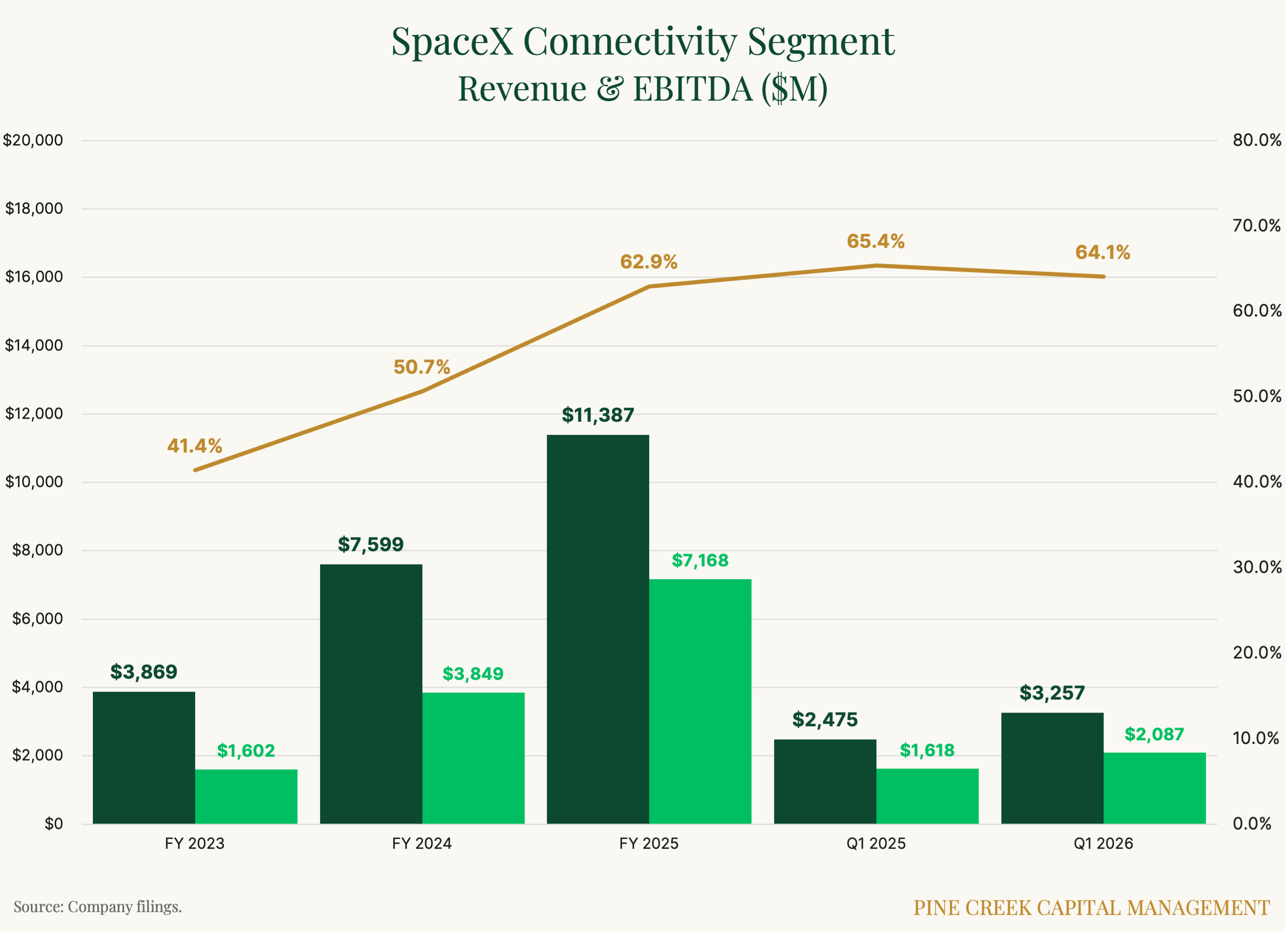
In total, the Connectivity segment generated $11.4 billion of revenue in 2025, up 50% from 2024 Connectivity revenue of $7.6 billion. This growth is driven two vectors: Subscribers, and Average Revenue Per User (ARPU).
Subscribers: Starlink ended Q1 2026 with 10.3 million subscribers across 164 countries, a 2x increase from 5 million in Q1 2025.
ARPU: Monthly revenue per subscriber fell from $86 to $66 over the same year, down from $99 in 2023. This is intentional, as Starlink expands into markets outside North America which command lower prices in USD, with the trend expected to continue.
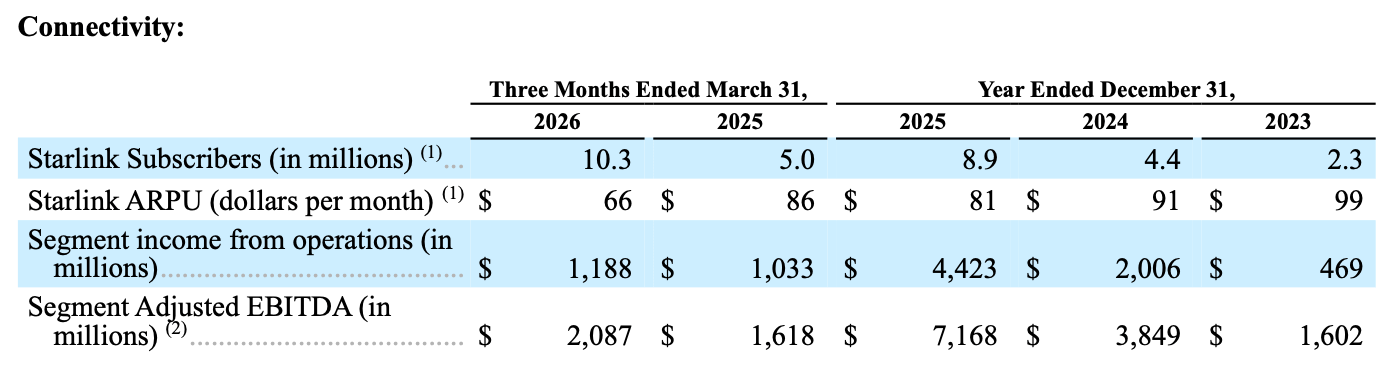
With Subscribers doubling every year while ARPU only marginally softens, Connectivity is, in our view, the crown jewel of SpaceX. As it stands, the company is a hypergrowth internet service provider with a massive opportunity to displace the existing global communications market in nearly the same way it reinvented space transportation. There is no other company on Earth that can launch communications satellites into orbit as cheaply, frequently, and efficiently as SpaceX.
This combination of scale and efficiency enables Connectivity to post incredibly high profit margins, with Segment Adjusted EBITDA Margin in the mid-60% range in the past year.
However, some would argue that Connectivity is actually the most “boring” piece of SpaceX’s business, and that the real crown jewel is the AI segment.
Business 3 | AI (LLMs, Data Centers, and Twitter)
The AI segment is the combined operations of xAI and X (formerly Twitter), and it has two primary ways of generating revenue:
Advertising on X (aka Advertising)
Subscriptions to Grok and renting out data center capacity (aka AI solutions and infrastructure)

In 2025, these businesses generated $3.2 billion in revenue. Despite the hype behind AI and data centers, the majority of this revenue came from selling advertising space on X to the tune of $1.8 billion in 2025. The other $1.4 billion came from AI solutions and infrastructure.
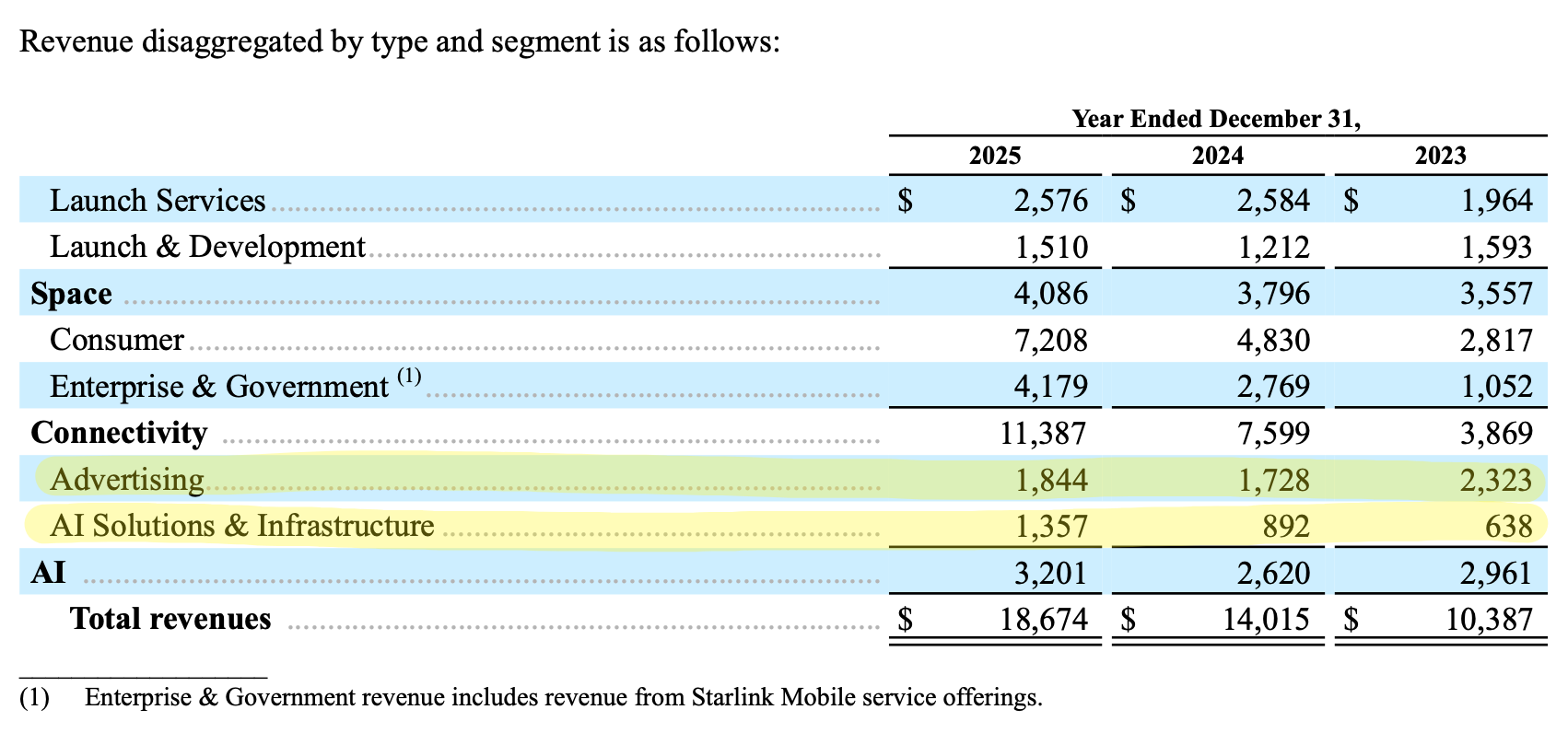
Here we find a wrinkle in SpaceX’s S-1 disclosures. How much of AI Solutions & Infrastructure are consumer subscriptions to Grok and X Premium, and how much comes from actually renting out data center capacity?
From 2024 to 2025, AI Solutions & Infrastructure revenue grew $465 million. The S-1 explains what is driving this:
The increase in AI solutions and infrastructure revenue is mainly due to an increase in X and Grok subscription revenue of $365 million and an increase in revenue from data licensing arrangements of $88 million.
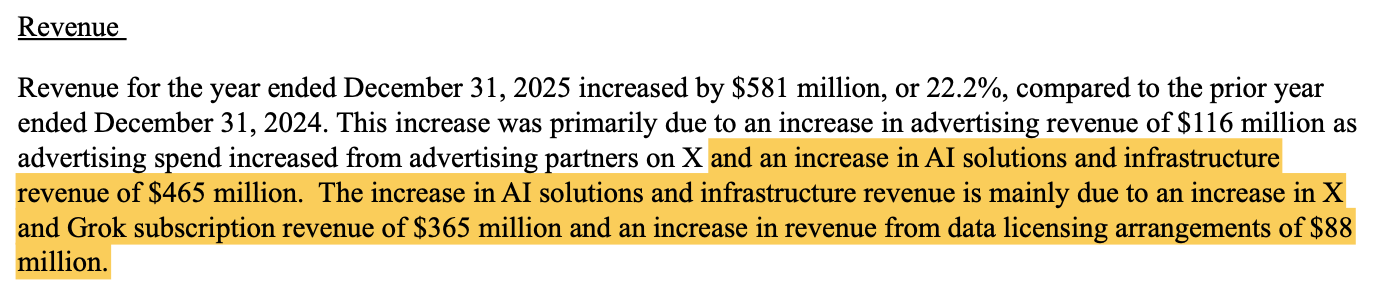
Put another way, SpaceX’s revenue grew ~$4.7 billion from 2024 to 2025. Of that, $0.088 billion came from AI-related data licensing arrangements. Normally this would not be an issue, it is completely normal for companies to invest in small, fast-growing new business lines. In SpaceX’s case however, AI is the primary driver of the company’s record shattering valuation.
According to the S-1, SpaceX’s Total Addressable Market (TAM) is $28.5 trillion, or about 25% of global GDP. $26.5 trillion of this figure, or 93%, is “Enterprise Applications” which just another way of saying “AI.”
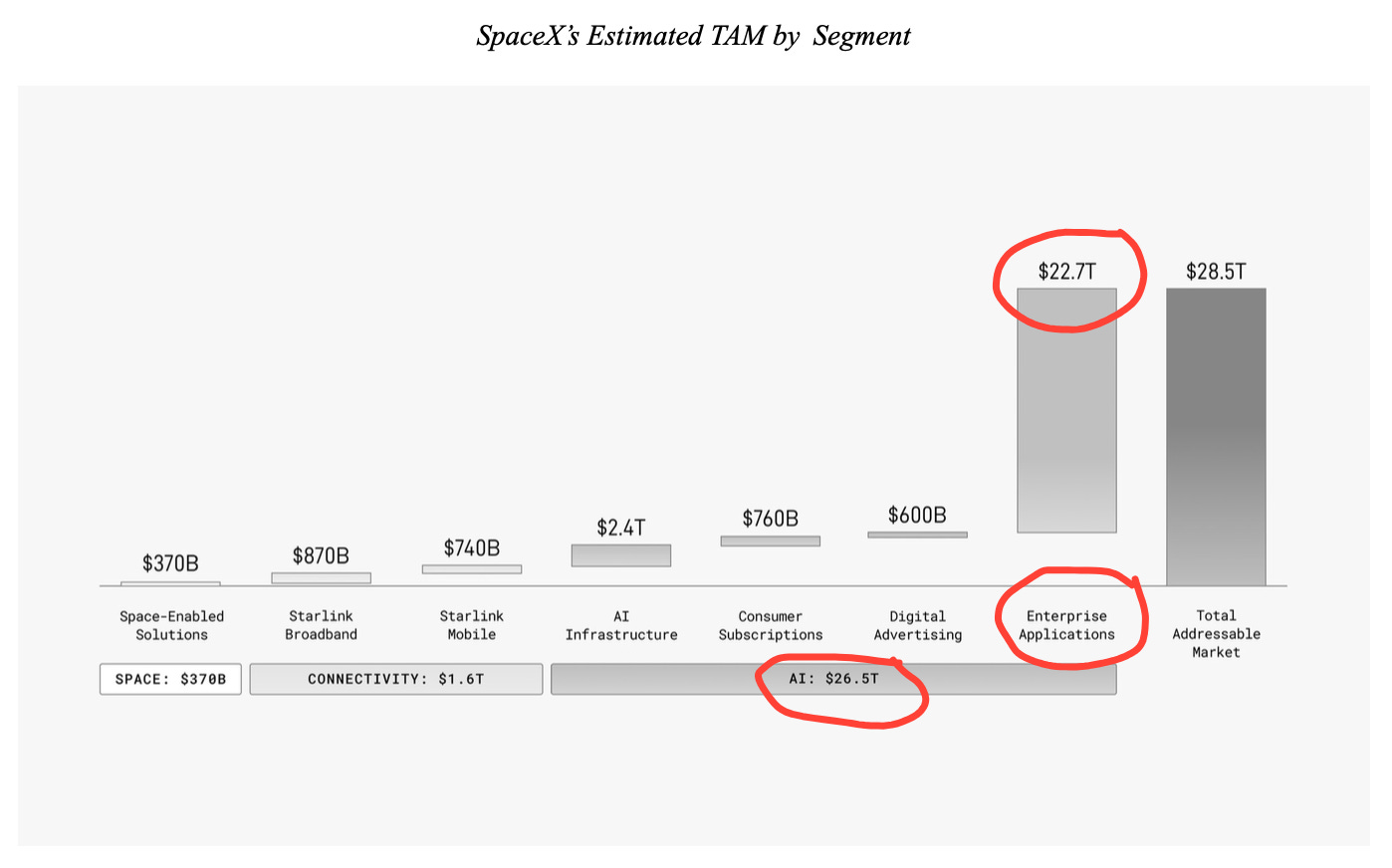
The filing elaborates:
Consumer and Enterprise Applications. We leverage our leading frontier models and compute infrastructure to deliver consumer and enterprise applications. In under six months, we developed Grok Voice, a real-time speech engine, including in multilingual performance. Our image and video generation system, Imagine, produced approximately 10 billion images and over 2 billion videos per month, on average, for the quarter ending March 31, 2026. Together with Tesla, we are also developing Macrohard, an agentic AI platform designed to be capable of fully emulating digital workflows and augmenting human operation of computers—from coding and product development to management and entire business processes—using sophisticated autonomous agents. We believe Macrohard will have the potential to fundamentally transform how companies are structured and operate, thereby allowing dramatic increases in human productivity. In addition, we believe our existing government relationships and track record as large government contractors are a structural advantage as governments become significant consumers of AI applications.
In summary, SpaceX would have investors believe that it is chasing a $26.5 trillion market opportunity which last year added $0.000088 trillion of revenue.
Of course, we are ignoring some real AI revenue, which are Grok subscriptions. But SpaceX makes it impossible to distinguish how much of AI Solutions & Infrastructure revenue is from these subscriptions. They do, however, provide the total number of Grok and X Premium subscribers.
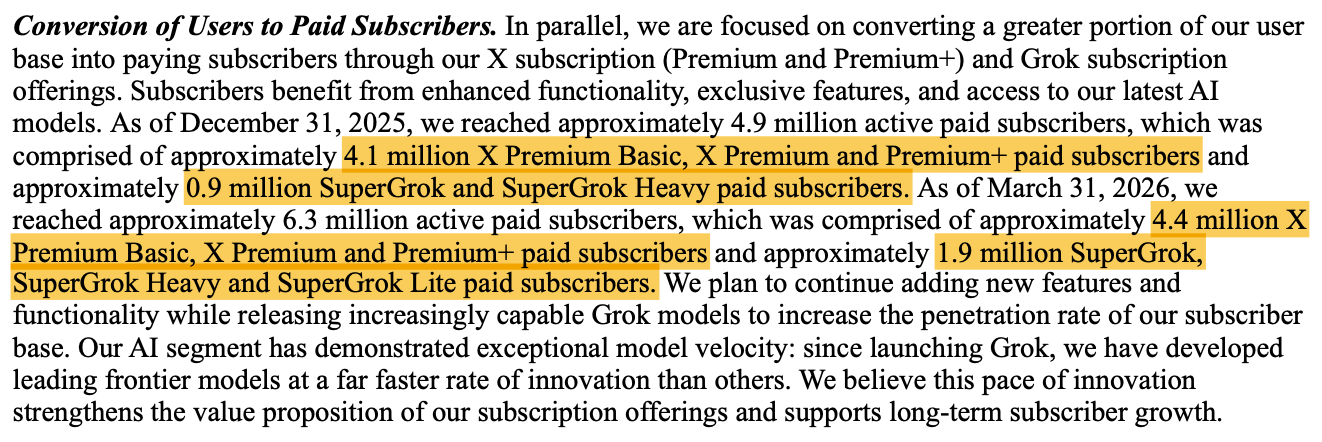
In our view, this is likely because a portion of this revenue is padded with X Premium subscriptions, whose users pay a monthly subscription to eliminate ads from their social media experience. Since these subscriptions are in lieu of advertising revenue, they should be included in Advertising revenue, not in AI Solutions & Infrastructure.
Of course, SpaceX is likely aware of the optics of claiming a massive global TAM driven by AI while having very little AI revenues. So it makes sense that the company would announce multiple AI-related deals as it came to market.
Anthropic
Five weeks before trading began, SpaceX announced a deal with Anthropic which it disclosed in the S-1. From the filing:
…in May 2026, we entered into Cloud Services Agreements with Anthropic…capacity provided includes approximately 325,000 NVIDIA GPUs, backed by hyperscale-class CPUs…[Anthropic] has agreed to pay us $1.25 billion per month through May 2029…the agreements may be terminated by either party upon 90 days’ notice.
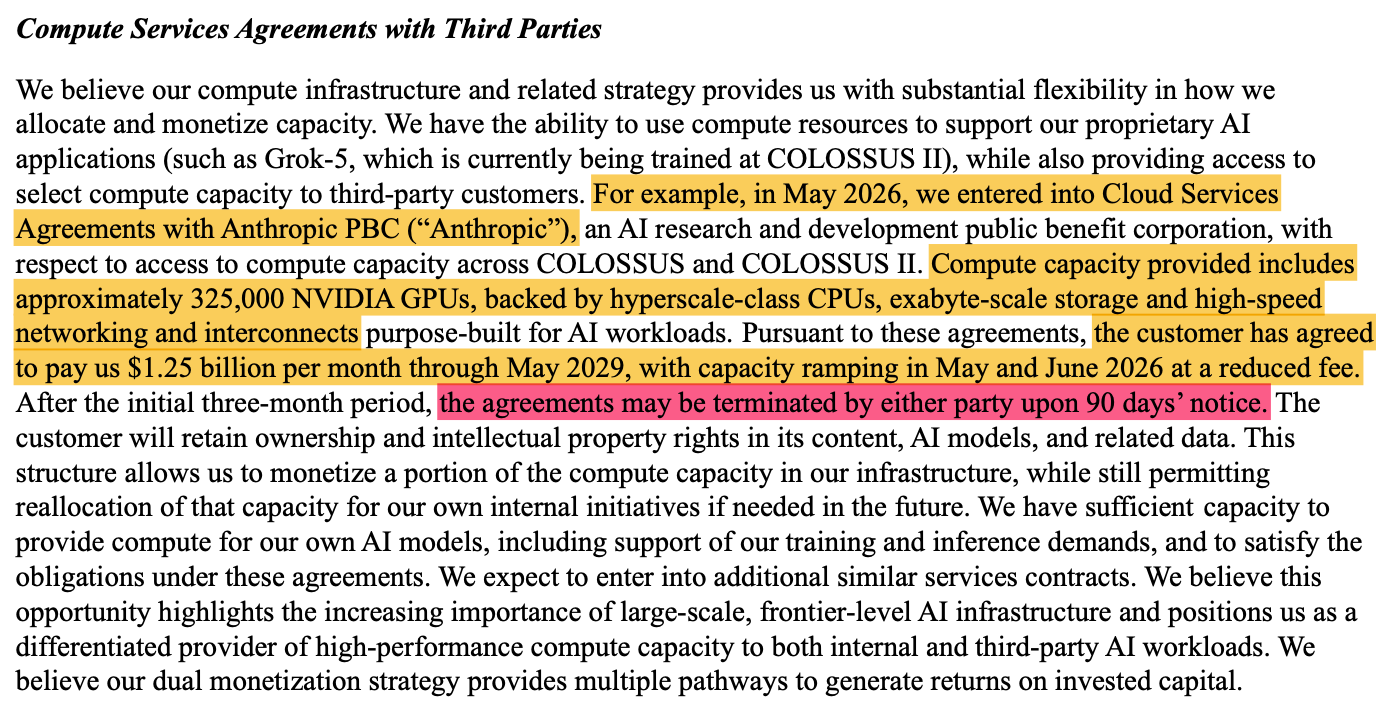
Now that’s more like it; however, the standout is the 90-day termination policy. While $1.25 billion per month is incremental, this revenue is nowhere near as sticky as space launch contracts up to 14 years in duration.
Google
SpaceX must have realized that wasn’t enough, so one week before trading, the company announced a similar deal with Google.
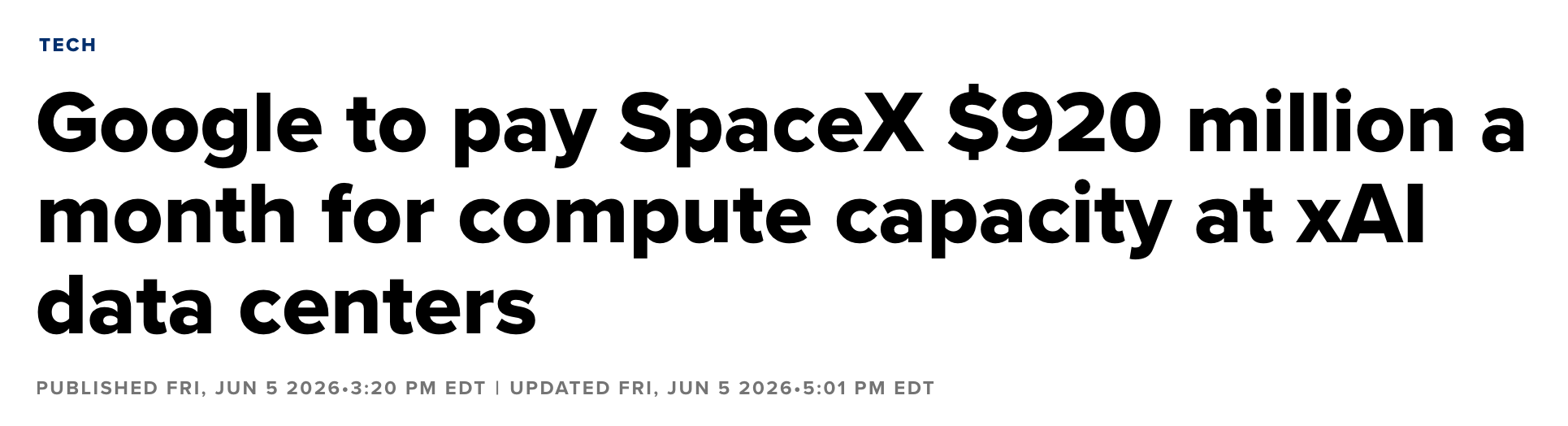
From the disclosure filed with the SEC:
“On June 5, 2026, we entered into a Cloud Service Agreement with Google LLC…capacity provided includes approximately 110,000 NVIDIA GPUs…the customer has agreed to pay us $920 million per month from October 2026 through June 2029…After December 31, 2026, the agreement may be terminated by either party upon 90 days’ notice.
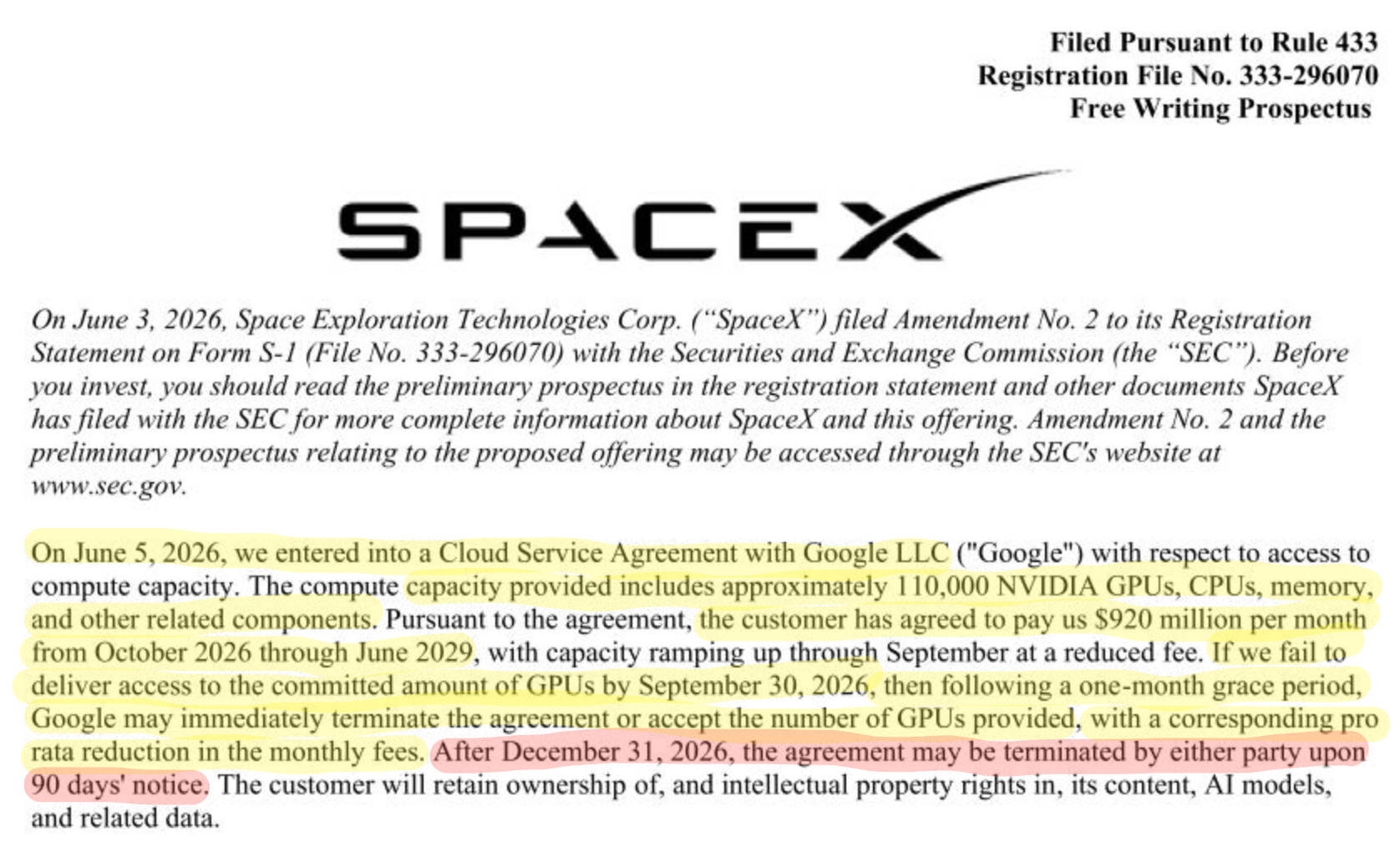
As with the Anthropic agreement, we can see that these revenues are not sticky, and SpaceX will have to compete with every other hyperscaler and neocloud company building data centers with the latest generations of GPUs and related hardware.
Cursor
Finally, we have the Cursor acquisition, which has a pre- and post-IPO development. From the S-1, in a section titled “Collaboration with Cursor:”
In April 2026, we entered into a compute and option agreement with…Cursor…Under the compute agreement, we will provide Cursor with certain GPU cluster compute capacity…With the option agreement, we have the right, but not the obligation to acquire Cursor at a predetermined price or pay a fee.
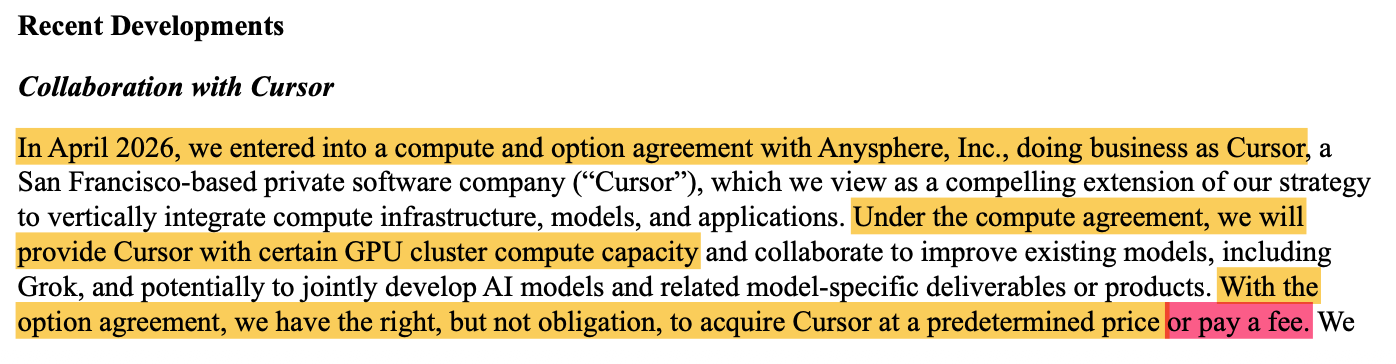
Wait, wait… “pay a fee?” This does not sound like a typical “option” or a true “collaboration.” This is structured like an in-flight acquisition agreement with a breakup fee. The filing elaborates:
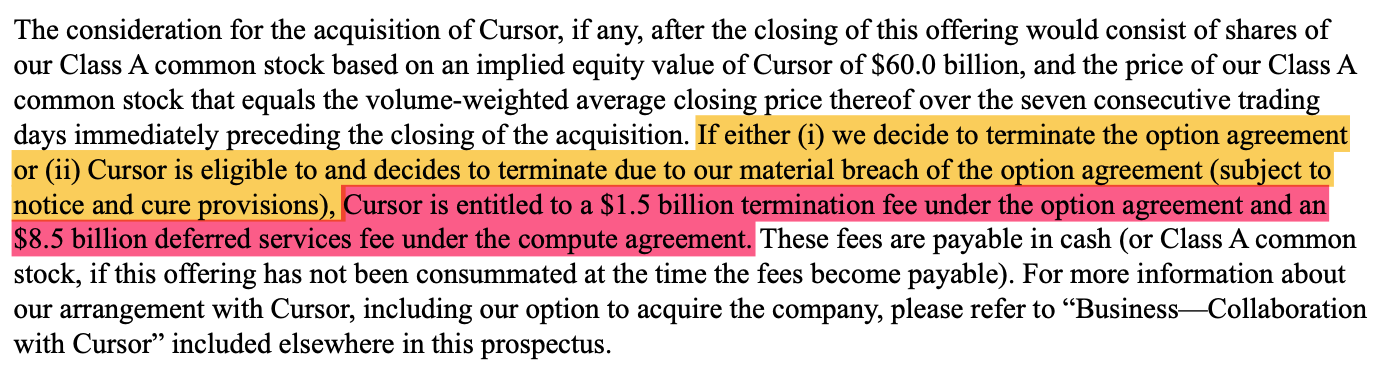
If either (i) we decide to terminate the option agreement or (ii) Cursor is eligible to and decides to terminate due to our material breach of the option agreement (subject to notice and cure provisions), Cursor is entitled to a $1.5 billion termination fee under the option agreement and an $8.5 billion deferred services fee under the compute agreement.
A $10 billion breakup fee if either side walked away from this deal…that is more than all of SpaceX’s AI segment revenue from 2023 through 2025. This is definitely not much of an “option” or a “collaboration,” it really is an acquisition deal.
It was no surprise then when SpaceX announced they would be exercising their “option” to acquire Cursor at the predetermined $60 billion valuation. Kudos to Cursor for the deal of the decade!
While it is admirable that SpaceX is doing something AI-related by shoving $90 billion worth of deals in at the 1 yard line, keep in mind that $60 billion of that is an outflow to purchase an AI-coding tool! Granted, the purchase is in stock, but in the grand scheme of things SpaceX dug themselves a $30 billion AI hole right as it went to the public markets.
We have spent some time discussing SpaceX’s AI segment, and there is much more to discuss. However, their earnings drop imminently, and we will inevitably have to update our thesis based on what SpaceX reports this week.
By now, we have developed a comprehensive understanding of SpaceX as a company: where it came from, how it has evolved over time, its three major business lines, how they make money, and our thoughts and analysis with respect to the AI business specifically.
Let’s now answer the million dollar question: Given the information we have from the IPO, how much is SpaceX worth?
