


Hello Investors,
This week interest rates took center stage.
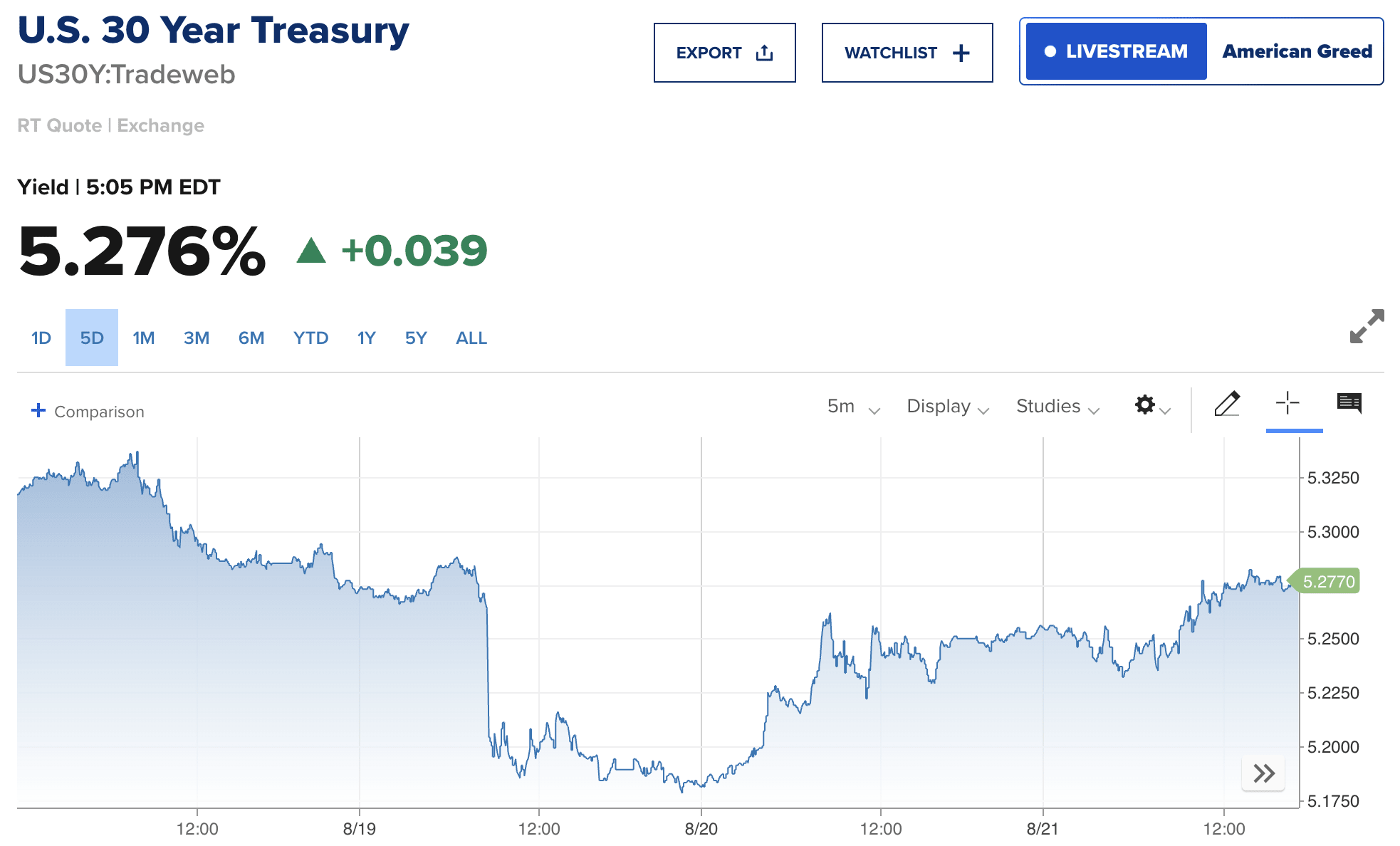
Rates on long-term yields have continued rising amid a worsening fiscal outlook for the United States, and prolonged conflict in the Middle East leading to elevated oil prices and, in turn, inflation expectations.
By the middle of the week, Treasury Secretary Scott Bessent decided enough was enough. He was going to personally lower long-term interest rates by increasing the amount of long-term bonds the Treasury buys. This increased demand is meant to push bond prices up, which in turn brings yields down.

And for a minute, it worked. Following the announcement, the 30-year Treasury Yield dropped sharply before steadily reclaiming its lost ground by the end of the week.
What Bessent is doing is known as Yield Curve Control, a process by which the government attempts to force interest rates to change at certain levels. In this case, the government wants interest rates to come down so that it can continue borrowing more and more money.
For better or for worse, it will not work, and this plan will likely backfire in uncomfortable ways. The reason this won’t work is the market is too big for the government to influence. Bessent announced an additional $2 billion in purchases of long-dated Treasuries. The total US Treasury market is ~$32 trillion. $2 billion is a drop in the bucket.
And in making this move, the government has shown their cards: they are concerned about interest rates. Attempting to intervene shows weakness, and the market will capitalize on that. This will likely lead to even higher interest rates and a weaker dollar as investors pull money away from the US.
If there were ever a time for the “Sell America” trade, it’s probably now.
On to the update!
-Brian
By the Numbers
Equities
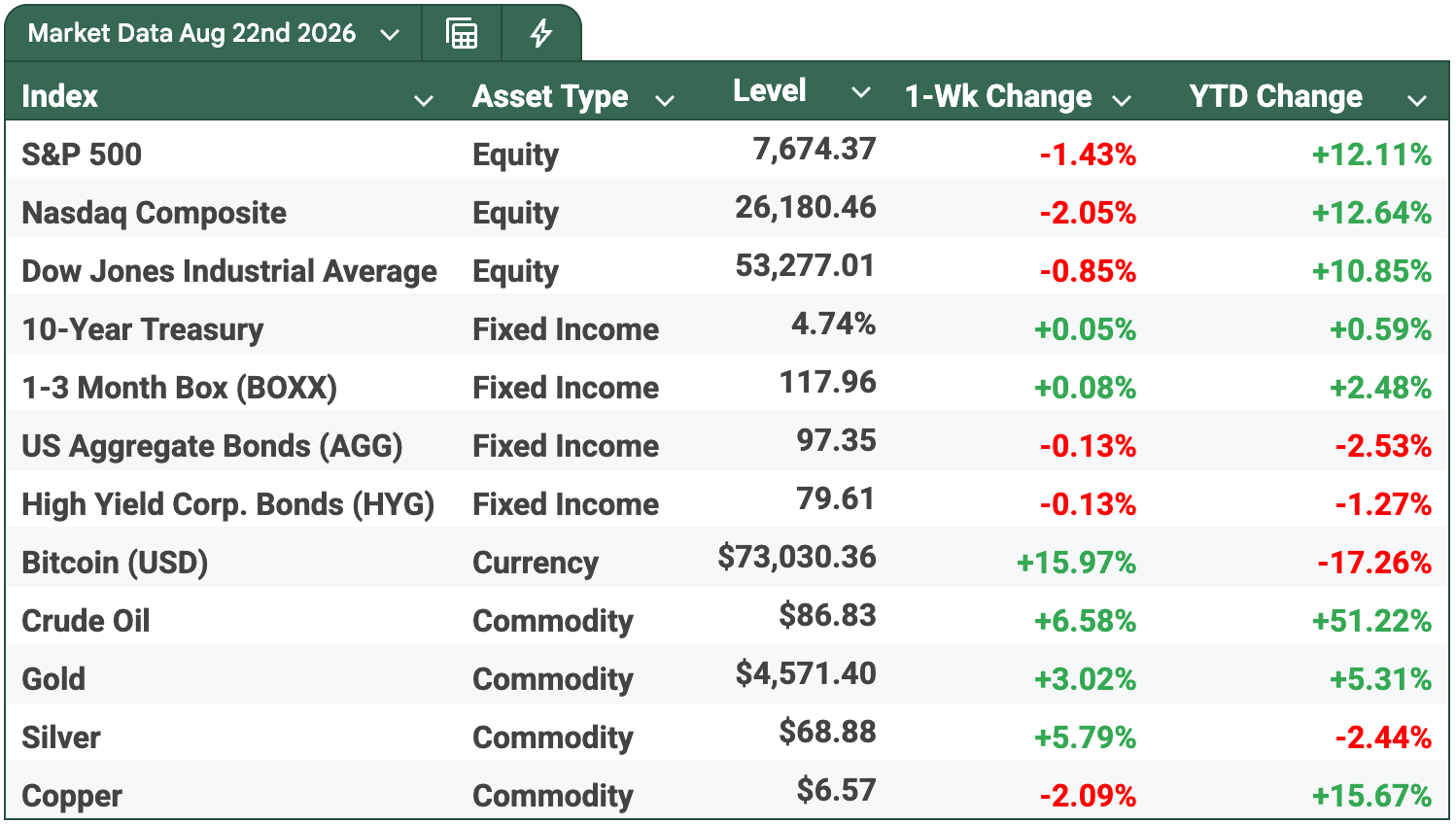
Stocks posted their worst week in months as investors rotated out of AI-stocks and into value stocks. The S&P 500 fell 1.43% while the tech-heavy Nasdaq dropped 2.05%. The Dow on the other hand fell a more modest 0.85%.
There was no one specific piece of news that drove this decline. Throughout the week, the situation in Iran has continued to deteriorate. At the same time, U.S. total debt surpassed $40 trillion, and long-term government bond yields continued their march higher. None of these developments individually sparked the decline in equities. Rather, there seemed to be a risk-off move as investors reallocated away from high growth AI-adjacent names and into value stocks. I called this the “Michael Burry Trade” on X.


The Michael Burry trade refers to being short AI-related stocks and long value stocks. This is a general theme that I have applied in our fund here at Pine Creek Capital, and this week it has been rewarded. There is a broader trend here worth noting here though, and that is the rotation between Growth and Value stocks.
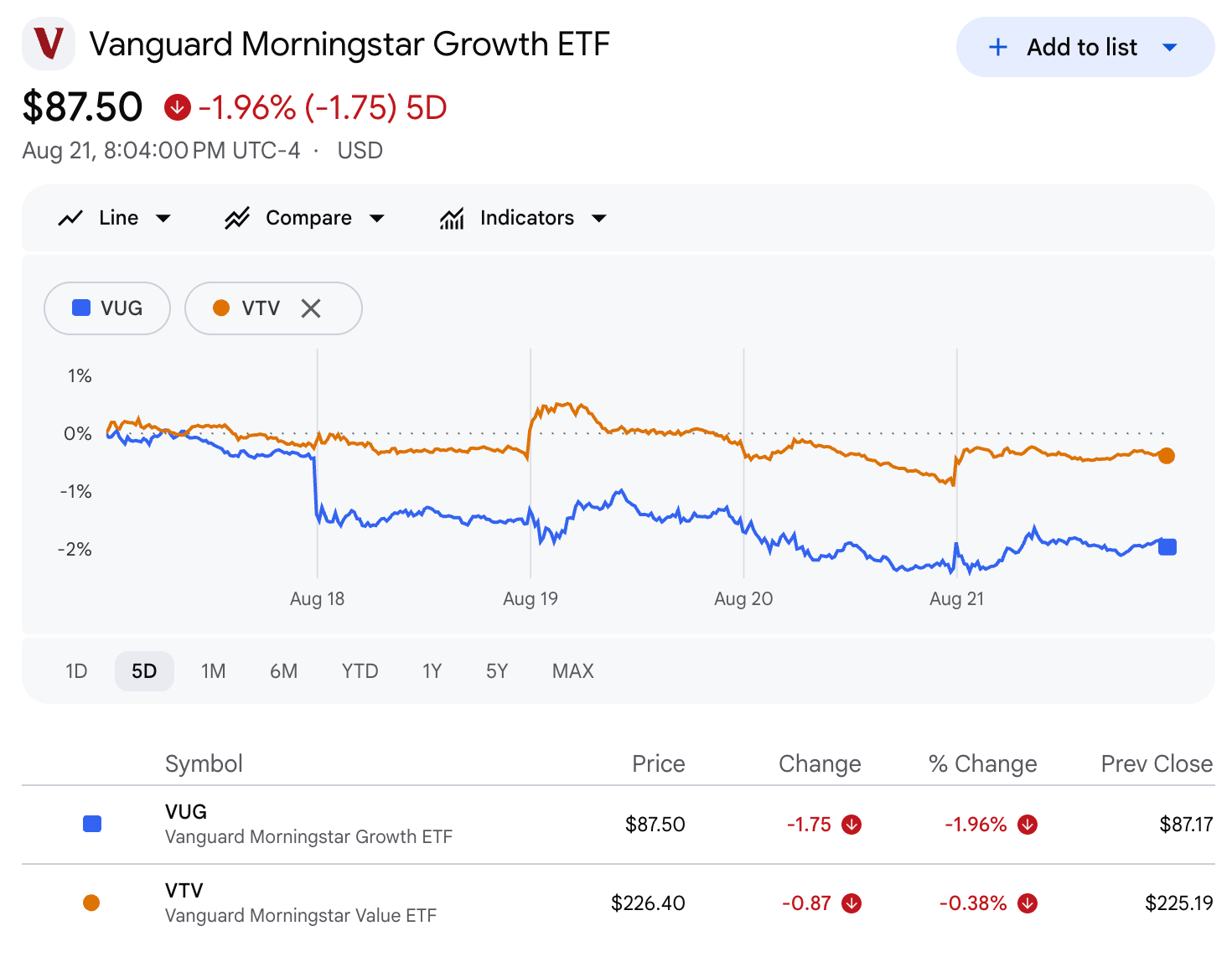
Below, I’ve posted the past 5 trading days of VUG, one of the leading Growth ETFs, and VTV, its Value counterpart. Here there is a clear divergence between the two starting on April 18th, with similar moves during the AM sessions each day since.
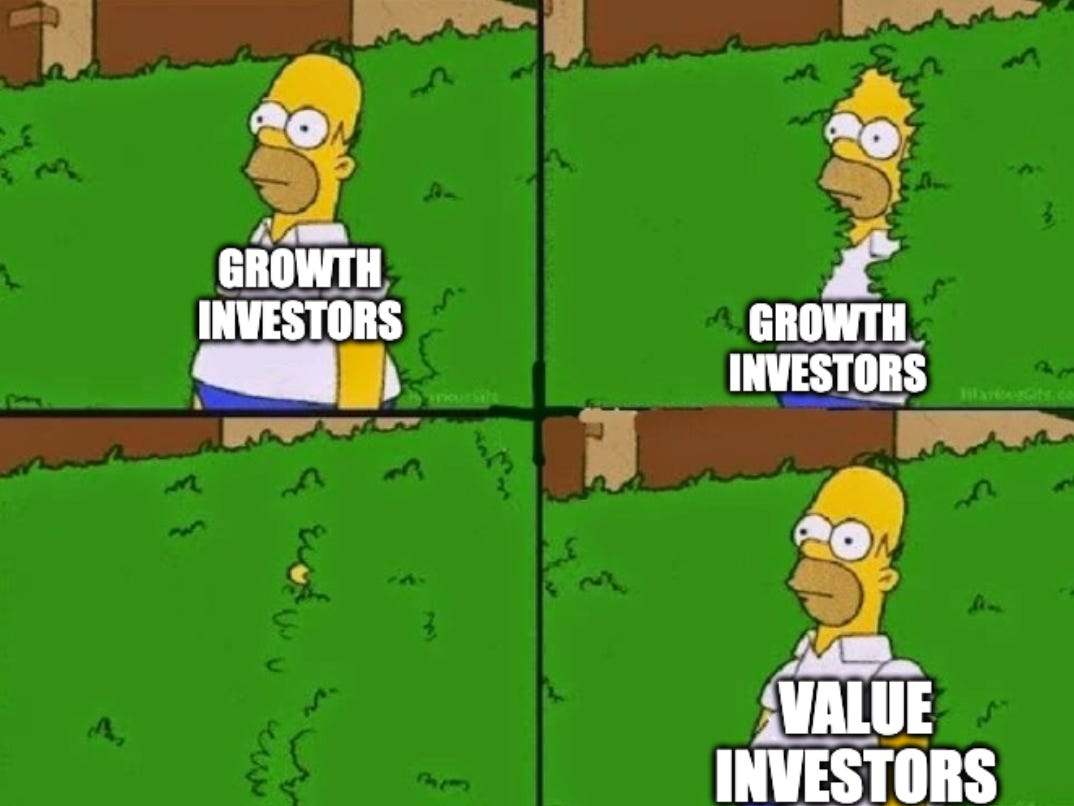
This trend has ebbed and flowed throughout the year, first peaking around April when it then reversed in favor of Growth, and later resuming in June. As shown in the chart below, Value stocks (as measured by the ETF VTV) are outperforming their Growth counterparts by ~11% this year.
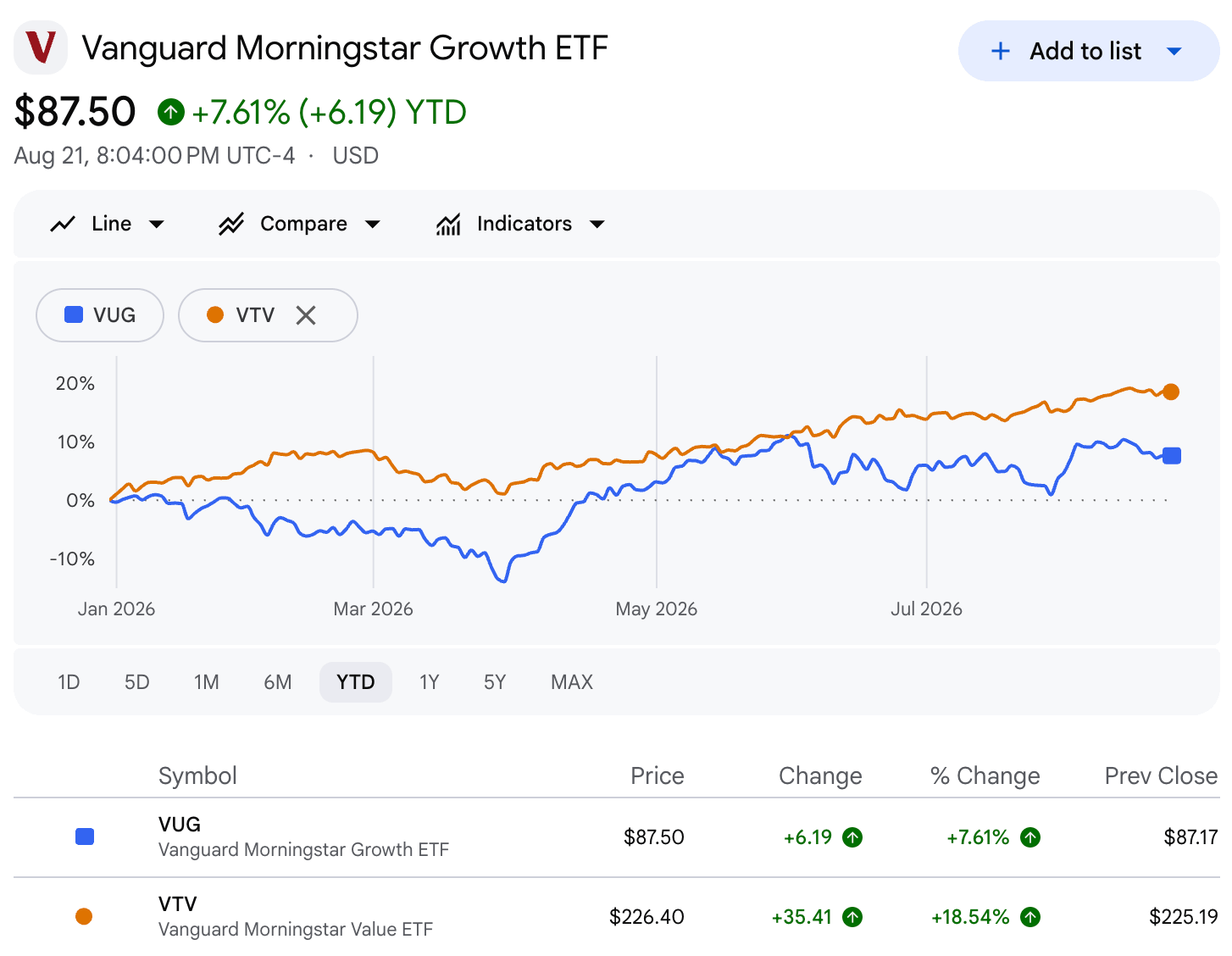
This is a trend that has gone virtually unnoticed, and I believe it speaks to the general nature by which the AI Trade is fading. Rather than a bubble that violently pops, it’s more like a balloon that is slowly but surely losing air. More and more investors are slowly backing away from heavy AI exposure, especially after witnessing the historic collapse of the hedge fund Situational Awareness.
Increasingly, I am seeing attention (and capital) shift from high-growth and high-capex AI stocks to companies that are generating real profits and cash flows at historically low valuations. If this trend continues as I’ve described it, Pine Creek’s portfolio should continue to benefit from outsized returns across much of the long and short positions.
More broadly, my thesis with respect to equities is that:
Value will continue to outperform Growth, driven by investor sentiment softening on the AI buildout and higher interest rates requiring real returns on equity for shareholders (i.e. profitability > growth).
Ex-US will continue to outperform US, driven by continued isolationist policies stateside, leading capital that would have otherwise invested in the US to other developed (and emerging) countries.
Pine Creek remains well positioned to capitalize on this thesis, as we are generally long value, short AI, and long a number of stocks in China and Japan.
If you would like to follow Pine Creeks’s trades in real-time and view portfolio positions, consider becoming a paid subscriber at the link below.
Interest Rates
Interest rates increased notablly with the 10-Year Treasury Yield at 4.74% compared to 4.68% a week ago, just 0.01% from notching a new high for the year.
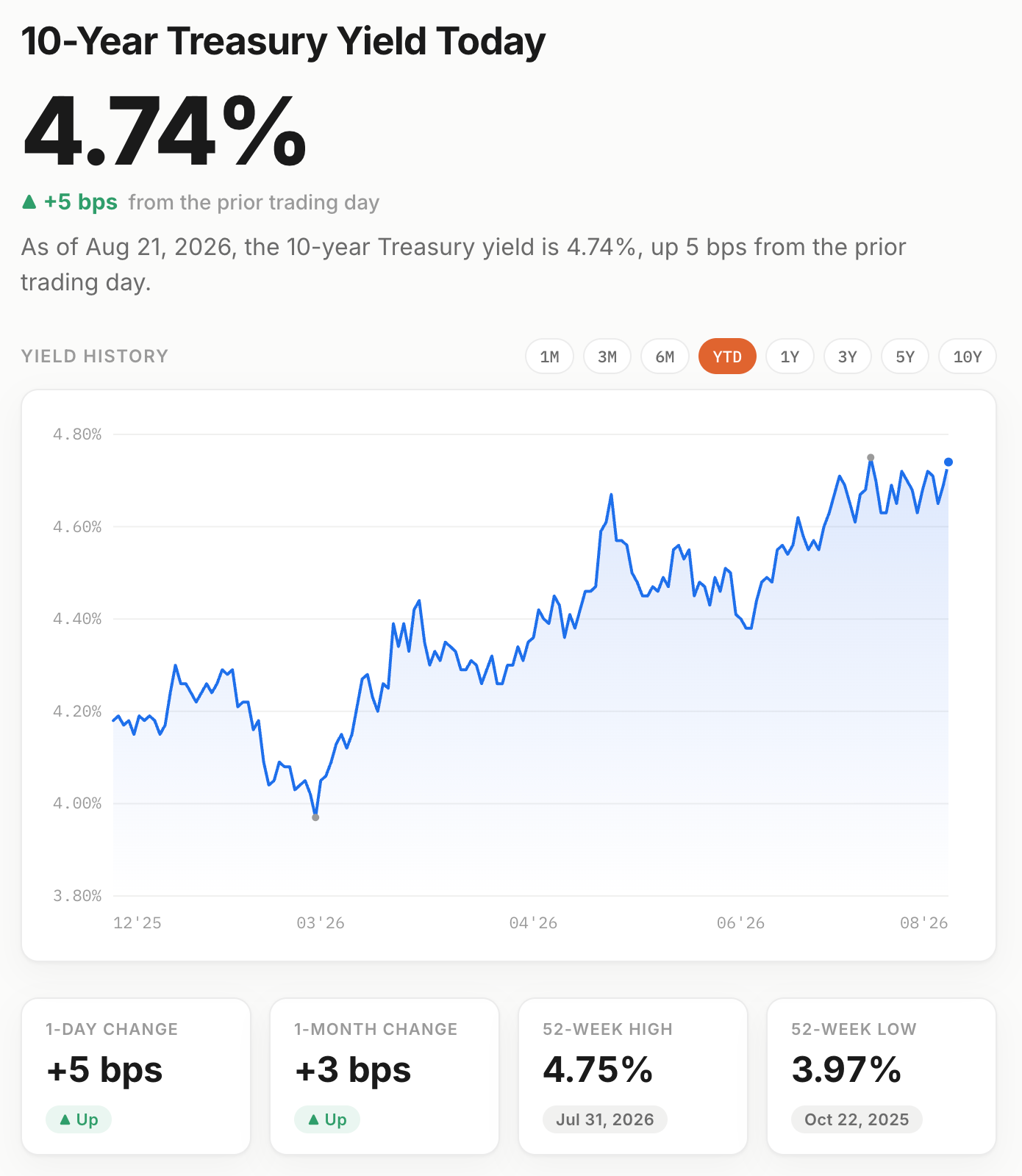
While this trend is in-line with my longstanding thesis that interest rates will continue to be higher for longer, there were a few key developments that helped boost rates further this week.
Total US Public Debt crossed $40 trillion for the first time in history
Treasury Secretary Scott Bessent attempted to directly drive long-term interest rates lower
The War in Iran has continued to escalate, increasing oil prices and, in turn, inflation expectations
In this letter, I discussed interest rates and what drives them. However, one way to think about interest rates intuitively is with respect to a mortgage. If a person were to apply for a mortgage and they have a bad credit score, they will likely be charged a high interest rate. This is because the low credit score is a signal to lenders that this person does not manage their finances well. On the other hand, a borrower with a strong financial profile and therefore good credit score will qualify for a lower interest rate because they are seen as low risk. The same can be said for companies and even countries.
If a country runs a balanced budget, has strong growth, and keeps total debt in check, it will attract lots of investors, keeping interest rates low. If a country runs steep deficits, racks up lots of debt, and has a lackluster economy, investors will pull back, increasing interest rates on that countries debt.
Of course, there is more to interest rates than just fiscal profile: Japan for example has lots of debt but low interest rates, and Norway has a budget surplus but rates on par with the US. In general though, a country with a declining fiscal profile will see its rates increase to compensate investors for the additional risk that comes with deficits and high debt levels. And that is exactly what the US is experiencing today.
Between historically high total debt, a persistent fiscal deficit, and high inflation weighing on the economy, it is no wonder that interest rates on longer-term US Treasuries are at levels not seen since the Great Financial Crisis.
With respect to US interest rates and fixed income, I remain of the view that rates and inflation will be higher for longer, leading to restrictive monetary policy, meaning that the Fed would rather raise interest rates than lower them. I continue to believe being overweight fixed income at short durations is prudent in the current environment.
Commodities
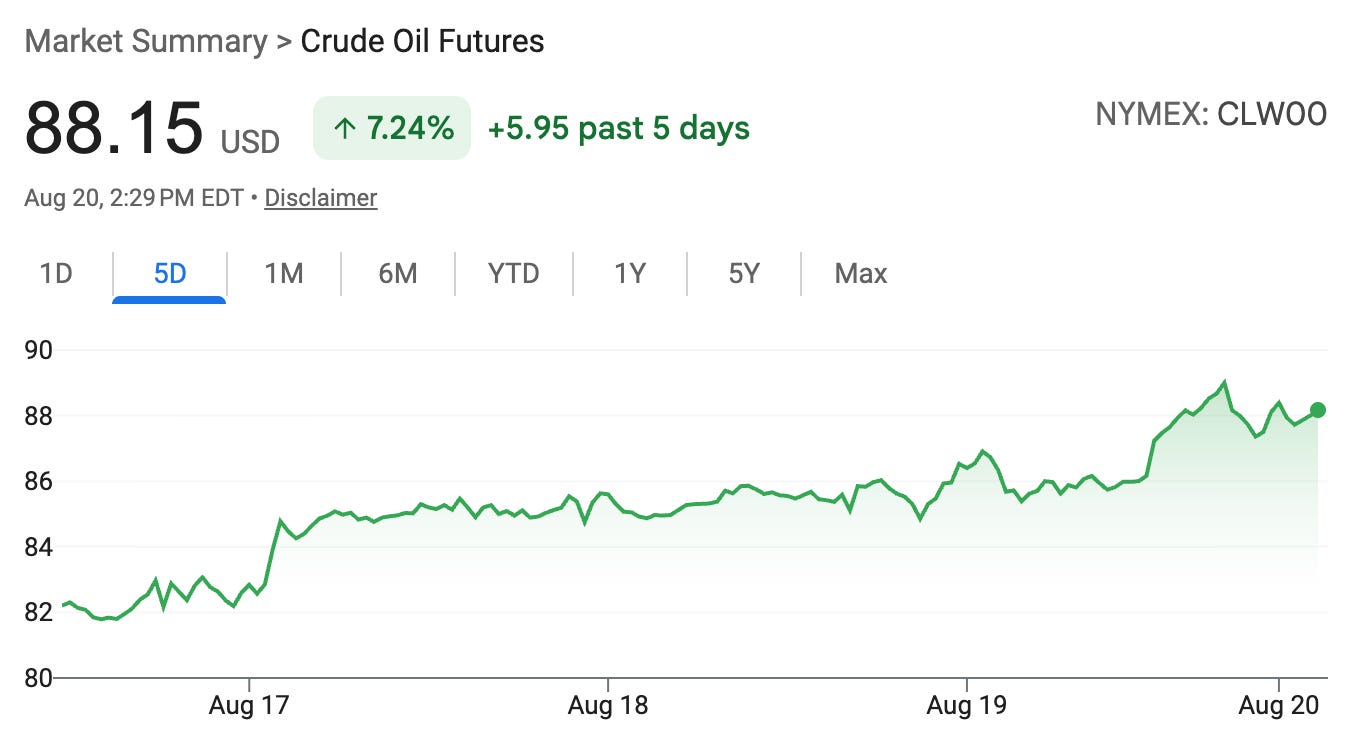
Crude Oil increased to $86.83/barrel, up 6.58% from the prior week, and is listed at $88.15 as of this writing on Saturday (figure shown in screenshot). This increase in oil prices comes as the US and Iran have dug in their heels and escalated their War with each other over the past few weeks.
In what seems increasingly like a losing battle, the US has announced a pivot from kinetic warfare (i.e. military strikes) to economic warfare via sanctions. From the Associated Press:
Nearing the six-month mark of the Iran war and facing diminishing stockpiles of key weapons, the Trump administration is touting a crushing financial campaign against Tehran, promising an “economic D-Day” against a country that has withstood nearly five decades of punishing American sanctions.
With sparse details, President Donald Trump announced this week that the U.S. would be imposing an “unprecedented” level of economic warfare and isolation on Iran, aiming to force its leadership to cave to demands to end its nuclear program and fully reopen the crucial Strait of Hormuz to oil and natural gas tankers.
This was largely expected, as I wrote in this letter on August 9th:
As we have laid out previously, we do not see a diplomatic offramp for the US unless it comes with unprecedented concessions. The only way out is through, and it seems clear to us that President Trump is loathe to pursue further military action. For what reason is another story entirely, though many speculate that the US has depleted a large portion of its missile supply.
I believe we are now in the endgame of the Iran War, and there are two major paths:
Abandon / Status Quo: We have seen President Trump previously sweep uncomfortable subjects under the rug; most recently being the Epstein Files (remember those?) In this scenario, the current economic standoff becomes the new status quo, and the news cycle moves onto something new. Iran retains control of the Strait, oil prices remain persistently higher for the foreseeable future, and the global economy is forced to adapt to this new paradigm.
Escalate: Door #2 involves resuming a full military operation in Iran. Troops are sent into the country in an attempt to overthrow existing leaders. The US gains control of Iran and the Strait, and later transitions control to a democratically-elected government.
Both of these options are uncomfortable, and all roads lead to higher for longer oil prices. As it stands today, however, there is no evidence for a cleaner diplomatic offramp, and Iran seems to be clearly in a position of strength at this point in the war.
I reiterate my longstanding thesis: I remain bullish on oil with a near-term target price of $100+ and a longer term floor of $65-$70 per barrel. PCCM does not hold a direct position in oil futures.
Gold and Silver increased 3.02% and 5.79%, respectively, while Copper fell 2.09%. The precious metals remain volatile as they are coming off historic highs and multiple competing pressures drive prices. My view remains unchanged: I believe Gold and Silver remain too volatile to hold exposure to, while Copper remains attractive as a critical metal for supply chains.
PCCM does not hold a position in any of the three metals.
Bitcoin increased sharply this week, up ~22% from ~$63,000 per coin to ~$77,000 per coin.
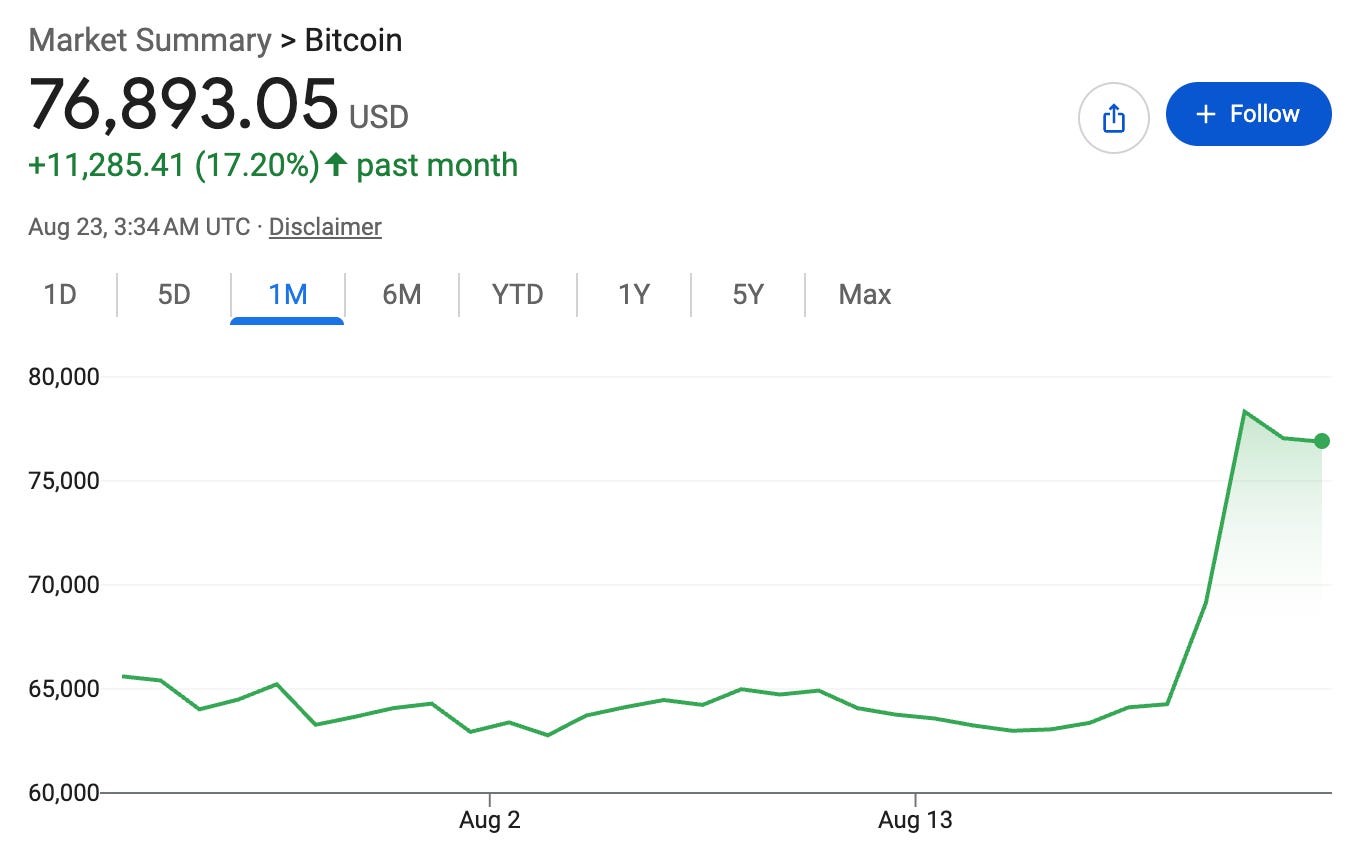
The move comes after President Trump hosted a digital asset summit where he urged Congress to pass the Clarity Act. As part of his remarks, the President hinted that certain members of the US government “talked about” accumulating Bitcoin as part of a strategic national reserve of the cryptocurrency. This sparked renewed enthusiasm in the speculative asset and sent its price up double digits.
It has been some time since I detailed my views on Bitcoin and similar currencies, so I will summarize them here. First, let’s talk about the reasons why Bitcoin supposedly has value:
Fixed Scarcity: There will only ever be 21 million Bitcoins, meaning that insitutions such as the Federal Reserve cannot print additional Bitcoin thereby causing it to “devalue” like the Dollar (allegedly).
Financial Sovereignty: Users are in control of their own currency, and there are no middlemen. Your Bitcoin are not held at an institution like a bank that can freeze your assets.
Growth Potential: Bitcoin is often cited as one of the highest returning assets, making it a better investment than stocks.
Each of these arguments is problematic, with one core contradiction to the bull case for Bitcoin:
The evidence that currency supply leads to devaluation is unclear, at best. This might sound counterinuitive, but printing more dollars doesn’t inherently make dollars worth less, primarily because of growth. Imagine you have an economy with 100 people and there is $100,000 of dollars in existence. $1,000 per person. If the central bank prints $100,000 and now there is $200,000, the curerncy has been “devalued,” right? There is now $500 per person. But what if the population has grown to 200 people, say through births and immigration? Well then there is still $1,000 per person. There are more dollars, but the economy is bigger. On the other hand, having a fixed supply of currency would cause problems. As the population grows, there is less and less currency to go around. New entrants to the economy find it hard to get the money they need to start businesses and create value, and growth is hindered. So Bitcoin having a “fixed supply” is not necessarily a good thing.
Also, who cares about Bitcoin’s supply of 21,000,000 when a) Bitcoins can be divided into incredibly small fractions, and b) there are countless other cryptocurrencies now in existence with varying amounts of supply? Supply is not, in fact, limited with respect to cryptocurrencies.
It might sound nice to not have your money in a bank, until you need the protections and services that a bank offers. Every few months we read about how millions of dollars in Bitcoin has been siphoned out of the digital wallets of unsuspecting people. In these instances, there is no recourse, no accountability. There is no FDIC insurance or 3rd party to be held responsible. Cryptocurrency is the wild west. Sure, legislation such as the Clarity Act could add much needed consumer protections, but that drives Bitcoin closer to become like the Dollar. A regulated asset that can be tracked, controlled, seized, revoked at any time.
The ultimate contradiction is the notion that Bitcoin is a good investment. The figures that are often cited are the appreciation of Bitcoin as measured in Dollars. I encourage you to read that sentence again, because it is easy to miss. If Bitcoin is supposed to have all this value that a “useless fiat currency” like the Dollar doesn’t have, why does it’s Dollar value mean anything? Is the plan to convert the world to Bitcoin, or is it to just hold Bitcoin, pump up the price, and exchange it for more Dollars in the future? The fact that Bitcoin is priced and measured in Dollars is the ultimate self-contradiction.
Therefore, my view is that Bitcoin is ultimately worthless and should really be viewed as a collectible. I believe it may retain some value as a piece of digital history, but with so many in existence and no differentiation between individual coins, it is unlikely that value will be very high.
Pine Creek Capital does not currently hold a position in BTC, or related cryptocurrency assets and stocks, and my long-term intrinsic value estimate of Bitcoin is $0.
Earnings & Data
This week brings Nvidia earnings, July PCE inflation, and the Jackson Hole symposium, where Chair Warsh delivers his first keynote Friday morning.
Earnings
Monday, (8/24):
AM: PDD, XPeng.
Tuesday, (8/25):
AM: Bank of Montreal, Scotiabank, Dick’s Sporting Goods.
PM: Intuit, Zoom, HEICO, Semtech.
Wednesday, (8/26):
AM: Abercrombie & Fitch, Kohl’s, Li Auto, Williams-Sonoma, J.M. Smucker.
PM: Nvidia, Salesforce, CrowdStrike, HP, Synopsys, Okta, Veeva.
Thursday, (8/27):
AM: Best Buy, Dollar General, Dollar Tree, Burlington, Royal Bank of Canada, TD.
PM: Marvell, Workday, Autodesk, Ulta, Affirm, Gap.
Friday, (8/28):
AM: Miniso.
Economic Data
Wednesday (8/26): July PCE inflation, personal income and spending, and the second estimate of Q2 GDP
Thursday (8/27): Initial jobless claims, Jackson Hole symposium begins.
Friday (8/28): Chair Warsh’s Jackson Hole keynote in the morning, University of Michigan final August sentiment and inflation expectations at 10:00 a.m. ET.
That’s all I had for you this week, let us know your thoughts by leaving a comment. You can also like this article via Substack to show your support.