


Hello Investors,
This week saw the market notch new all-time highs as the Trump administration signaled a deal with Iran would arrive as soon as Wednesday.
Wednesday came and went with no mention of this alleged deal.
In the meantime, the BLS reported jobs numbers well below analyst estimates, and CDS spreads for some of the largest AI-related companies sit near 2008 levels.
We believe that when equity markets are this frothy while bond markets are bracing for impact, investors should take caution.
In today’s update:
The earnings growth driving markets to fresh all-time highs are not what they seem.
The jobs market is cooling, which is pushing investors to pare down the probability of a rate hike in September.
Where the US and Iran stand today, and what this means for oil prices.
Also, a warm welcome to our newest subscribers! I hope that you find our content to be valuable to your investment process.
If you have any feedback about how we can improve our research, please shoot an email over to brian@pinecreek.capital
Let’s dive in!
-Brian
By the Numbers
Equities
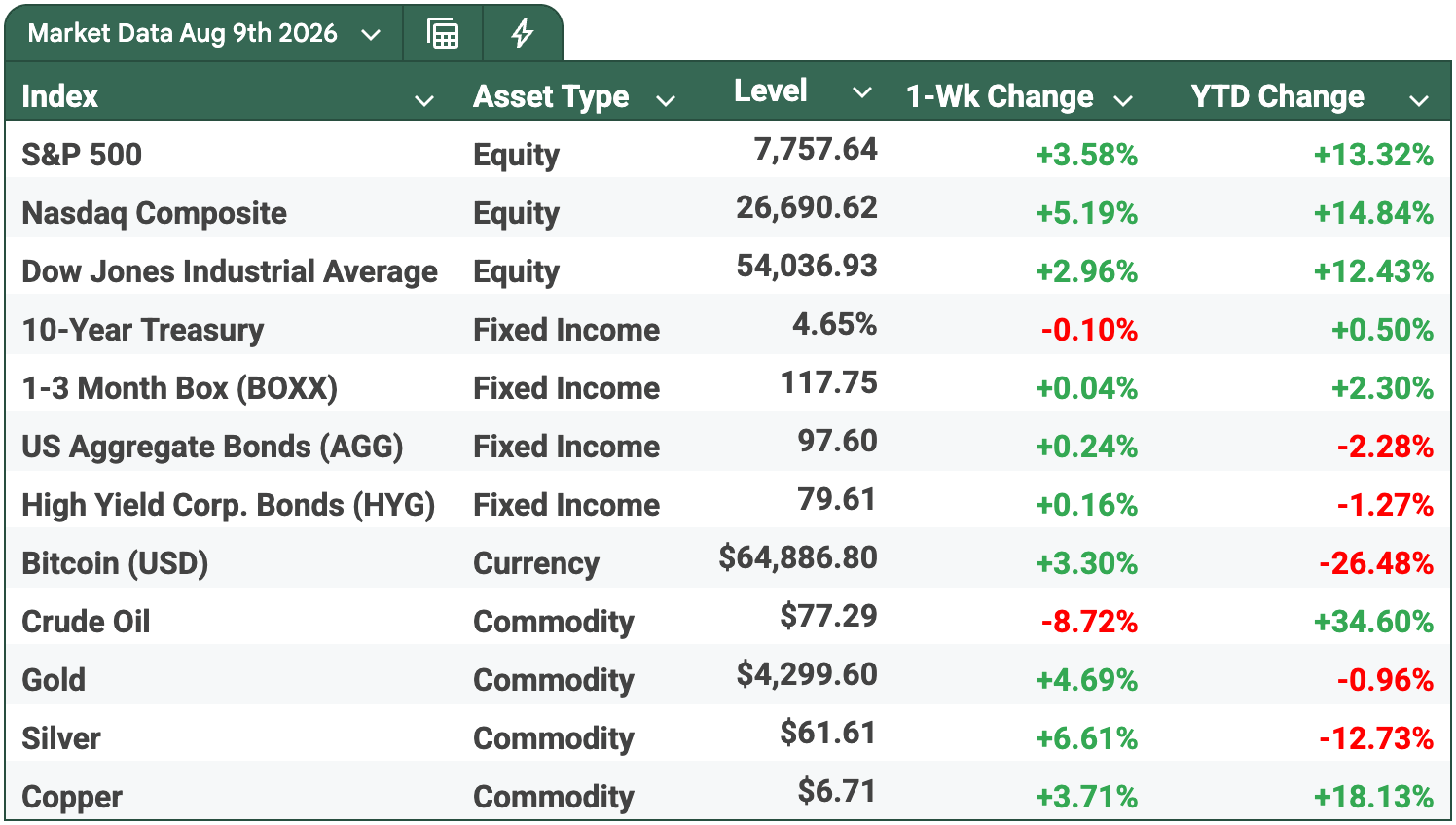
Stocks were up massively this week, initially sparked by the US cancelling planned strikes on Iran in hopes of reaching a peace deal. The S&P 500 and Dow rose 3.58% and 2.96%, respectively, while the tech-heavy Nasdaq soared 5.19%. Additionally, a softer than expected jobs report seemed to add to the momentum, as the market reduced its probability of future interest rate hikes from the Federal Reserve.
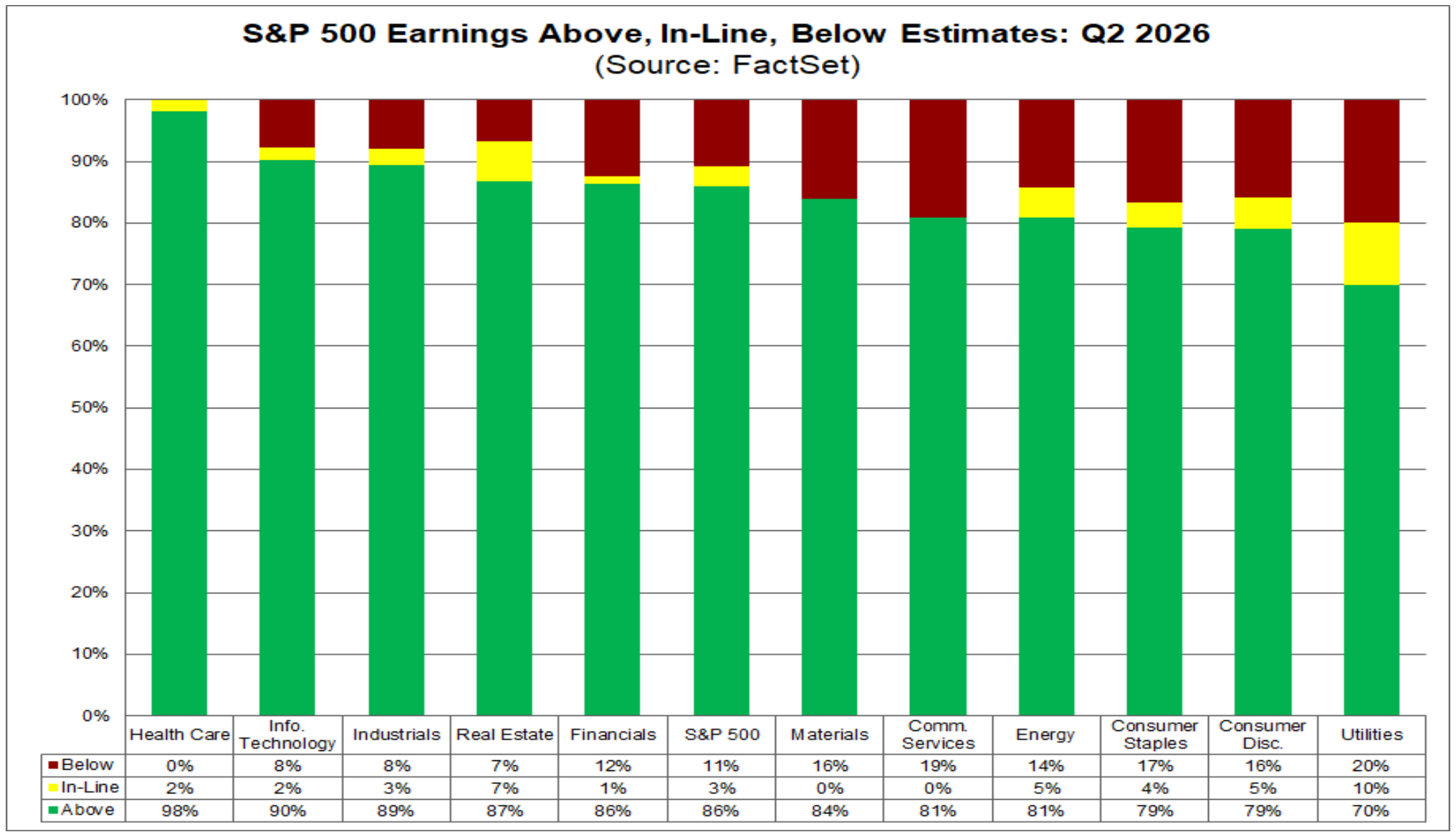
Yet the tide that has lifted all boats over the past two weeks has been earnings. According to Factset, 440 companies in the S&P 500 have reported earnings for Q2 2026 so far, and 86% of them have reported EPS above analyst expectations, and 76% reported a revenue surprise.
This follows an inflection point in corporate earnings growth that began around Q1 2025 that has lifted the stock market higher. In March 2025, aggregate earnings per share for the S&P 500 was $275. Today, less than one and a half years later, it is now over $375, a more than 36% increase.
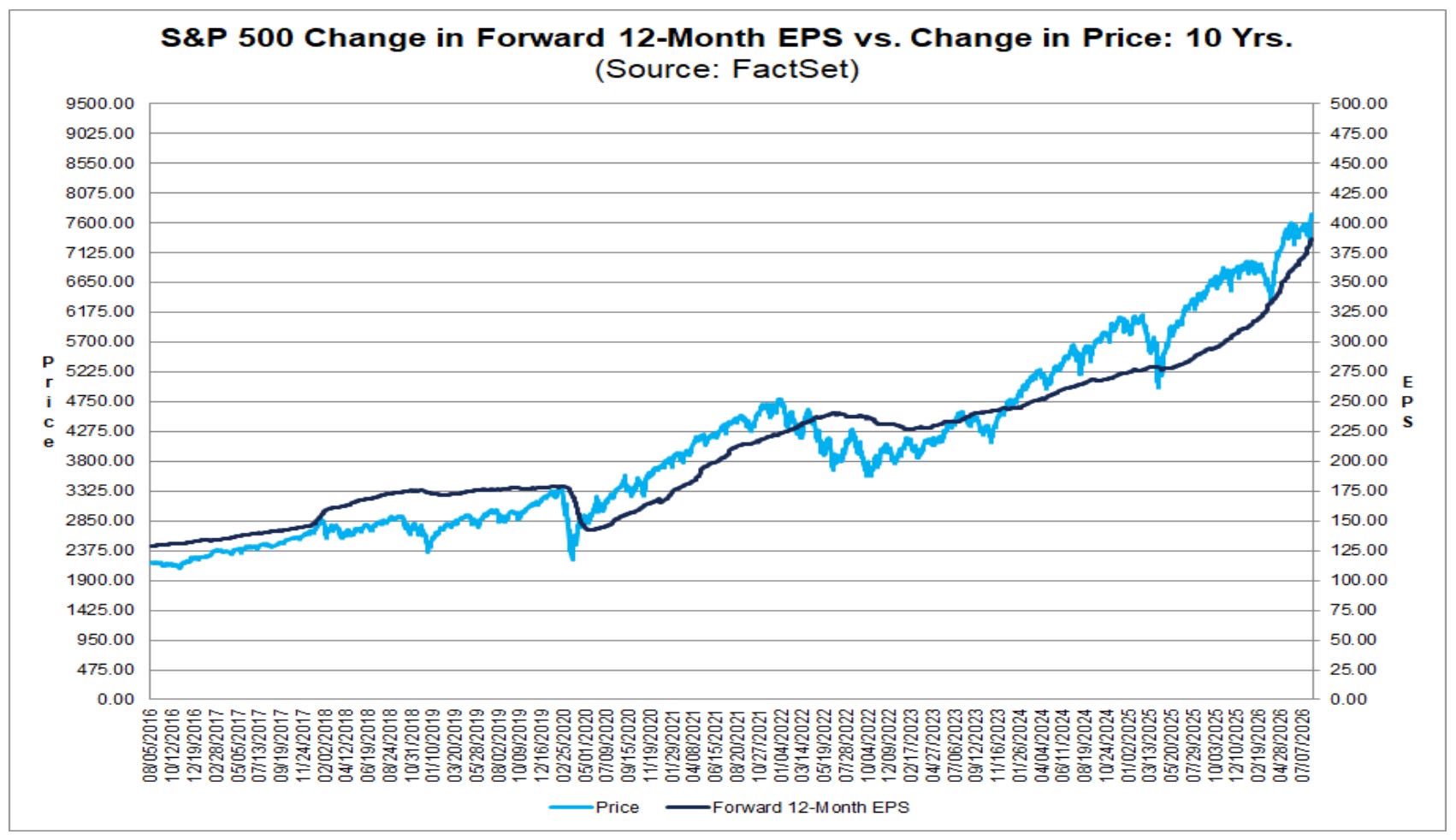
However, this is somewhat of an illusion. The above chart is forward 12-month earnings per share, which is always an estimate into the future. And these estimates are often optimistic. The picture changes when we look at trailing 12-month earnings, which are the profits that companies actually realize.
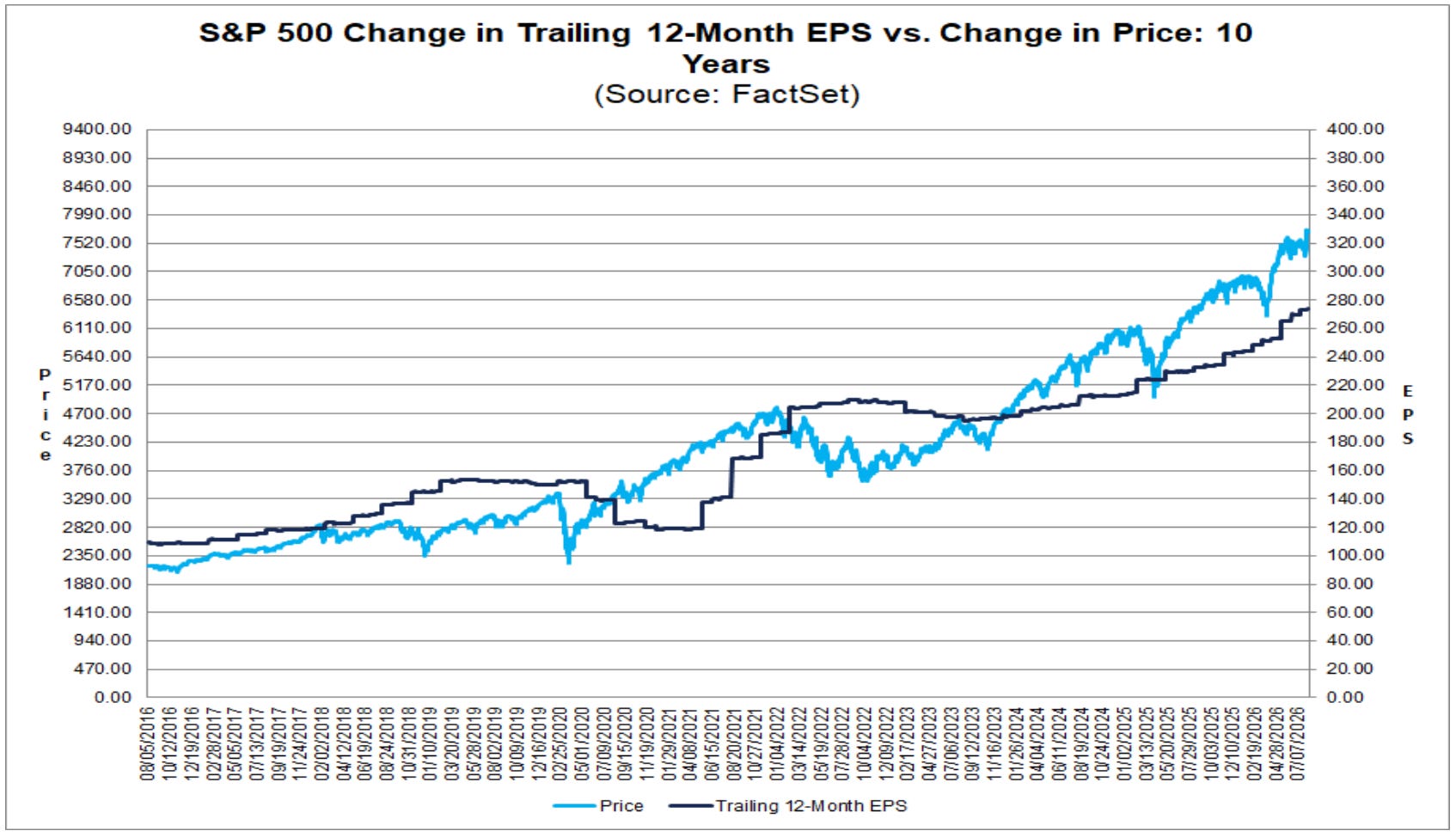
Here the picture is less rosy, more realistic. Trailing 12-month earnings grew from ~$220 in March 2025 to ~$275 today, a still strong 25% increase. However, even this number is not the real picture.
Back in 2016, official accounting rules changed requiring companies to report their unrealized investment gains as part of their earnings by 2018. Before 2018, if a company earned $100M in profits selling widgets, it reported net income of $100M. After 2018, if a company earned $100M in profits selling widgets, and it also owns stocks that went up $50M in value, then its net income is now $150M. If the following quarter, that same company earns $110M in profits from selling widgets, but its investments went back down $50M, then it’s net income is now $60M ($110M less $50M).
This complicates things…take Alphabet for example.
In Q2 2025, the company earned $33.9B in pre-tax income. In Q2 2026, that figure increased just over four times to $138.8B. However, $99.0B of that Q2 2026 pre-tax earnings comes from investments in other companies, primarily from SpaceX.
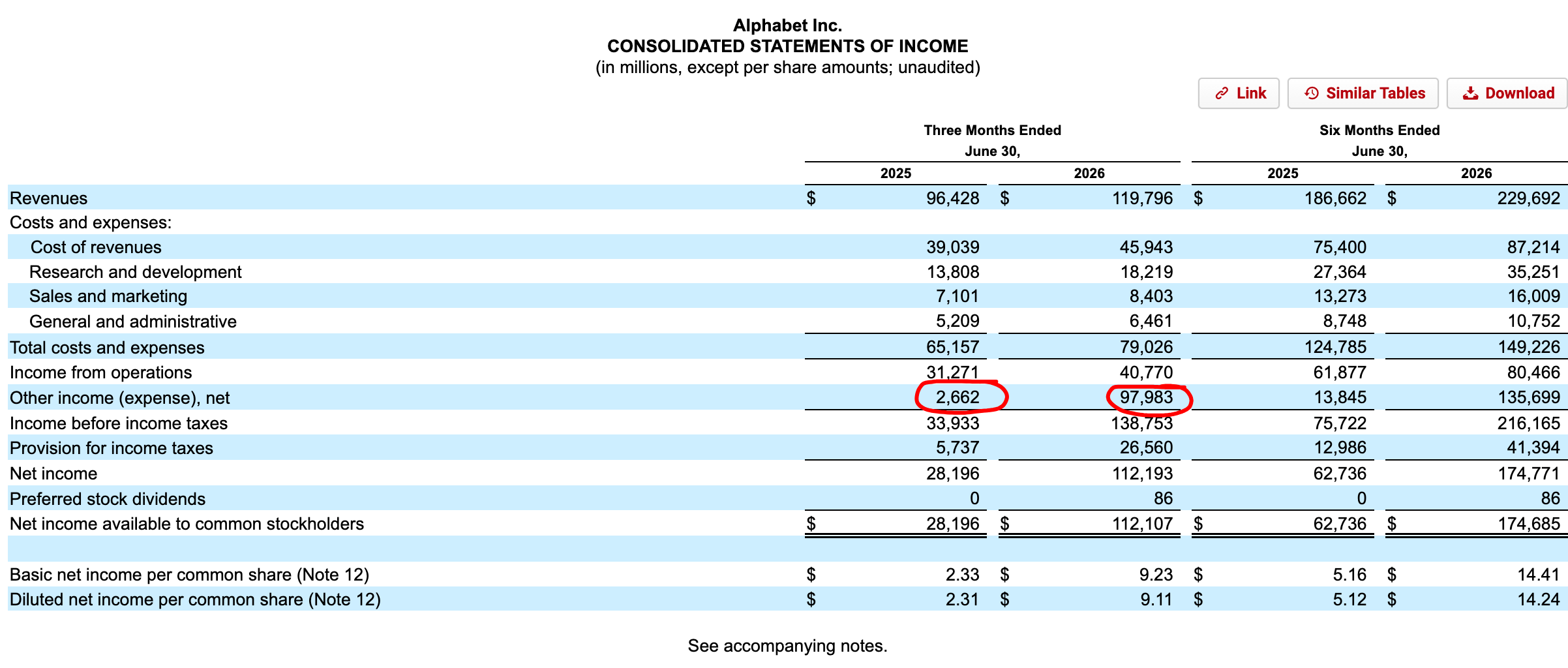
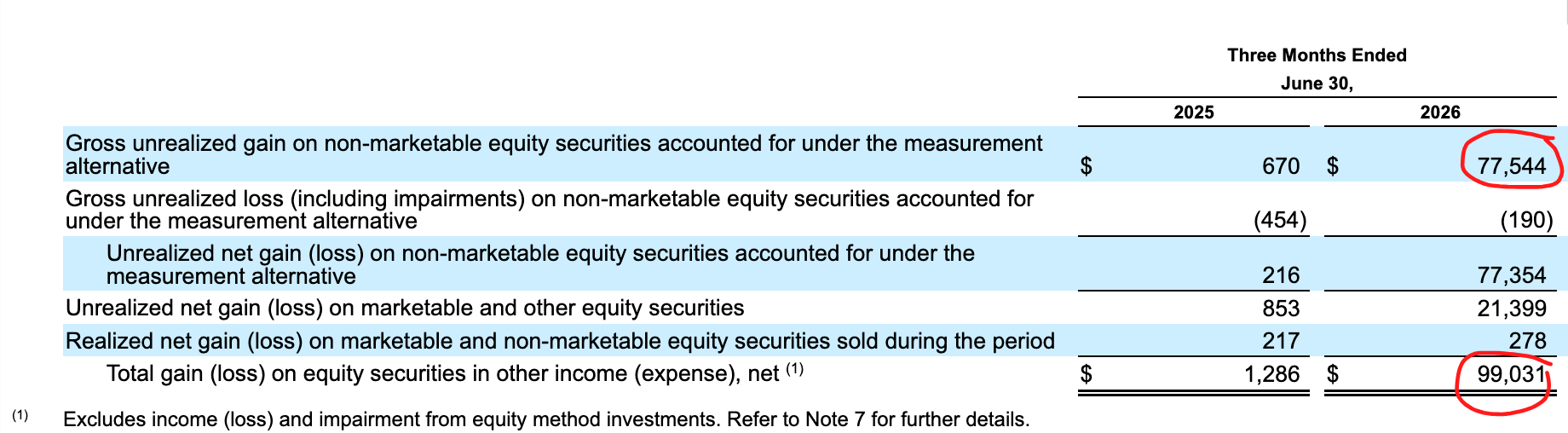
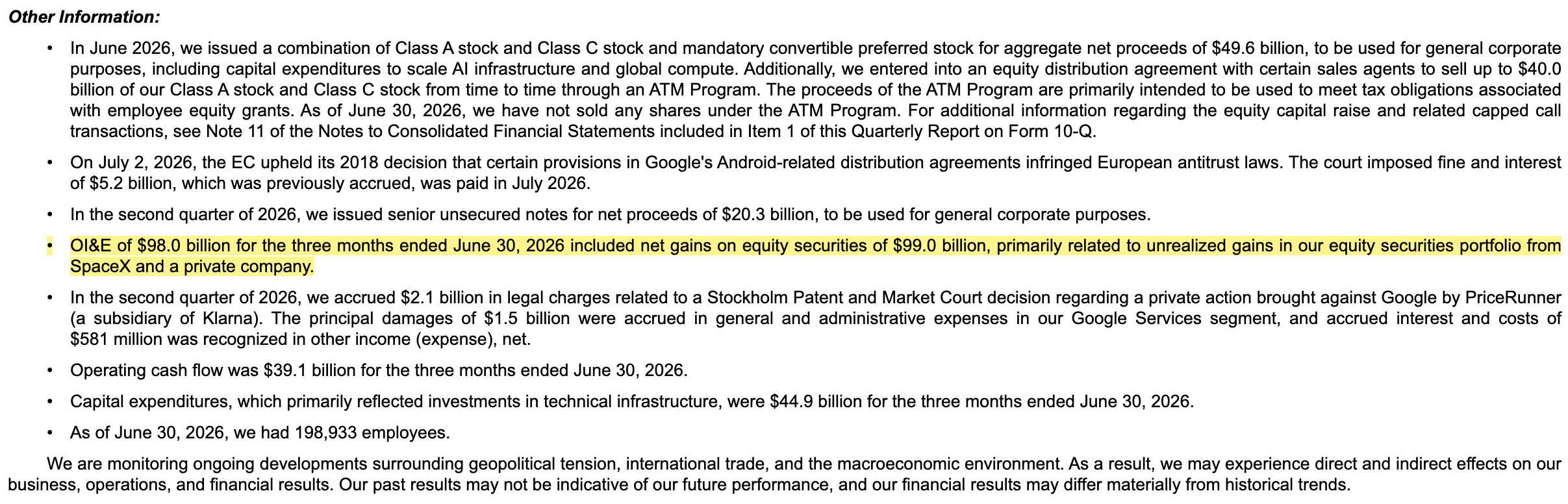
In Alphabet’s case, roughly 70% of their reported income comes from investments in other companies. According to Edward Jones, nearly half of earnings growth in the past quarter was driven by investment gains from Alphabet and Amazon alone.
Many of these investments are in companies that are also business partners of the investing firm. Take Alphabet and SpaceX for instance. As SpaceX went to market, it was announced that Alphabet agreed to a massive $30B deal to rent computing power from SpaceX. No doubt, this deal helped boost investor optimism in SpaceX which opened above it’s IPO range and traded from $150 per share up to $170 per share on June 30th, the end of the Q2 reporting period.
Many of these investments are also in private companies, the values of which do not fluctuate with the public markets. When stocks are down 20%, Anthropic’s and OpenAI’s valuations do not also fall 20%. This insulates publicly traded investors in private companies from taking a hit to earnings during volatile times, such as now. So it is almost no wonder that 86% of companies have exceeded analysts’ earnings expectations for Q2 2026.
With that said, the padding of earnings with mark to market investment gains is not, by itself, a bomb waiting to go off. Many companies are seeing real and durable returns to growth after years of malaise. Our view, however, is that the average investor today does not realize that the earnings they are investing in are not all as they seem.
Interest Rates
Interest rates decreased slightly with the 10-Year Treasury Yield at 4.65% compared to 4.75% a week ago.
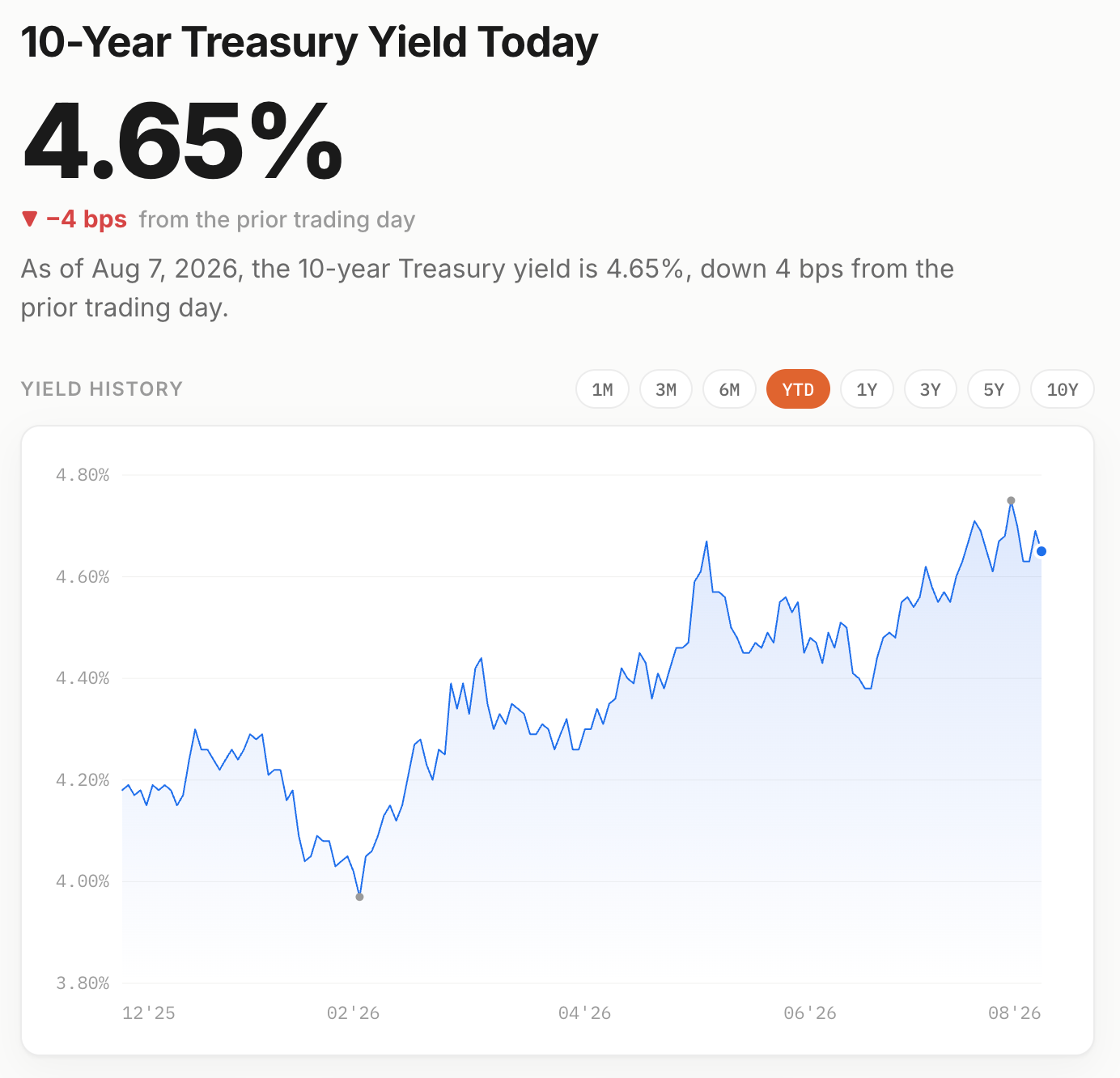
This was primarily driven by the release of the latest jobs data which showed that the economy lost 23,000 jobs in July. This came as a surprise as forecasters were expecting an increase of 80,000 jobs.
Interest rate expectations for the Federal Reserve’s September meeting reacted sharply. Before the report, the market was estimating an 88% probability of at least a 0.25% increase, with a 26.64% chance of a larger sized 0.50% hike. After the jobs data, markets now see a near coin flip between a hold and a 0.25% increase and a 0% chance of a half percentage hike.
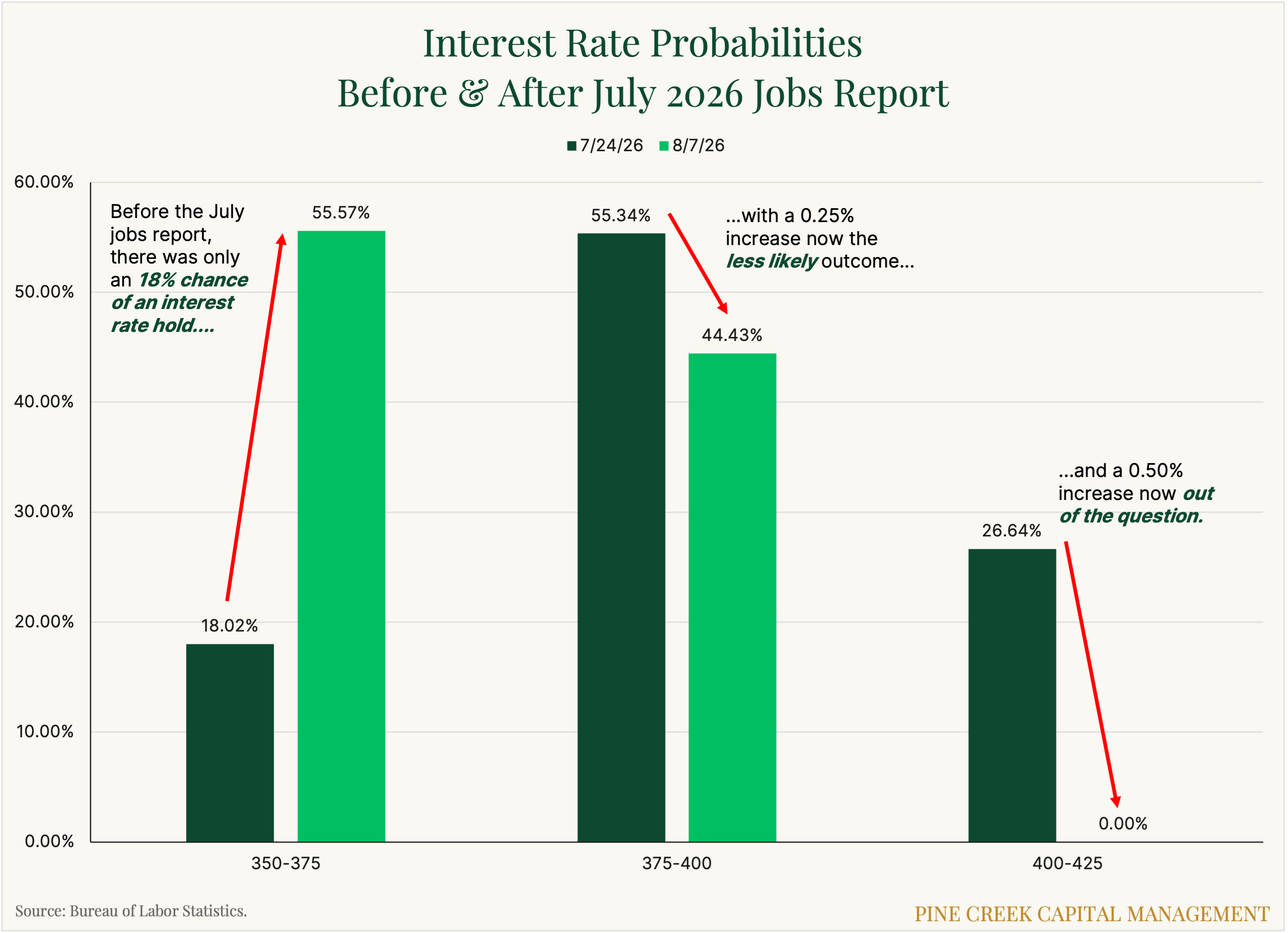
This is because the Federal Reserve is typically hesitant to raise rates on a soft economy and risk sparking a recession. In this case though, we do not believe the Fed should be hesitant at all. We are talking about a quarter of a percent after all…
As with our thesis ahead of the July Fed meeting, we would like to believe that this is a mistake in that the Fed should raise at least 0.25%. However, as discussed in our July Performance Update, we made the mistake of conflating what we believe the Fed should do with what they likely would do. We will not make that mistake again.
For now, we are aligned with the market: it seems to be nearly a coin toss whether or not the Fed will hike rates.
We will also get a fresh reading of inflation from the Consumer Price Index this week which will influence the likelihood of an interest rate change. If CPI comes in lower than expected, then the Fed may hold rates steady. If CPI is hotter than expected, then the Fed may raise rates.
We do not have a view on which way CPI will break, so we will have to wait and see.
With respect to US interest rates and fixed income, we remain of the view that rates and inflation will be higher for longer, leading to restrictive monetary policy, meaning that the Fed would rather raise interest rates than lower them. We continue to believe being overweight fixed income at short durations is prudent in the current environment.
Commodities
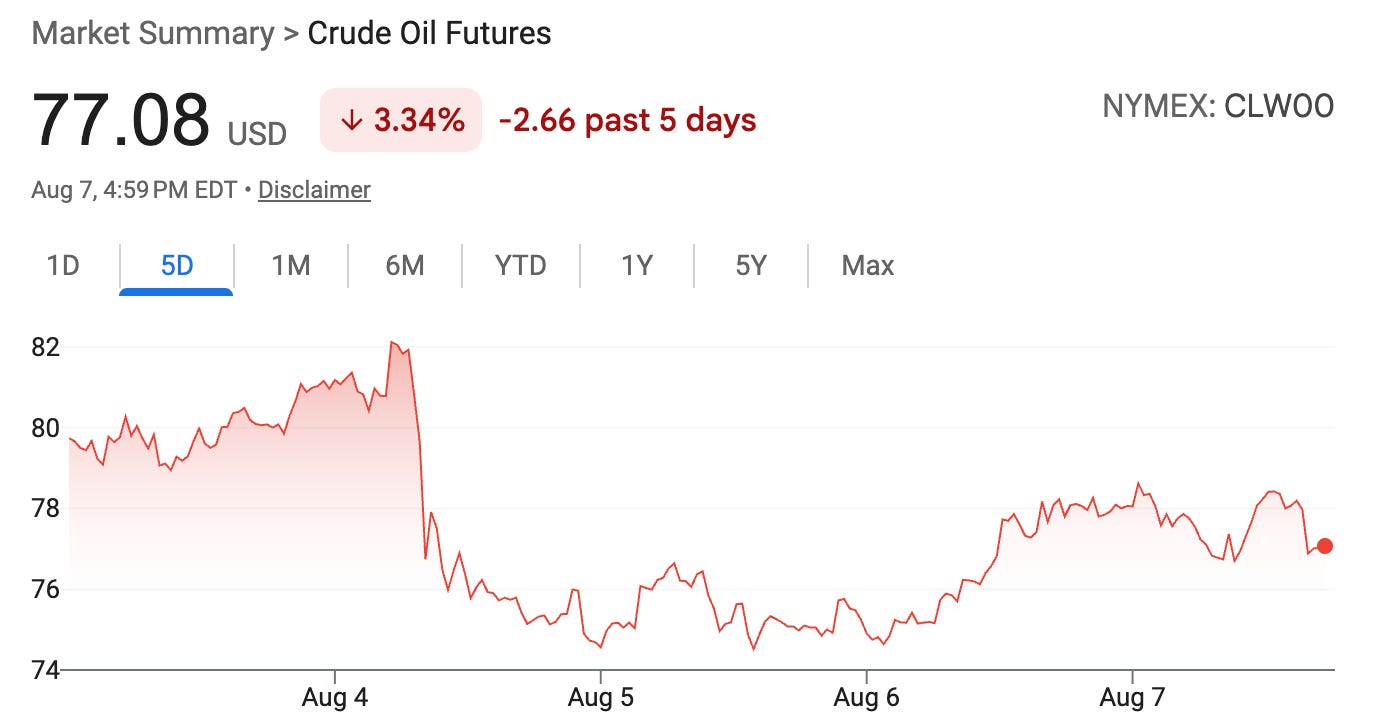
Crude Oil fell to $77.29/barrel, down 8.72% from the prior week. This decline in oil prices comes as US continues to delay striking Iran in hopes of reaching a deal to reopen the Strait of Hormuz.
The President Who Cried “Deal!”
Last week, we provided our views on the breaking news that the US had backed down from planned strikes on Iran, with President Trump announcing that peace talks with Iran would begin Monday.
From the letter:
Based on all available information, a few things seem clear:
There are no active negotiations between the US and Iran.
The current headlines describe a framework of a potential deal created by third party countries.
The US has revealed that it will back down from striking Iran on any hopes of making a deal, revealing our desperation for a deal.
As of this week, the situation has not changed. Despite the Trump Administration and Treasury Secretary Scott Bessent claiming that a deal would be struck as soon as Wednesday, the week came to a close with no news of any talks between the US and Iran. While it does seem like there are talks between mediators, they have come to a standstill. From the Wall Street Journal:
President Trump last weekend called off a wave of U.S. attacks aimed at breaking the deadlock, citing progress in talks. He and other administration officials have said a deal to reopen the strait was close. But mediators say it has stalled in recent days amid Iranian demands for financial relief and a U.S. insistence that shipping traffic not be impeded.
As we have laid out previously, we do not see a diplomatic offramp for the US unless it comes with unprecedented concessions. The only way out is through, and it seems clear to us that President Trump is loathe to pursue further military action. For what reason is another story entirely, though many speculate that the US has depleted a large portion of its missile supply.
We reiterate our longstanding thesis: we remain bullish on oil with a near-term target price of $100+ and a longer term floor of $65-$70 per barrel, though we do not hold a direct position in oil futures.
Gold and Silver increased 4.69% and 6.61%, respectively, while Copper increased 3.71%. The precious metals remain volatile as they are coming off historic highs and multiple competing pressures drive prices. Our view remains unchanged: we believe Gold and Silver remain too volatile to hold exposure to, while Copper remains attractive as a critical metal for supply chains.
PCCM does not hold a position in any of the three metals.
Bitcoin has continued to languish, trading up to the high $64,000 per coin range. The cryptocurrency is currently down ~26% this year as investors look to other investible assets.
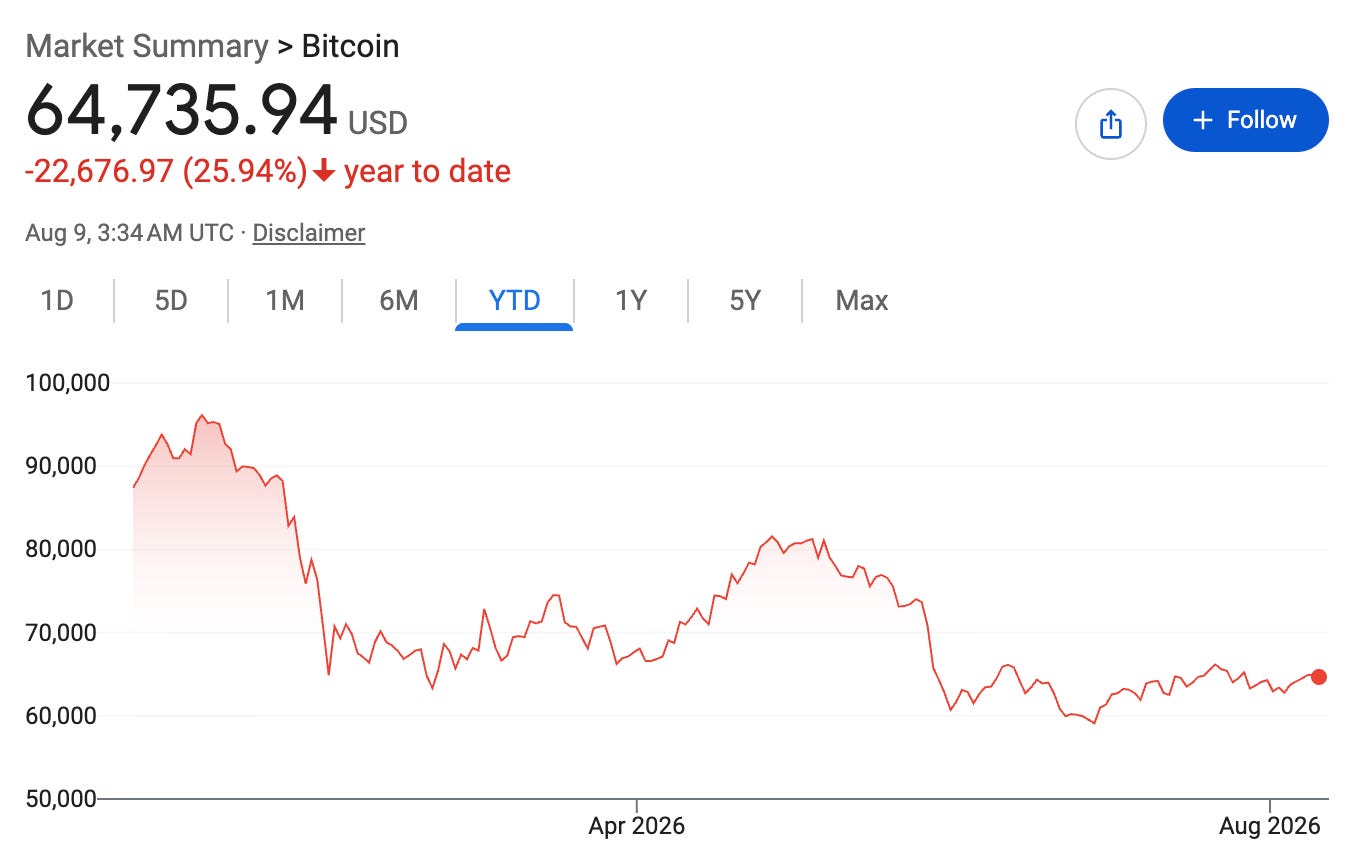
The cryptocurrency scene has been relatively quiet over the past few weeks, but we remain bearish long-term on Bitcoin and crypto-adjacent companies such as Strategy (MSTR) and its preferred stock STRC.
Note: Pine Creek Capital does not currently hold a position in MSTR, STRC, or BTC, and our long-term intrinsic value estimate of Bitcoin is $0.
Earnings & Data
This week we will round out earnings season and get a fresh reading on CPI.
Earnings
Monday, (8/10):
AM: monday.com, Ferguson, and Barrick Mining.
PM: Hims & Hers, Rocket Lab, Simon Property Group, AST SpaceMobile, Archer Aviation, and Plug Power.
Tuesday, (8/11):
AM: Cardinal Health, Sea Limited, On Holding, Aramark, Tencent Music, Smithfield Foods, and eToro.
PM: CoreWeave, Super Micro, CAVA, Lumentum, Franco-Nevada, and H&R Block.
Wednesday, (8/12):
AM: Nebius.
PM: Cisco.
Thursday, (8/13):
AM: JD.com, Tapestry.
PM: Applied Materials.
Economic Data
Wednesday (8/12): July CPI at 8:30 a.m. ET. Consensus is for headline inflation to ease to 3.4% year over year from 3.5%, with core down to 2.5% from 2.6%, after June’s headline index fell 0.4% on the month on lower gasoline prices.
Thursday (8/13): July PPI and initial jobless claims, both at 8:30 a.m. ET.
That’s all we had for you this week, let us know your thoughts by leaving a comment. You can also like this article via Substack to show your support.