


Hello Investors,
This past week we saw a surge in volatility in every corner of the market.
Donald Trump has become increasingly frustrated with the Iran War and is reportedly in “revenge mode,” according to the Wall Street Journal.
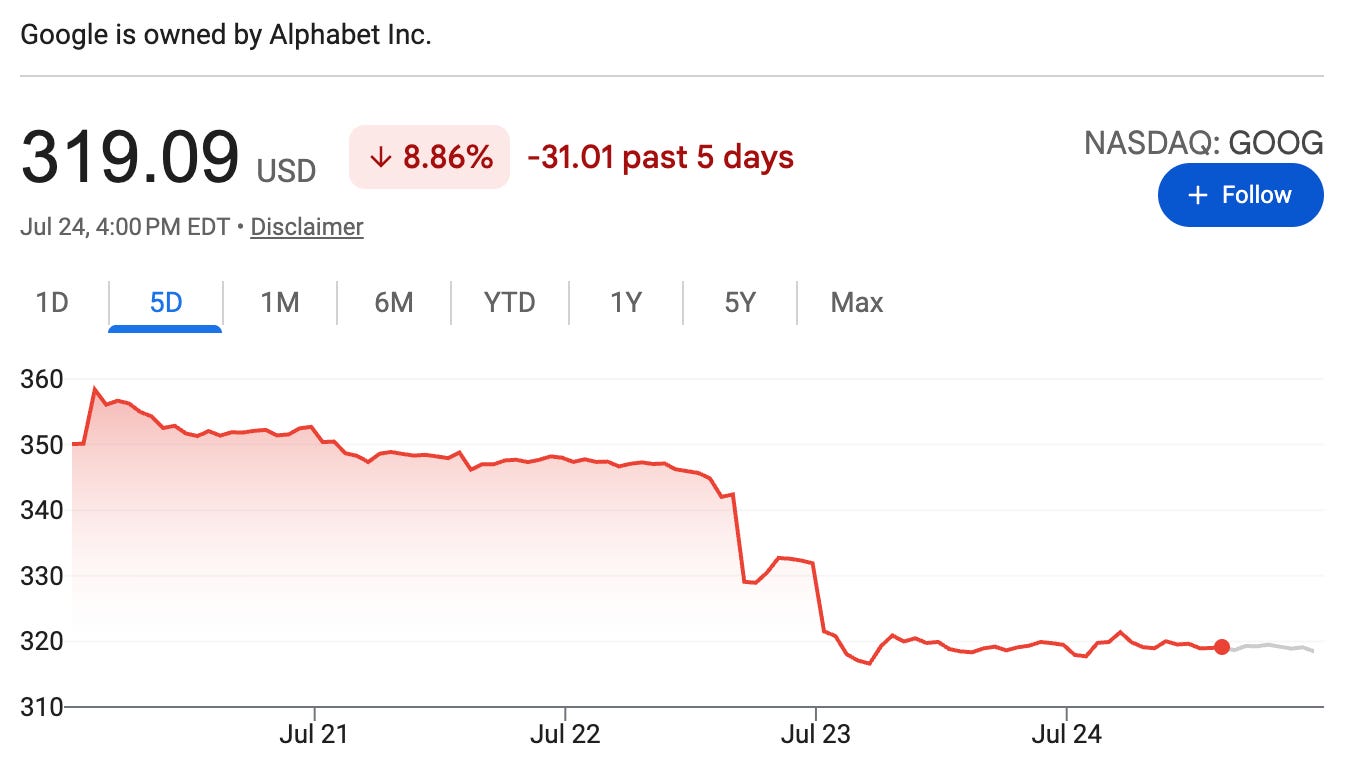
The market drove Google’s shares off a cliff after the company reported a strong top-line earnings report, sparking a broader sell-off through the back half of the week.
The 10-year Treasury yield reached a new high for the year near 4.7% as expectations for inflation and long-term interest rates increase against a volatile macro backdrop.
We will cover each of these topics and a bit more in this week’s market update.
Before we jump in I want to give a quick thank you and welcome to our new subscribers this week!
I hope that you find our content to be valuable and differentiated to your investment process.
If you have any feedback about how we can improve our research, please shoot an email over to brian@pinecreek.capital
Let’s dive in!
-Brian
By the Numbers
Equities
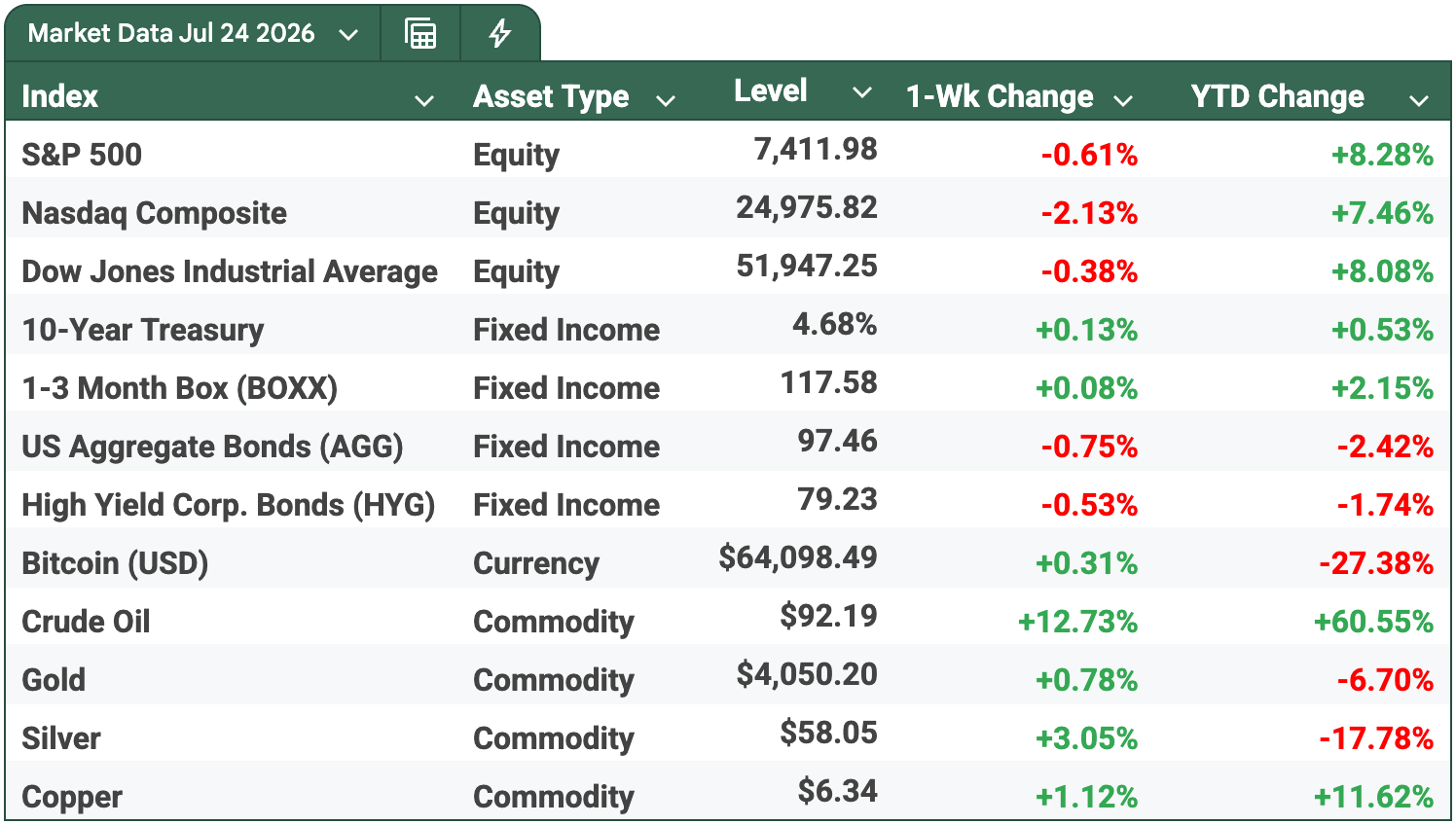
Stocks were down this week, as last week’s rotation out of AI-adjacent stocks continued despite what looked to be strong earnings from major tech companies. The S&P 500 fell 0.61% while the tech-heavy Nasdaq sank by 2.13%. The Dow was much calmer, falling just 0.38% in comparison.
Google Earnings
Patient zero was Google which reported earnings this week, and at face value, their numbers came in very strong. Google Cloud quarterly revenue grew 82% from last year, with a $514B backlog. AI product usage is up across the board, with monthly Gemini app users nearing 1 billion, and Tokens Per Minute up roughly 38% compared to last quarter. And total business revenue for the quarter grew 24% versus last year.
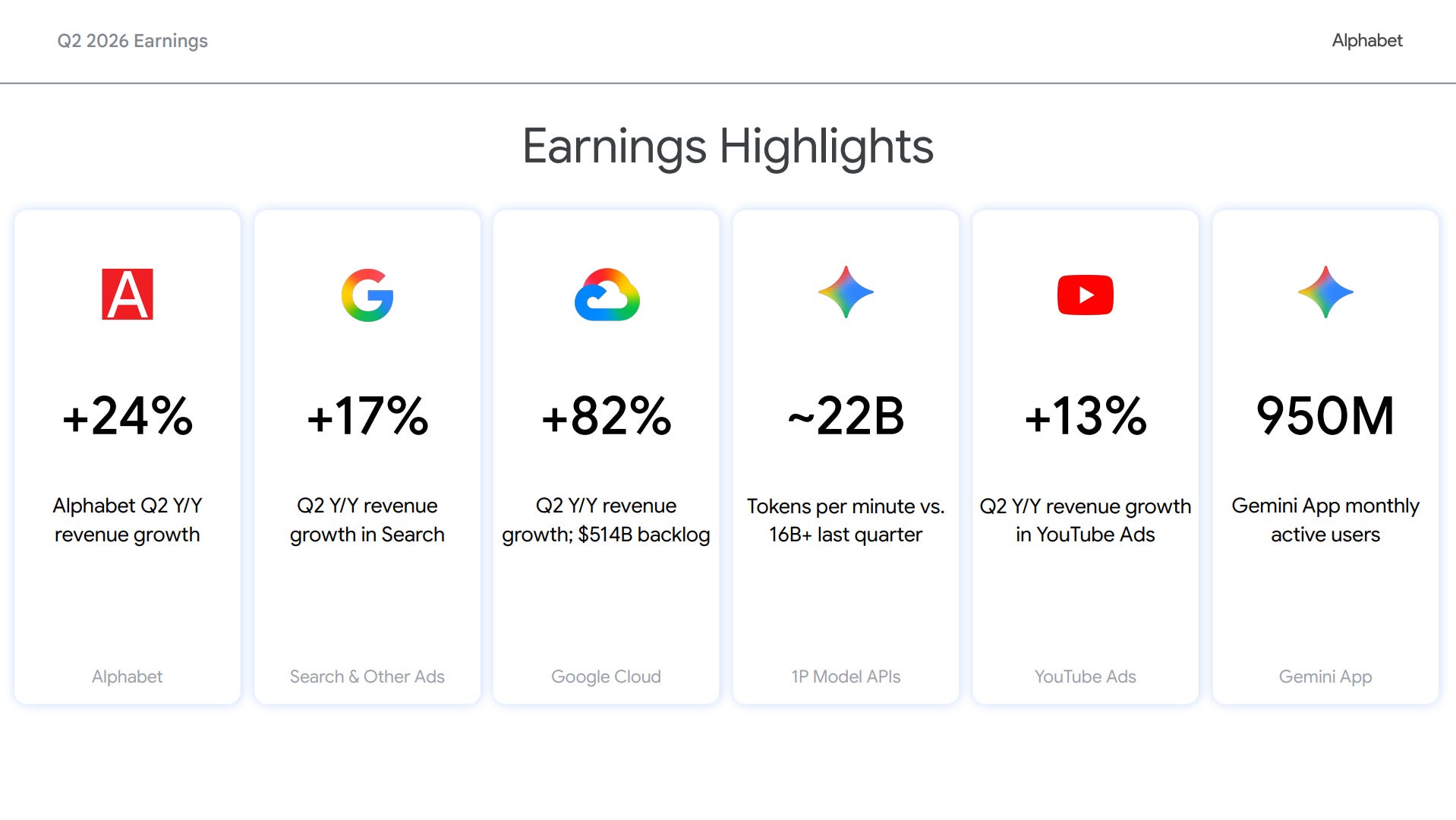
The slide above was shared across Substack and YouTube investing circles as proof of Google’s stellar performance. However, it’s important to keep in mind that this is a company-provided slide. It’s been carefully curated by management to portray the best story possible, and should be taken with a massive grain of salt (if at all).
The real story lies in Google’s capital expenditures and cash flows. How much is the company spending on AI, and what is their return on investment for this spending? Below is a chart we put together showing exactly that.
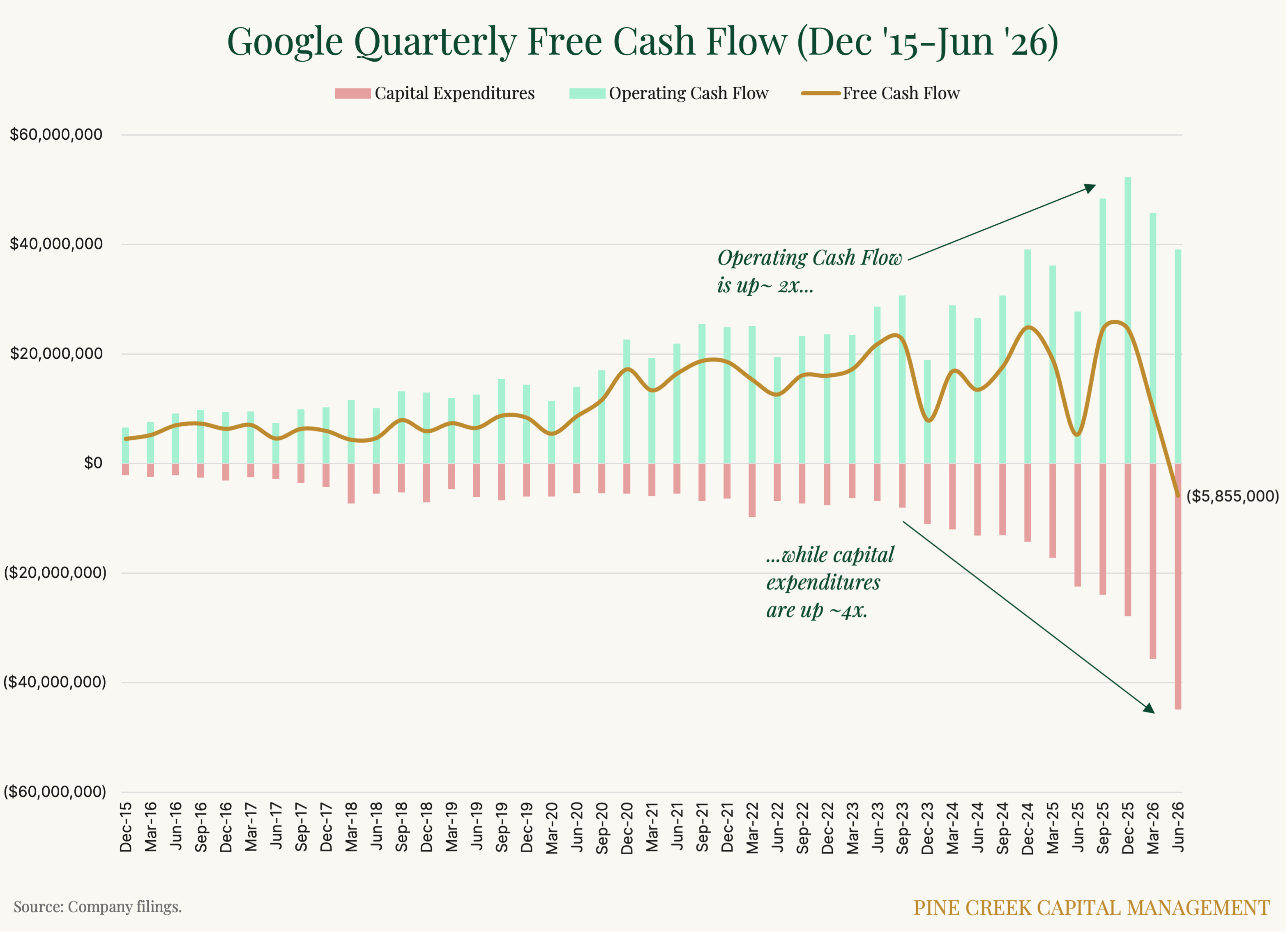
Since Google began aggressively spending on AI-related infrastructure in 2023, the company has increased spend by roughly four times. Over the same period, Operating Cash Flow has only increased two times, resulting in negative free cash flow of nearly $6 billion.
Put another way, for every $2 Google has invested since 2023, they have only seen $1 worth of additional Operating Cash Flow. This of course assumes that 100% of that growth comes from the growth in capex. One can easily argue, however, that the long-term trajectory of Operating Cash Flow has not changed.

From September 2020 to June 2023 (12 quarters total), average annual growth in Operating Cash Flow was 25% on $80 billion in capital expenditures. During the following 12 quarters, capex totaled $244 billion to achieve average annual growth of 27%.
While freelance and professional analysts alike shared management’s slides and applauded Google’s top-line numbers, the market saw straight through to the only question that matters for Google and the rest of the so-called hyperscalers: what is hundreds of billions in additional investment adding in value? Is it adding anything at all?
The answer, for the last three years at least, is that a quarter trillion dollars in additional investment buys Google two percentage points of additional growth (if that). It should be no surprise then that Google shares fell off a cliff shortly after posting these results, sparking the broader tech sell-off into the back half of the week.
While PCCM does not hold a direct position in Google, we did begin entering short positions in line with our view that the AI bubble has popped and the rotation out of AI has started to accelerate.

Interest Rates
Programming Note: This section has been renamed from “Fixed Income” to “Interest Rates,” which will include a broader scope going forward.
Interest rates increased across the board with the 10-Year Treasury Yield at 4.68% compared to 4.56% a week ago.
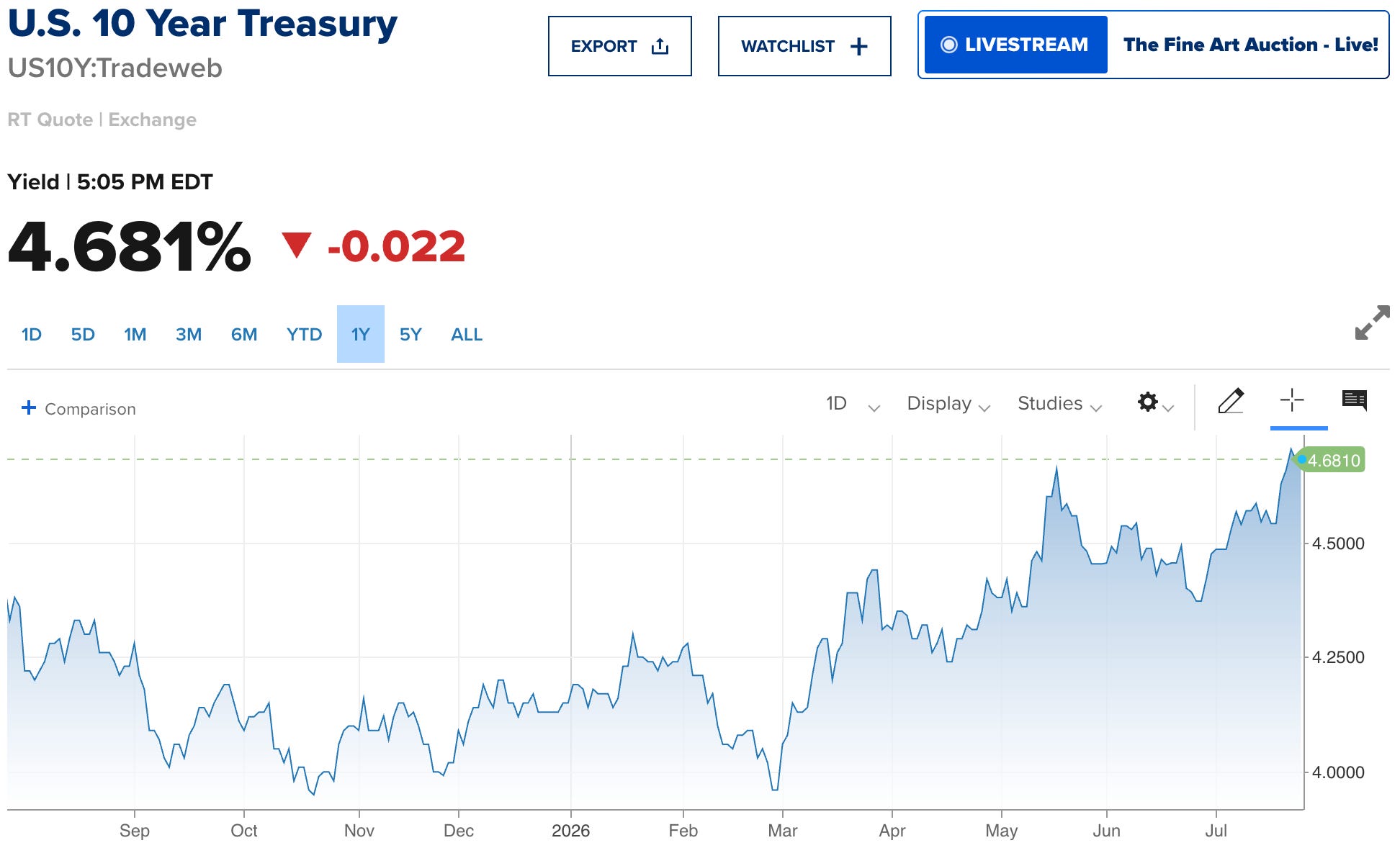
Interest rates have increased substantially since the beginning of the year, driven primarily by the continued war between the US and Iran. As the war and its resulting supply chain disruptions drag on, the risk of an inflation supercycle such as we saw in 2022-2023 increases. These higher inflation expectations feed directly into higher interest rates, starting at the short end of the curve and percolating into longer-term maturities.
There are many implications of higher interest rates, including higher borrowing costs on government debt, downward pressure on the housing market via higher mortgage rates, and downward pressure on equities via higher discount rates. Each of these is its own concern. Yet, there is one downstream effect from higher US rates that seems to be getting little attention: The Yen Carry Trade.
The Yen Carry Trade
A carry trade happens when two currencies offer widely different interest rates. For example, short-term rates here in the US are about 3.5%, vs. 1.0% in Japan. Investors can capture the difference between these interest rates by borrowing Yen at 1%, and investing that money into Dollars earnings 3.5%. The result is a gross return of 2.5%.
To execute this trade, Yen is effectively sold to buy Dollars, putting downward pressure on the Yen and upward pressure on the Dollar. This may be a key phenomenon driving the Yen to 40-year lows vs. the Dollar.

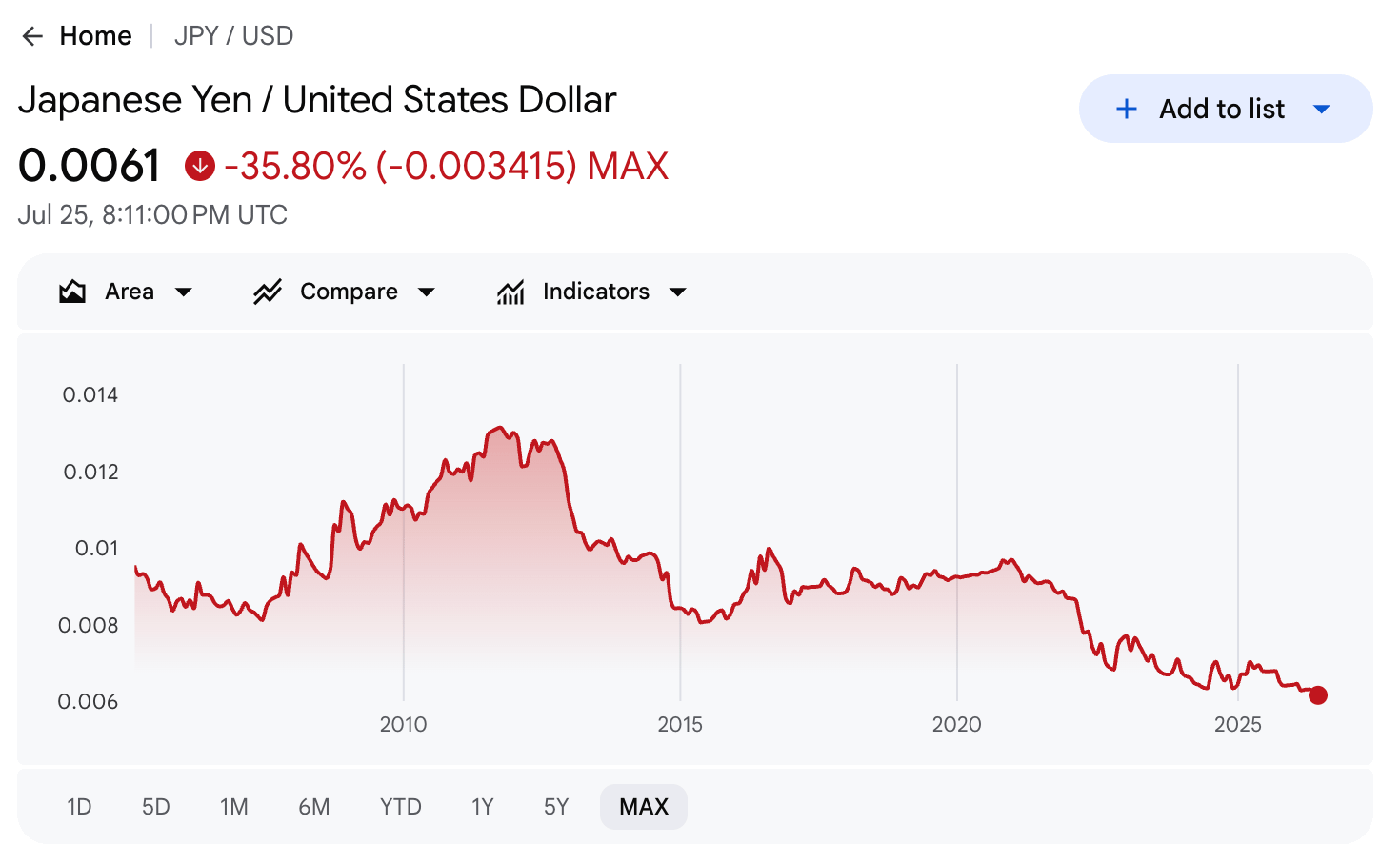
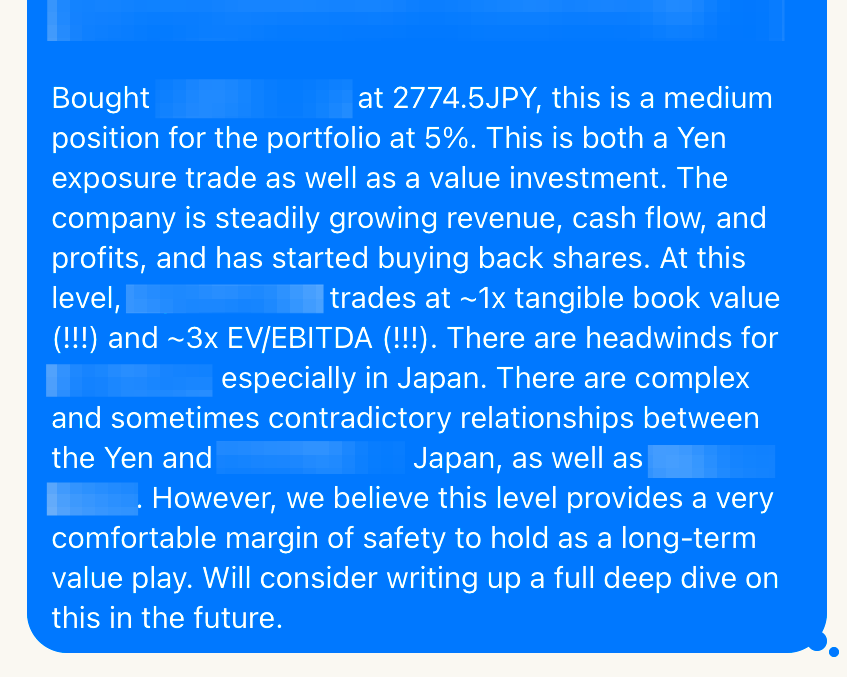
Whatever the case may be, depressed currencies often provide asymmetric setups, as currency-based trades such as the Yen Carry Trade can lead to violent short-term unwinds. We are looking closely at increasing our exposure to Yen, and this week we added a new position in a Japanese company that is trading at 1x book value and 3x EV/EBITDA while Revenue is up 9% Y/Y and EBITDA is up 18% Y/Y.
With respect to US interest rates and fixed income, we remain of the view that rates and inflation will be higher for longer, leading to restrictive monetary policy, meaning that the Fed would rather raise interest rates than lower them. We continue to believe being overweight fixed income at short durations is prudent in the current environment.
Commodities
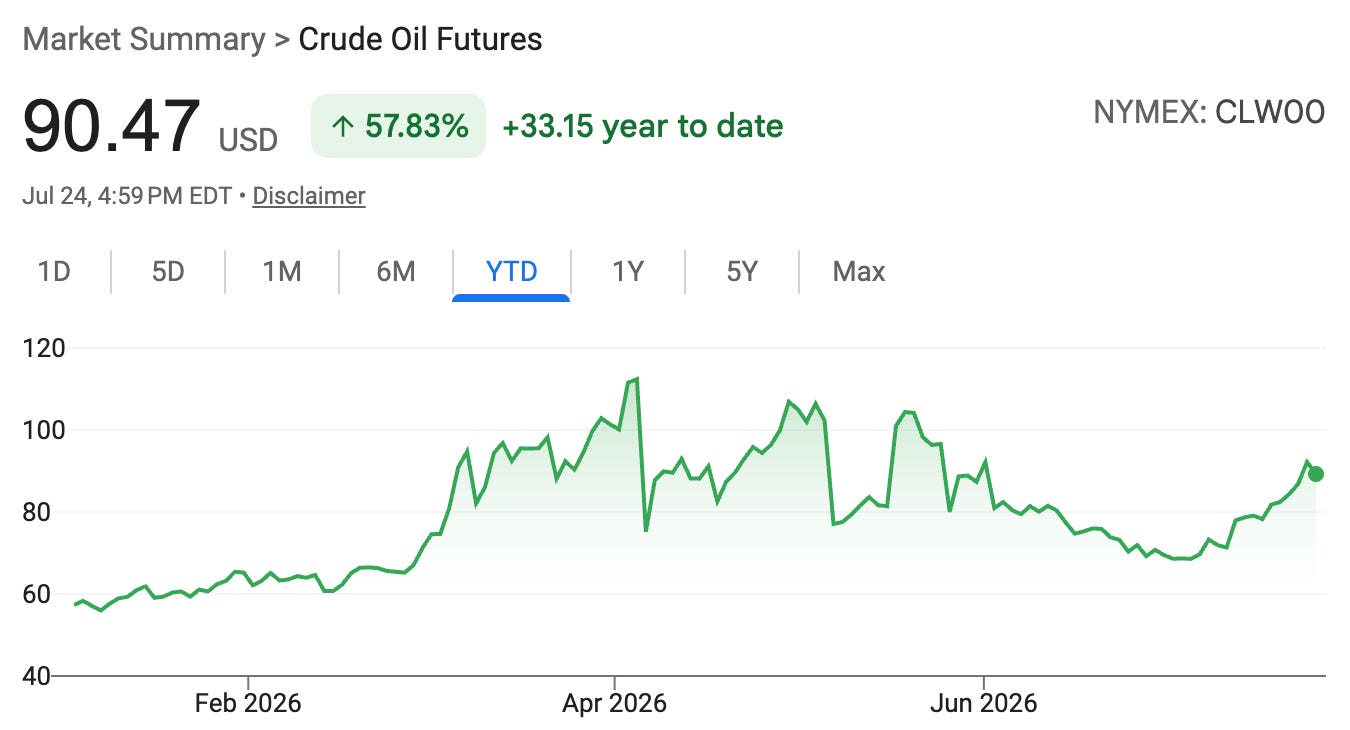
Crude Oil rose to the $90/barrel range, up another 12.7% from the low $80s last week. This jump is directly attributed to continued escalation between the US and Iran over the past week as the two countries wrestle for control over the Strait of Hormuz.
Trump is in “Revenge Mode.”
In last week’s newsletter, we summarized our thesis to date on the Iran War, ending with the following:
Barring an improbable breakthrough in diplomacy, we believe that the situation in Iran will only get worse before it gets better for the US and her citizens. In our view, it is more likely than not that this conflict will continue to escalate. As midterm elections approach in November, the Trump Administration may become increasingly frustrated with a lack of progress on oil prices and inflation, resulting in rash decision making.
This week, the Wall Street Journal reported that the scene from inside the White House seemed to follow our note as if it were a script:
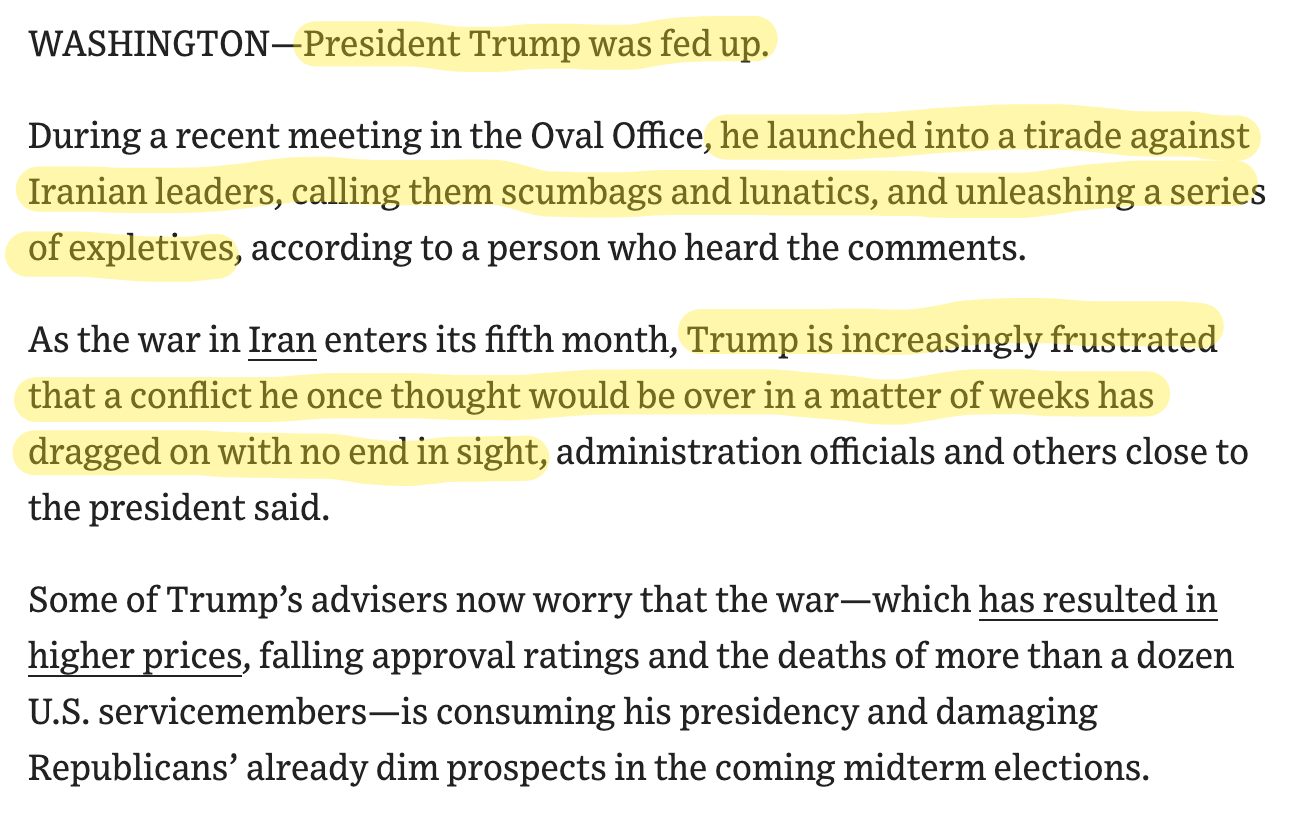
The article continues…
The president in recent days has grown skeptical that negotiations with Iran can produce a lasting peace, according to people familiar with the matter. A senior administration official said Trump believes that the only thing Iran understands is military force, adding that he was in “revenge mode” against Tehran. The president, the official said, sees few good options besides continuing strikes.
Surprisingly, this article came and went without much coverage as investors were glued to their Bloomberg Terminals monitoring a busy week of earnings. While oil prices did increase 12.7% on the week, the impact for the rest of the market seemed relatively muted.
We believe this is a mistake.
Despite the recent rise in oil prices, we believe oil remains structurally underpriced and equities overpriced given the level of risk implied by oil markets and the very real potential for a drastic escalation by the US in an attempt to deliver a “final blow” to Iran. Such a move, such as a full-scale bombing campaign or a ground invasion, could result in widespread collateral damage with long-lasting supply chain constraints.
For this reason, we entered positions this week based on our thesis with respect to the Iran War, including short selling stocks we believe are relatively overvalued compared to their fundamentals and exposure to a prolonged conflict. On oil, we remain bullish with a near-term target price of $100+ and a longer term floor of $65-$70 per barrel, though we do not hold a direct position in oil futures.
Gold and Silver increased 0.78% and 3.05%, respectively, while Copper increased 1.12%. The precious metals remain volatile as they are coming off historic highs and multiple competing pressures drive prices. Our view remains unchanged: we believe Gold and Silver remain too volatile to hold exposure to, while Copper remains attractive as a critical metal for supply chains.
Although we have yet to cover metals in detail, we highly recommend this deep dive by our friends at Aurelion Research.

PCCM does not hold a position in any of the three metals.
Bitcoin has continued to languish, trading sideways in the $64,000 per coin range. The cryptocurrency is currently down ~27% this year as investors look to other investible assets.
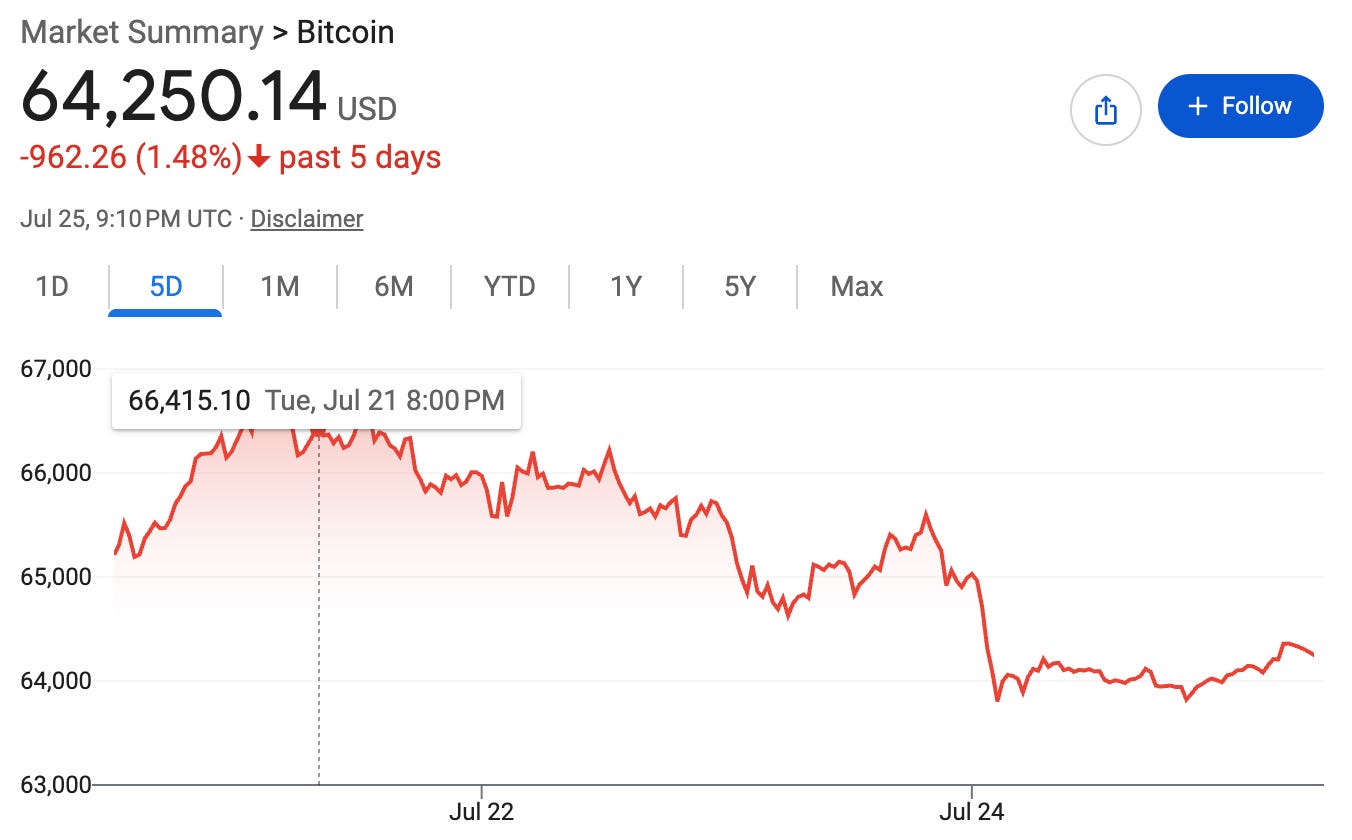
The cryptocurrency scene has been relatively quiet over the last week, but we remain bearish long-term on Bitcoin and crypto-adjacent companies such as Strategy (MSTR).
Note: Pine Creek Capital does not currently hold a position in MSTR, STRC, or BTC, and our long-term intrinsic value estimate of Bitcoin is $0.
Earnings & Data
We are heading into week two of earnings with 971(!) companies reporting through Friday. For the full list, please visit earningsxray.com, a portfolio site of PCCM.
Earnings
Monday, (7/27): AstraZeneca and Baker Hughes report before the open, with Nucor, Whirlpool, Welltower, Celestica, F5, and Amkor after the close. Nucor is the follow-through read on steel pricing after Steel Dynamics last week, and Baker Hughes is the first look at whether triple-digit crude is pulling through to service pricing and rig activity.
Tuesday, (7/28): Boeing, Coca-Cola, UPS, and PayPal report before the open, alongside Sherwin-Williams, Paccar, Illinois Tool Works, Carrier, S&P Global, Hilton, and Royal Caribbean. Visa, Ford, Mondelez, Waste Management, KLA, NXP, Skyworks, Seagate, and Enphase follow after the close. UPS parcel volumes and Visa payment volumes are the two cleanest consumer reads of the day.
Wednesday, (7/29): Microsoft and Meta both report after the close. Microsoft consensus sits at $4.24 EPS on roughly $87.6B revenue, up about 15%, but the number that matters is fiscal 2027 capital spending after the roughly $190B calendar 2026 guide. Meta consensus is near $7.18 EPS on about $60.2B, against company guidance of $58B to $61B, and its $125B to $145B capex range implies roughly $38B per quarter for the rest of the year, about double the first quarter pace.
Wednesday, (7/29 continued): Qualcomm, Arm, Lam Research, Fortinet, Robinhood, Starbucks, Chipotle, O’Reilly, Carvana, and Electronic Arts also report after the close. Procter & Gamble, General Dynamics, Boston Scientific, ADP, Amphenol, Humana, Garmin, Vertiv, and Old Dominion report before the open.
Thursday, (7/30): Apple and Amazon both report after the close. Apple consensus is $1.89 EPS on roughly $108.8B to $110B, with management guiding to 14% to 17% growth, so a print at the low end reads as a miss. This is also expected to be Tim Cook’s last call as CEO before John Ternus takes over. Amazon consensus is $1.82 EPS on about $196.7B, with AWS under the magnifying glass after 28% growth in the first quarter. Bank of America has moved its AWS growth estimate to 33% from 31%.
Thursday, (7/30 continued): Mastercard, McDonald’s, Bristol-Myers, Cigna, Altria, Hershey, Regeneron, ICE, KKR, Shell, Valero, Trane, and Yum report before the open. Coinbase, Reddit, Roblox, Rivian, Stryker, First Solar, and Illumina follow after the close.
Friday, (7/31): Exxon Mobil and Chevron report before the open, alongside AbbVie, Linde, Colgate, Eaton, Cboe, T. Rowe Price, Cameco, and Moderna. With crude topping $100 a barrel on Thursday, upstream realizations and any change to buyback pace will be key data points.
Economic Data
Monday (7/27): Durable goods orders for June at 8:30 a.m. ET, with core capital goods the piece that matters for business investment. Dallas Fed manufacturing for July follows at 10:30 a.m., and Treasury sells $69B in 2-year and $70B in 5-year notes at 1:00 p.m.
Tuesday (7/28): Conference Board consumer confidence for July at 10:00 a.m. ET, after two straight monthly gains. Case-Shiller 20-city home prices for May land at 9:00 a.m.
Wednesday (7/29): FOMC decision at 2:00 p.m. ET, with Chair Warsh’s press conference at 2:30. Economists polled by FactSet expect a fifth straight hold at 3.5% to 3.75%, but CME FedWatch now puts hike odds at 38%, up from 12% a week earlier. No projections accompany this meeting, so the statement language carries the weight.
Thursday (7/30): Q2 GDP advance estimate and June personal income and spending, both at 8:30 a.m. ET. Q1 grew 2.1% annualized on the third estimate. May PCE ran 0.4% on the month and 4.1% year over year, with core at 0.3% and 3.4%, and forecasters look for June core near 0.1%, which would pull the annual core rate toward 3.2% and headline toward 3.7%. Initial jobless claims come at the same time, off a print of 187,000, the lowest since 1969, with continuing claims at 1.796 million.
Friday (7/31): Employment cost index for Q2 at 8:30 a.m. ET, followed by Chicago PMI for July at 9:45 a.m. and final July Michigan sentiment with 1-year and 5-year inflation expectations at 10:00 a.m.
That’s all we had for you this week, let us know your thoughts by leaving a comment. You can also like this article via Substack to show your support.