


Hello Investors,
It is looking increasingly likely that the AI bubble has a hole in it.
The SOXX Semiconductor ETF is down over 20% in the past month, and individual companies like Micron (MU) are down 30% or more.
And the decline looks to be accelerating, with many AI-related companies posting double digit losses in just the past week.
Meanwhile, sectors with tangible earnings, such as the financial sector and the software sector have started to catch the attention they deserve.
All of this is in line with our broader thesis which we have covered since June, and our book remains well positioned to take advantage of a broader decline in equities.
As of this writing, PCCM is up 5% since our inception on June 23rd, with only 60% of total capital deployed.
This healthy cash position reflects our view that there is potentially more volatility ahead, which should present ample opportunities to deploy our remaining capital at attractive prices.
If you would like to keep up with our trades and portfolio positions in real time, consider becoming a paid subscriber.
Let’s dive in!
-Brian
By the Numbers
Equities
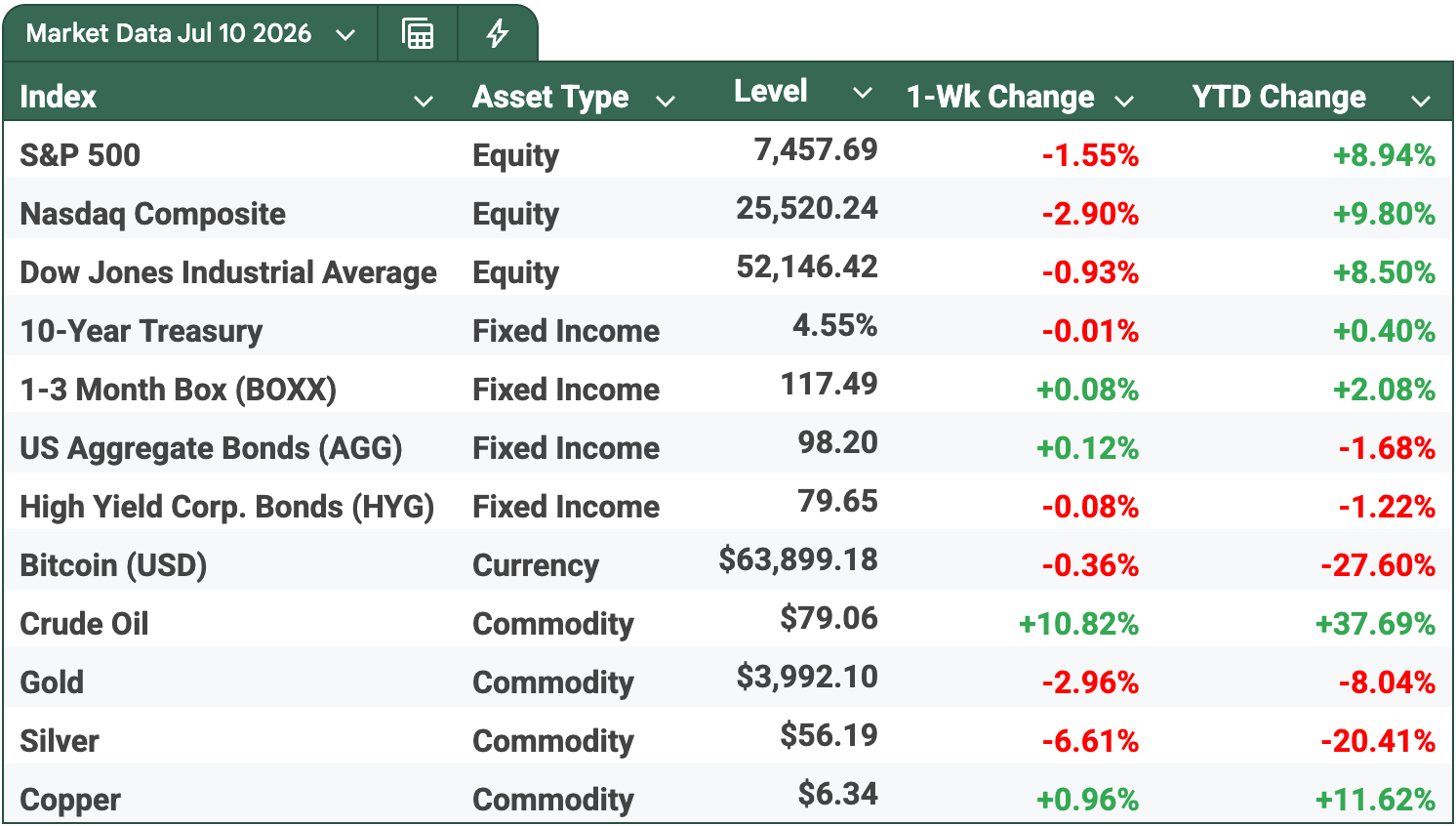
Stocks were down this week, driven by a rotation out of AI-adjacent stocks and into more profitable sectors. The S&P 500 fell 1.55% while the tech-heavy Nasdaq sank by 2.90%. The Dow’s drop was a bit more modest at 0.93%.
High flying semiconductor stocks like Micron (MU) were down as much as 20% for the week. Meanwhile, the big banks that drive the financial sector posted earnings beats across the board:
There are two major forces that drive bank earnings: interest rates and volatility.
The primary way banks make money is by taking in deposits at low interest rates (like a savings account) and lending out money at higher interest rates (like a mortgage). If a bank can pay 1% on $1M and lend that same $1M out at 7%, they keep the 6% spread. This spread is referred to as Net Interest Margin or NIM for short.
When interest rates go up, banks are able to lend at higher and higher rates, while maintaining control over the rates they pay on savings, leading to an increase in overall profits. Given that interest rates have been on the rise, it is no surprise that banks are posting record numbers.
Another way banks make money is through their proprietary trading operations. These are often limited to the largest investment banks; I think of Morgan Stanley or Goldman Sachs. These banks have specialized teams that develop trading strategies to profit from minute-to-minute moves in stocks.
These divisions tend to make more money when there is more volatility in the market. And 2026 has no shortage of volatility, be it from AI jitters or conflict in the Middle East.
Fixed Income
Interest rates were flat last week, with the 10-Year Treasury Yield at 4.55% compared to 4.56% a week ago.
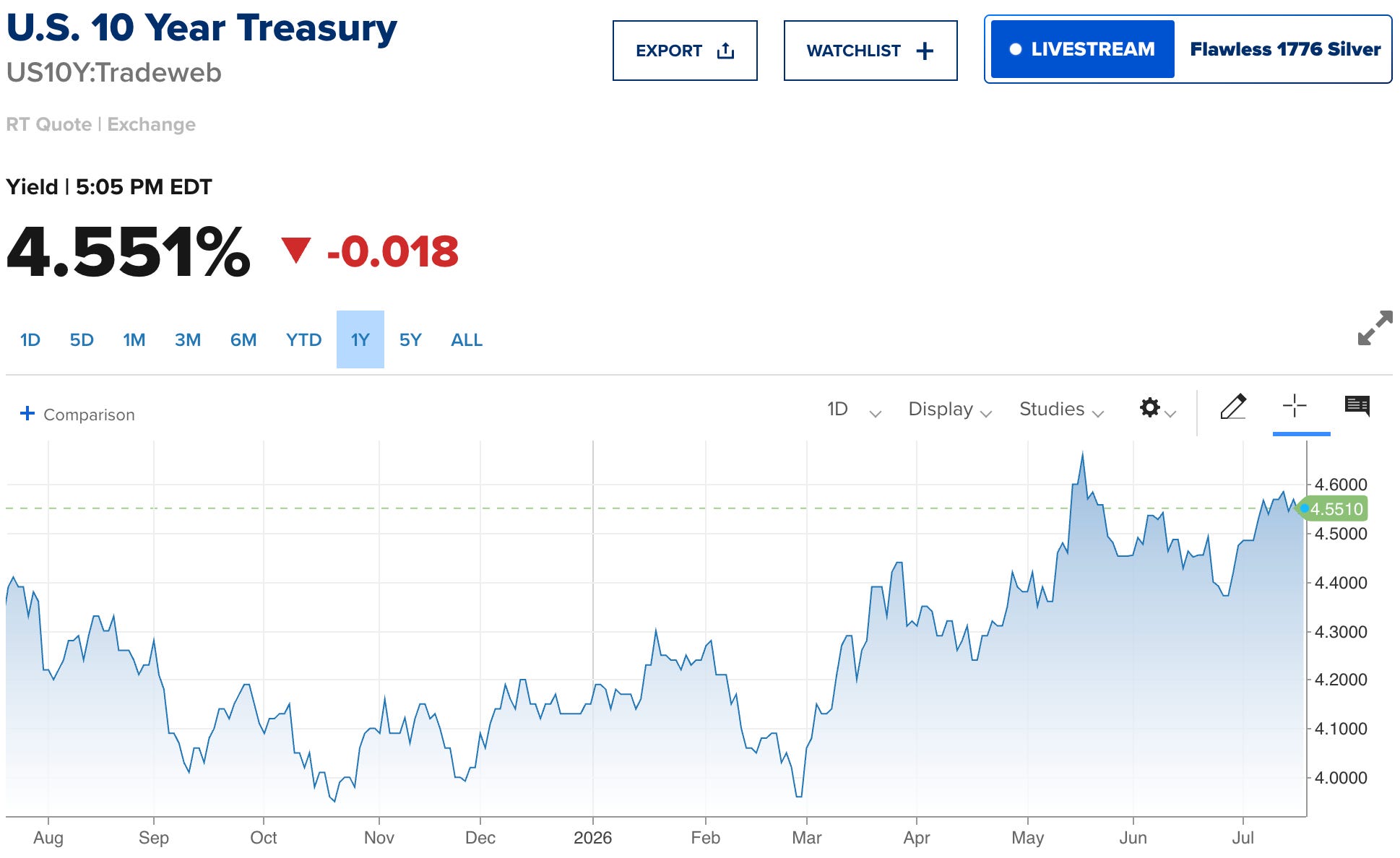
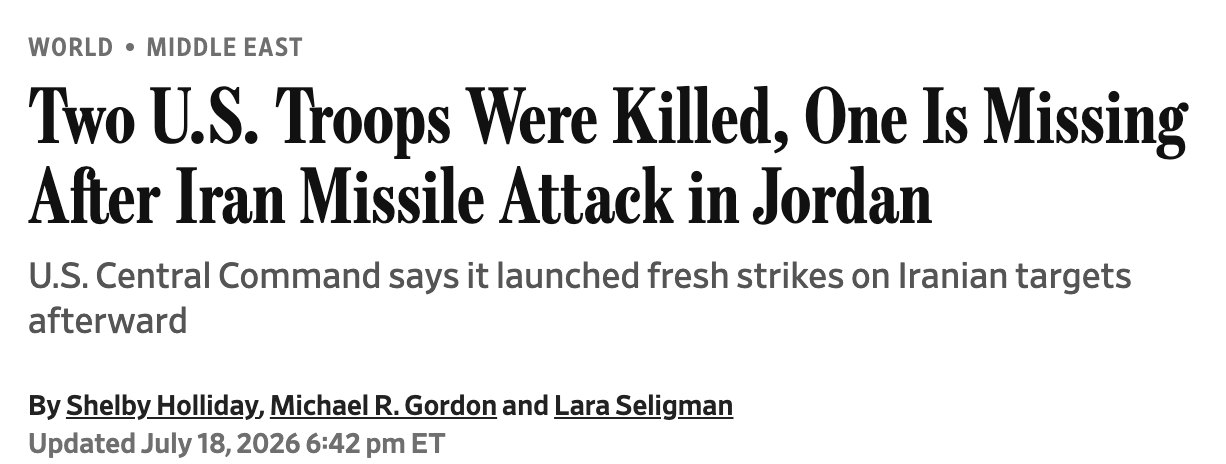
Interest rates remain elevated in line with elevated tensions between the US and Iran, which we warned readers would be a key risk when interest rates and oil initially fell on the announcement of a “deal.”

As of this writing, the two countries continue to trade tit-for-tat strikes, resulting in the loss of at least two American troops this weekend, with one other missing.
This has driven a sharp increase in oil prices which in turn increases inflation expectations and interest rates. With respect to the Iran War, our thesis is that the United States has backed itself into a lose-lose situation. There is no diplomatic offramp—the only way out is through. Our base case is that the US resumes its blockade of the Strait, recommitting to attrition as a means to force Iran’s hand.
We are of the view that rates and inflation will be higher for longer, leading to restrictive monetary policy, meaning that the Fed would rather raise interest rates than lower them. We continue to believe being overweight fixed income at short durations is prudent in the current environment.
Commodities
Programming Note: we have moved Bitcoin to the bottom of this section.
Crude Oil rose to the $80/barrel range, up 10% from the low $70s last week. This jump is directly attributed to a re-escalation between the US and Iran over the past week as the two countries wrestle for control over the Strait of Hormuz.
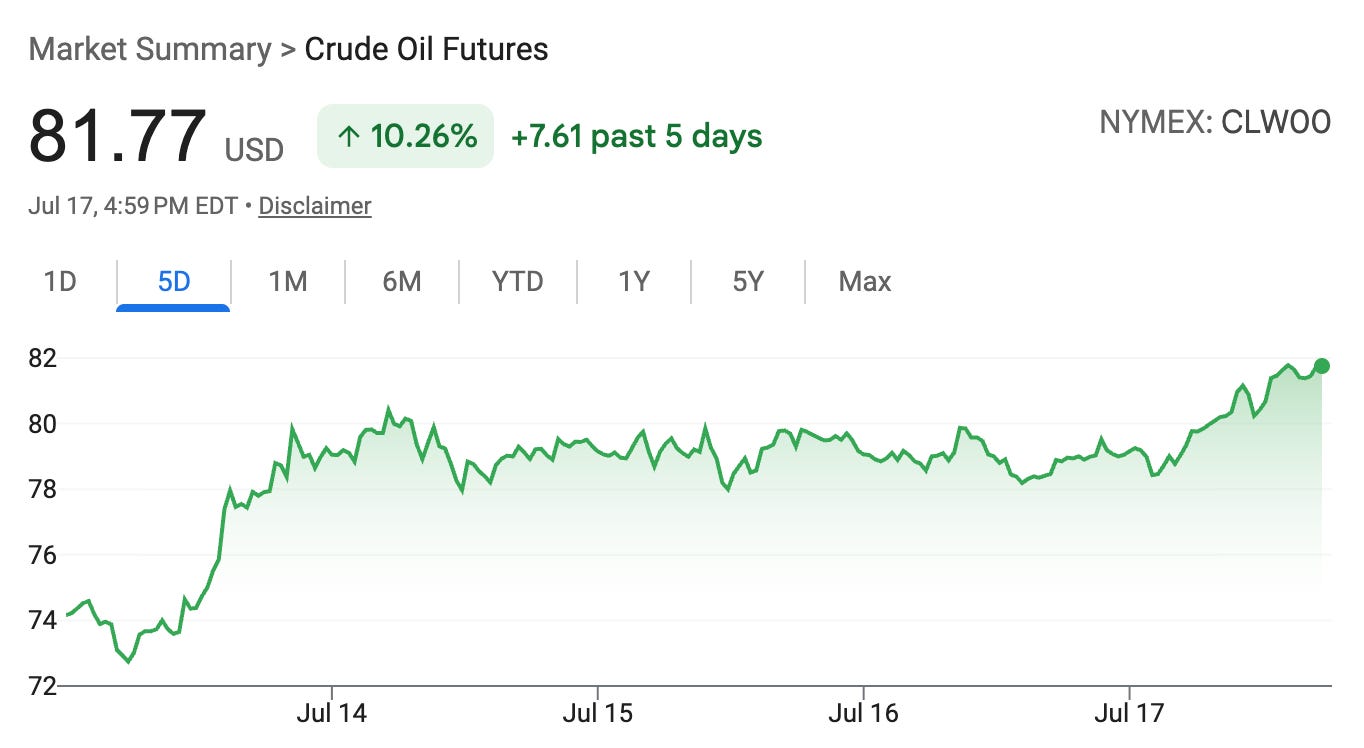
This is in-line with our thesis which we have outlined over the past four weeks:
June 14th: Crude at $77
At current levels, we believe oil futures are attractively priced for a sharp potential rebound. Should negotiations fail or drag on, or a deal result in large concessions to Iran, or heavy fighting restart altogether, oil prices could jump sharply.
June 21st: Crude at $76
we continue to believe oil futures are attractively priced for a sharp potential rebound…Additionally, we believe the $65-$70 per barrel range is an effective floor for the foreseeable future, as countries will need to replenish their strategic reserves.
June 28th: Crude at $70
…we believe that the market is underpricing the risk of a re-escalation of the Iran War. Despite renewed tit for tat strikes over the past week, oil has continued its decline. Our stance as of this writing is that it is more likely than not that we will see a breakdown in negotiations between the US and Iran.
July 5th: Crude at $68
We have stated previously that the $65-$70 price range is a key level for two reasons:
We believe that the market is underpricing the risk of a re-escalation of the Iran War. A flare up in tenstions or an all-out resumption of conflict could send oil back to $100+ per barrel overnight.
Global strategic reserves remain depleted and at historically lo levels. Countries will need to replenish their reserves and will buy oil at any price, putting an effective floor on the market for the next 2-5 years. We estimate this floor to be in the $65-$70 range.
Barring an improbable breakthrough in diplomacy, we believe that the situation in Iran will only get worse before it gets better for the US and her citizens. In our view, it is more likely than not that this conflict will continue to escalate. As midterm elections approach in November, the Trump Administration may become increasingly frustrated with a lack of progress on oil prices and inflation, resulting in rash decision making.
While PCCM does not currently hold a position in oil, we remain bullish with a near-term target price of $100+ and a longer term floor of $65-$70 per barrel.
Gold and Silver fell 2.96% and 6.61%, respectively, while Copper increased 0.96%. The precious metals remain volatile as they are coming off of historic highs and multiple competing pressures drive prices. Our view remains unchanged: we believe Gold and Silver remain too volatile to hold exposure to, while Copper remains attractive as a critical metal for supply chains. PCCM does not hold a position in any of the three metals.
Bitcoin continued to tread water this week, trading up to just over $64,000 per coin. The cryptocurrency is currently down 45% this year as investors look to other investible assets.
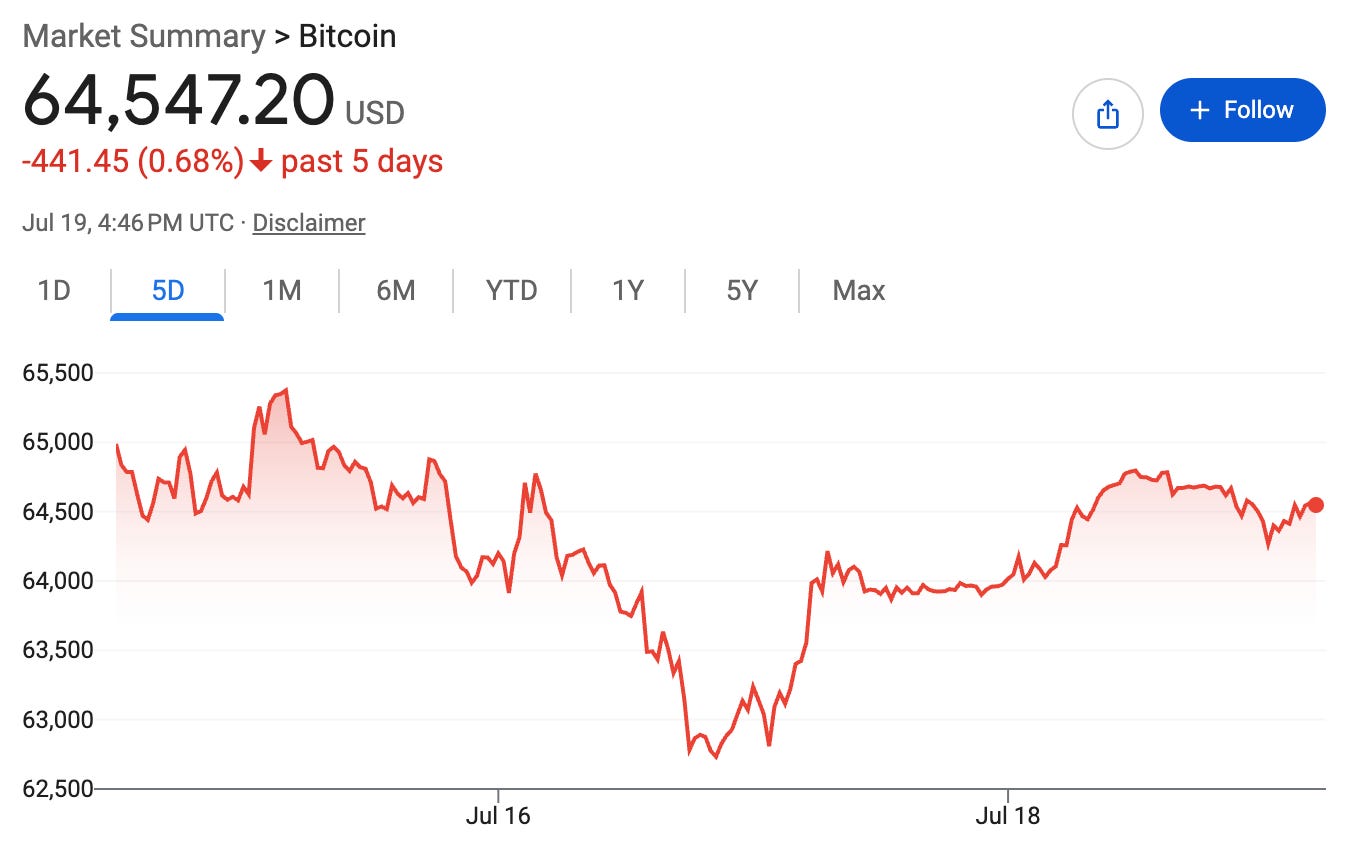
The cryptocurrency scene has been relatively quiet over the last week, but we remain bearish long-term on Bitcoin and crypto-adjacent companies such as Strategy (MSTR).
Note: Pine Creek Capital does not currently hold a position in MSTR, STRC, or BTC, and our long-term intrinsic value estimate of Bitcoin is $0.
Earnings & Data
This week will be a huge week for earnings across sectors:
Earnings
Monday, July 20: Domino’s reports before the open (consensus $4.16 EPS on $1.18B revenue), with Steel Dynamics, W.R. Berkley, and Zions after the close. Steel Dynamics is the read on steel pricing and volumes.
Tuesday, July 21: General Motors reports before the open ($3.13 EPS on roughly $46B), with tariff costs the main question after April’s guide of $2.5B to $3.5B for the year. Northrop Grumman, 3M, Danaher, Halliburton, Novartis, D.R. Horton, Schwab, and Synchrony also report early; Capital One and Chubb follow after the close.
Wednesday, July 22: Alphabet and Tesla both report after the close. Alphabet consensus sits near $2.88 EPS on $117B revenue, up about 21% from a year ago, with cloud growth and capital spending plans the swing factors. Tesla consensus is $0.47 EPS on $24.7B, and since Q2 deliveries of 480,126 units already beat badly, the report hinges on automotive margins and the robotaxi rollout.
Wednesday, July 22 (continued): IBM and ServiceNow also report after the close. IBM pre-released weak numbers on July 14 and fell 25.2% in a single session, its worst day on record, so this release is about guidance and whether software budgets are genuinely shifting toward AI hardware. AT&T, Philip Morris, Texas Instruments, CSX, and GE Vernova report earlier in the day.
Thursday, July 23: Intel reports after the close, with Q2 revenue guided to $13.8B to $14.8B and the 18A foundry ramp under the microscope. Honeywell, Lockheed Martin, RTX, Union Pacific, T-Mobile, Blackstone, Comcast, and Thermo Fisher all report before the open. Union Pacific carries the added weight of the pending Norfolk Southern merger.
Friday, July 24: Verizon and American Express report before the open, alongside HCA, NextEra, Charter, and Schlumberger. Amex spending and credit trends are the consumer read of the week.
Economic Data
Monday: Leading Economic Index for June at 10:00 a.m. ET, after a 0.1% gain the prior month.
Thursday: Initial jobless claims at 8:30 a.m. ET. The prior week came in at 208,000, a 10-week low against a 217,000 forecast, with continuing claims at 1.805 million.
Friday: S&P Global flash PMIs for July at 9:45 a.m. ET (June: manufacturing 55.7, services 51.3, composite 52.2), followed by June new home sales at 10:00 a.m. ET. May sales dropped 7.3% to a 580,000 annual rate, so a modest rebound is the base case.
That’s all we had for you this week, let us know your thoughts by leaving a comment! You can also like this article via Substack to show your support.