

Portfolio Update | July 2026 (+7.62%)
Pine Creek Capital returned +7.62% in July 2026, driven by China longs (JD, BABA, BYD) and semiconductor shorts, with a lesson from Fed funds futures.

Hello Investors,
July 2026 marks the first full month of Pine Creek Capital Management’s track record, and we are off to a good start.
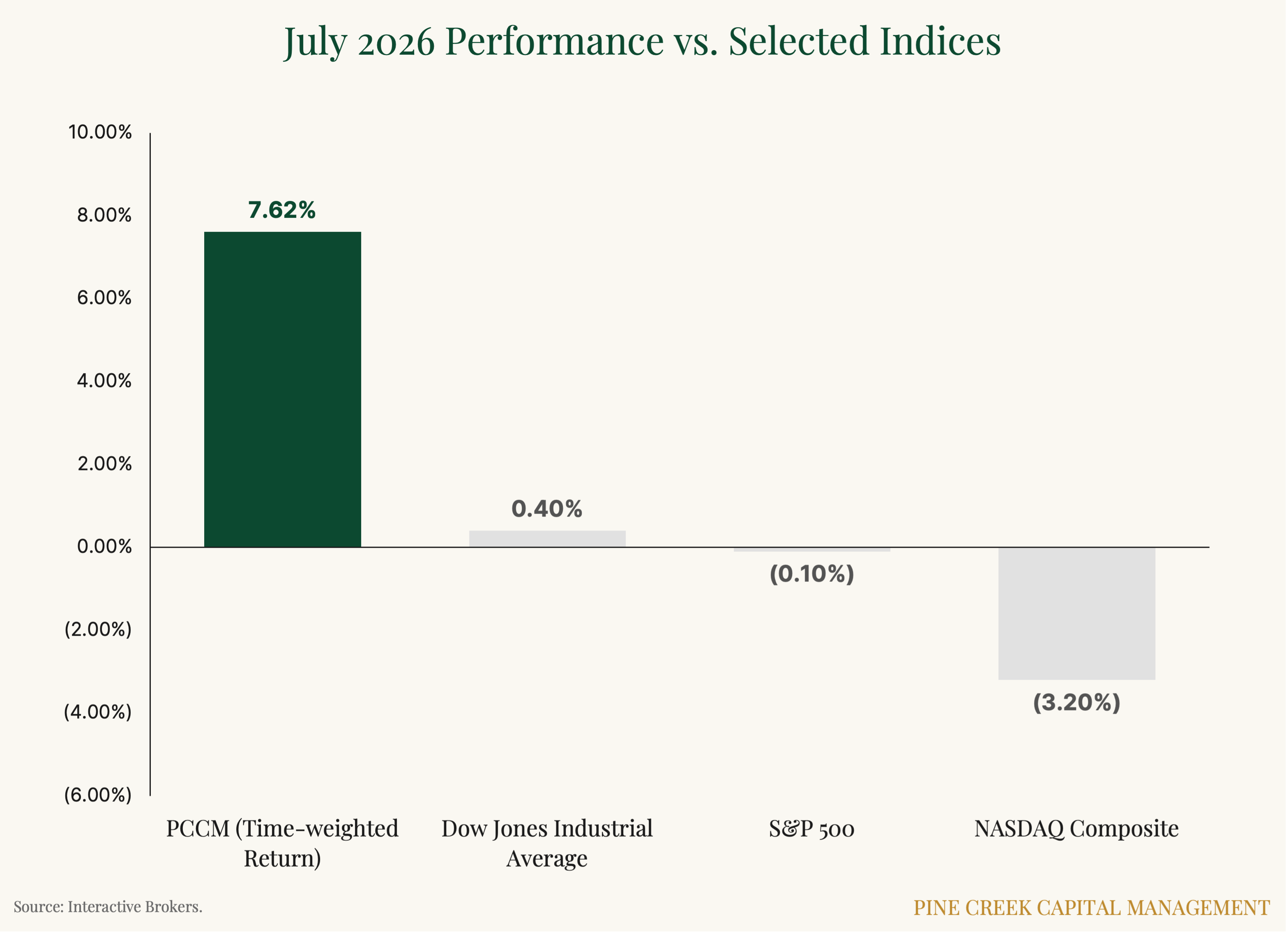
For the month, the fund was up 7.62% while the S&P 500 was down 0.10% over the same period. While we are very pleased with this performance, it was not without at least one learning experience that negatively impacted an otherwise flawless month of execution.
In last month’s update, we had just opened the fund and shared our opening positions. However, PCCM was not yet approved for a margin account with Interactive Brokers. Approval finally came during the last week of July, at which point we started aggressively deploying capital across our short book.
As of July 31, the fund held 17.3% of net assets in short positions, resulting in 77.1% gross exposure. Our target gross exposure is between 110% and 150%, which would typically comprise of ~100% long equities and ~10% to ~50% short equities. We have also implemented a small options overlay, which stood at 2.7% of our short book for the end of the month.
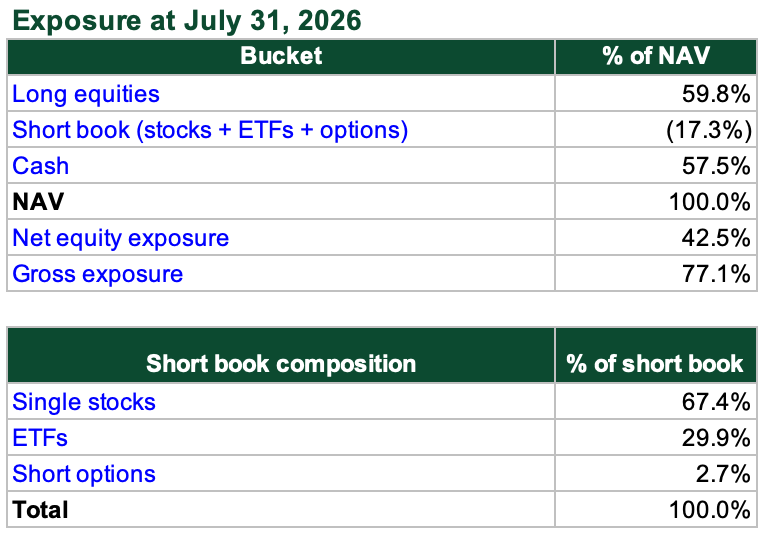
This means that going into August, we have a comfortable cushion of 33%+ that we are looking to deploy. However, we will not deploy capital for the sake of putting it to work. We will only invest when we have deemed an investment meets or exceeds our targeted rate of return of at least 15% per year. There is no guarantee that our estimates are accurate or that we realize this return, but it is a strong standard that forces us to have patience for truly great investment opportunities.
If you are interested in following our trades in real-time, you can start a free 30-day trial at the link below.
Market Commentary
July was a sleepy month for passive investors, with the S&P 500 and Dow Jones roughly flat. Things were more dramatic for Tech and AI investors, as the Nasdaq closed down 3.2% and the darlings of the AI trade were hammered, with some semiconductor stocks down as much as 37%.
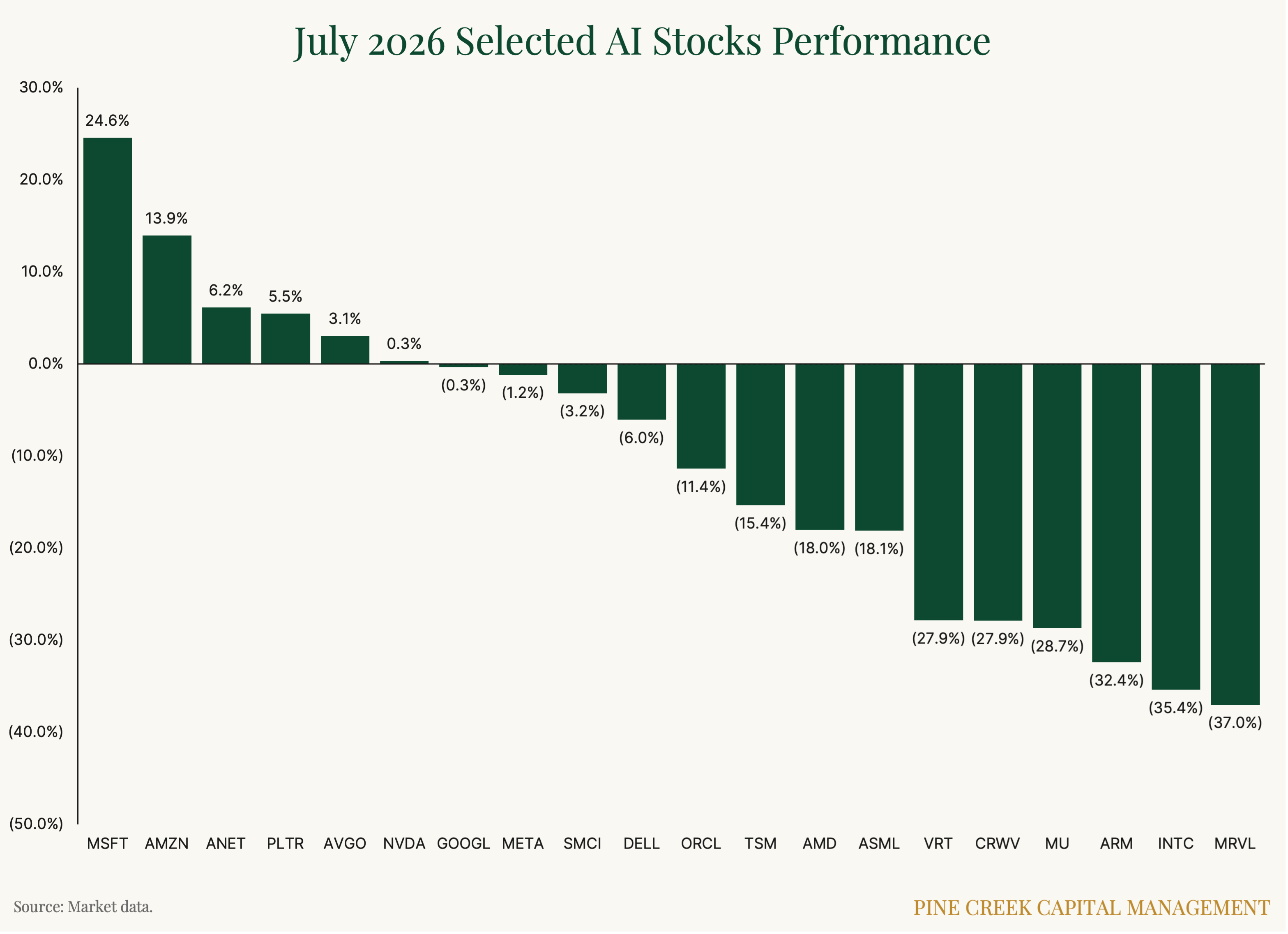
This was driven by a broader rotation within and out of AI stocks as investors have begun focusing on which companies within the AI trade are driving the most value. This is aligned with our commentary from early June that the AI Bubble has popped, and our follow up coverage in July that the rotation out of AI is accelerating (link below).

As such, our portfolio is designed to capitalize on this thesis playing out. We are generally long Value and Software stocks, and we are generally short Semiconductors. However, this does not mean we are totally against AI—we have long positions in both Meta and Microsoft for example.
The Federal Reserve also met in July and decided to leave interest rates unchanged. In the lead up to this meeting, we took the view that the Fed should start increasing rates given that inflation is elevated and the economy is well positioned to handle a 0.25% increase.
While the options market correctly priced in a rate hold, the bond market cast its vote that rates should be higher. Immediately following their meeting, the 10 year and 30 year treasury rates increased substantially. There were also three dissenting votes on the Fed committee, all in favor of a 0.25% increase.
Our view coming out of that meeting is that we were correct in our assessment that rates should be higher, but we incorrectly assumed that Fed Chair Kevin Warsh would favor a hold. We backed this conviction with our dollars and paid accordingly, which we will discuss in the next section on Portfolio Commentary.
First, a note on performance. 7.62% in a single month where the S&P fell 0.10% with only 77.1% of our assets exposed to the market is extraordinary. We certainly benefitted from good timing on many of our investments, and it is more than reasonable to wonder how much of this past month’s performance is due to luck, and how much risk we are taking on to earn such a high return.
We are well aware that this is only our first month in business, and we do not expect this type of performance to continue for any length of time. Our goal is to provide consistency in our approach, not in our performance. There may be periods where our investing process does not work, and there may be others, like now, where it works wonderfully.
Regardless of daily or monthly fluctuations, we believe in this process, and that, as long as we do not deviate, we can achieve above average returns.
Portfolio Commentary
As mentioned above, we earned a 7.62% return with gross exposure of 77.1%. Let us now decompose what drove this performance.
Performance Attribution
Within our portfolio, the majority of our performance came from our exposure to international equities. Our top three performing positions were Chinese-based companies: JD.com, BYD, and Alibaba. As explained in last month’s update, we believe that the Chinese market has a massive dislocation in value. Many of these stocks are trading at or near all-time lows despite earning revenue multiple times higher than when they last traded this low.
Our performance was dragged down by a loss in our interest rate futures position ZQ. This is a special type of futures instrument that derives its value based on the Federal Funds Rate as of a specific date. As mentioned above, we felt a high level of conviction that the Fed should raise rates. But we did not share the same level of conviction that they would raise rates. After all, the market was only pricing a ~30% chance of a rate hike.
For this reason, we positioned the trade accordingly. Since these investments can behave like binary bets—either the Fed hikes or it doesn’t—we lost 0.87% of NAV with no opportunity for recovery. Thanks to our conservative sizing however, the drag on our overall performance was minimal. This was also our first time trading interest rate futures, so we gathered valuable learnings with respect to execution and performance of these types of investments.
On top of ZQ, we also took a small position in short-dated Puts on QQQ, a Nasdaq ETF. Our thesis was that if the Fed hiked rates, the market would correct sharply, resulting in a very nice gain. After the rate hold was announced however, the market rallied. Ultimately, the market did correct sharply as we were hoping, but given the interest rate decision negated our original thesis, we exited the position early at a small loss. Although we could have held through the day for a very nice gain to offset our ZQ loss, we simply were not comfortable with how the situation was evolving.
We will note that these trades should be considered a special situation. We do not expect to trade interest rate futures and short-dated options in the future.
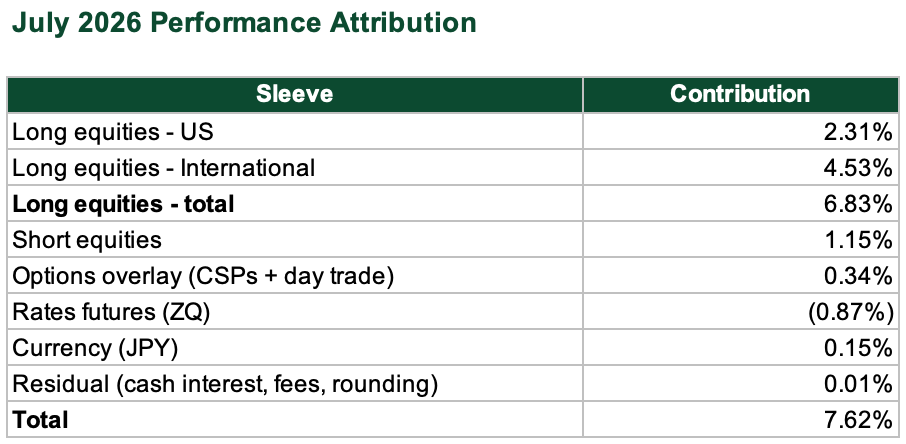
Our long US Equities and Short Equities positions also drove notable gains, with ADBE (long), KNSL (long), CAT (short), and SOXX (short) our top performing holdings for the month.
We also earned 0.49% from our Currency and Options overlays. Recently, we discussed the Yen Carry Trade and shared our view that the Yen looks attractive at current levels. As a result, we have about 5% of our net asset value held in Yen, and have begun opening positions in Japanese-listed companies, such as Japan Airlines. These positions have worked well so far and were added only recently.
With respect to options, we overlay our portfolio with strategic income-generating positions—primarily selling cash-secured puts—to enhance our overall returns.
Let us turn now to the composition of our portfolio.
Sector Exposure
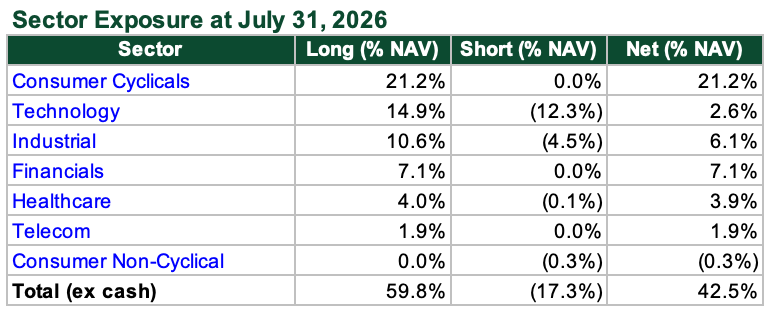
We hold relatively concentrated sector exposure, with 21.2% in Consumer Cyclicals, and fairly evenly distributed exposure across other industries. On a net basis, we have 2.6% exposure to the Technology sector, which is comprised of notable and somewhat offsetting long and short exposure.
However, there should be no illusion that we have small exposure to Technology, primarily because we are long Software and short AI, which is a correlated trade. When AI stocks go up, Software tends to go down, and vice versa. This leaves us exposed in both directions, though our combined long and short exposure is held at 27.2% of the portfolio assuming 100% correlation.
We should note that we are generally Sector agnostic, but given our experience in the Technology field and as evidenced below, we have a strong bias towards Technology stocks. It’s what we know best
Geographic Exposure
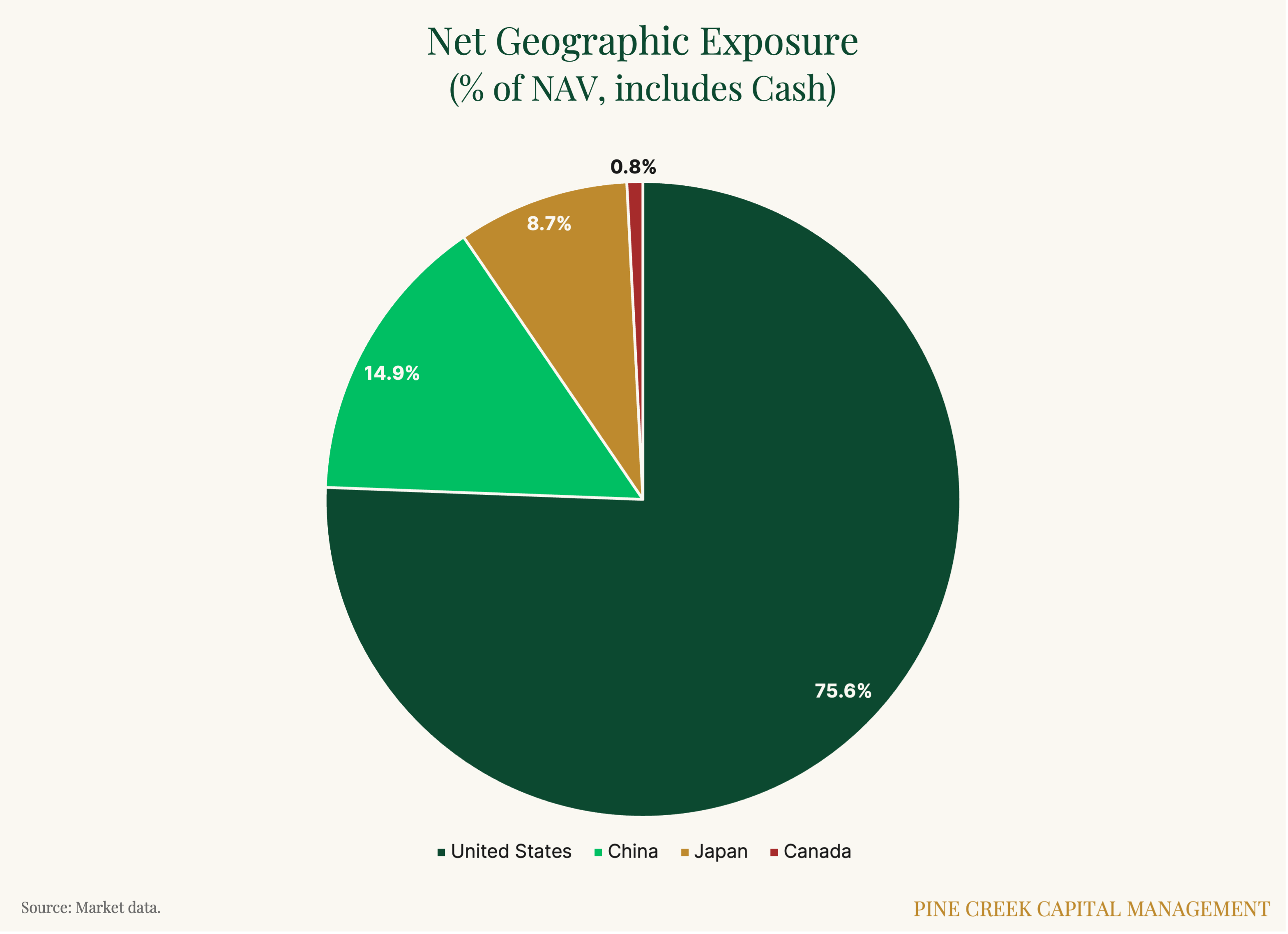
Including cash, we ended the month with about 75.6% of US exposure, which we believe is too much. While the United States has had arguably the strongest economic run in modern history, we believe that the stateside market is very crowded. Many international markets offer opportunities just as attractive as the United States, and in many cases more so, with less analyst coverage and investor dollars to compete with.
Additionally, with the US adopting what we see as an isolationist stance on the world stage, many international companies have the rare opportunity to partner together and find new growth excluding the United States. The next Amazon or Netflix or Apple to dominate its respective global market share may very well emerge from outside the US.
In an expression of this view, we have already deployed capital in China and Japan, and continue to evaluate other international markets where we can find opportunities that fit our criteria. As of July 2026, 14.9% of our capital is exposed to China, with 8.7% to Japan.
Closing Thoughts
July 2026 was Pine Creek Capital Management’s first full month of investing, and it exceeded my expectations. Between performance, execution, and lessons learned, I am very optimistic about the future of this fund. And as of this writing on August 7th, I can tell you that the momentum has only continued.
I am also grateful to all 42 newsletter subscribers here on Substack, and anyone else reading these updates and following along on our journey, whether or not you are subscribed. Every visit, click, and share is immensely helpful. And if you would like to get access to our trade updates and investment research, please consider becoming a paid subscriber.
Until next time,
Brian
Disclaimer
This publication is strictly for informational purposes and is not advice of any kind. Nothing in this publication should be interpreted, explicitly or implicitly, as a recommendation, a solicitation, or an offer to buy, sell, or otherwise transact in any security or financial instrument.
Pine Creek Capital Management, its owners, investors, and any affiliated parties may or may not hold positions in the securities mentioned in this publication and may transact in such securities at any time without notice.
The information presented represents Pine Creek Capital Management’s views as of the publishing date and may change at any time. Past performance is not indicative of future results, and all investments carry risk and the potential for loss of capital.
Pine Creek Capital Management has made a best effort to source information from sources believed to be reliable and makes no guarantee as to the accuracy or completeness of the information presented.
Readers should do their own due diligence and speak with a qualified finance, legal, or tax advisor before making investment decisions.